


Rocket Lab Stock Outlook: Can RKLB Extend Its Rally After a Record Contract Win?
TradingKey - Rocket Lab (NASDAQ: RKLB) closed at $101.16, marking a 3.21% gain and bouncing off the 0.618 Fibonacci retracement level of $93.10 following a bounce from ascending trendline support. Yesterday, June 29, RKLB rose 9.7%, led by KeyBanc Capital Markets rating it an Overweight and setting a $135 price target, while labeling the SpaceX-IPO-driven selling in RKLB as "unwarranted" and "overdone" on the back of launch-demand tailwinds.
Since RKLB's relative outperformance in the SpaceX IPO rotation on June 12, the company posted blowout Q1 2026 results: $200.3 million in revenue, 63.5% YoY, a 4.9% beat on estimates, plus a contract for the largest deal in Rocket Lab history with a confidential customer for both Neutron and Electron launches through 2029. RSI is at 60.11, which is neutral-bullish and has upside room, with no divergence and no bearish momentum.
The Largest Contract in Company History and a Record $2.2 Billion Backlog
The May 7 release of Q1 2026 results saw Rocket Lab handily beat every single piece of guidance. The company delivered $200.3 million in revenue, 4.9% over estimates, and 63.5% YoY. This was Rocket Lab's first $200 million quarter, which beat even the top end of its prior guidance of $185-200 million. RKLB raised its backlog to $2.2 billion, up 108% YoY and 20.2% sequentially, with a big shift in composition toward Space Systems at 58.5% and Launch at 41.5%. Rocket Lab sold 31 Electron and HASTE launches in Q1 2026 alone, which is more launches in a quarter than in all of 2025, as the total launch manifest grew above 70 contracted launches.
This also includes the biggest deal ever for a confidential customer for Neutron and Electron launches through 2029, a $190 million DoD block buy on 20 hypersonic test flights, a $30 million DoD test deal with Anduril Industries, as well as the acquisition of Mynaric AG (laser optical communications terminals) and the acquisition of Motiv Space Systems (Mars-heritage robotics) worth up to $60 million in cash/stock.
The CEO, Peter Beck, noted that the pace of new product and service releases this year "has been relentless" on the earnings call. The Q1 ending backlog of $2.2 billion is roughly 36% expected to become revenue in 12 months, which is very high near-term visibility for an earlier-stage company.
From $100 to $101 — What Changed in the Six Weeks Since the SpaceX IPO Selloff
RKLB closed +34% on earnings day in early May and broke $100/share for the first time ever, then dropped ~10% on or around the June 12 SpaceX IPO debut, which was the smallest decline of any space peer: Virgin Galactic falling 24%, Intuitive Machines 15%, and Redwire 14%. The market perceived the RKLB decline at the time to be the result of general rotation, not a statement on its own competitive position. RKLB joined the Nasdaq-100 index June 22 as expected, with the mechanical index buying that comes with an index addition.
KeyBanc upgrading RKLB to Overweight on June 29 and setting a $135 target (vs. the prior mean of ~$108.81) is the key recent event, helping fuel the recent upswing, which included an initial premarket +4.2% rebound after -10.8% down on the prior day. Aside from the analyst upgrade, three other operational news items contributed to a constructive outlook for the stock, independent of sentiment.
These included NASA awarding Rocket Lab three Electron launches from New Zealand beginning in early 2027; Rocket Lab completing a record-fast VICTUS HAZE launch for the US Space Force, which demonstrated complete, end-to-end defence launch capabilities, setting Rocket Lab's Electron launch vehicle apart from other rideshare options; and Rocket Lab completing its 10th consecutive, successful, dedicated Electron launch for Synspective with a 100% mission success rate, and has 17 more launches booked with Synspective throughout this decade; with every successful launch on this trajectory having a positive stock price impact, last week's launch with Synspective contributed to a 4.4% increase on the day.
Neutron at $50 to $55 Million Per Mission Is the Re-Rating Catalyst — Not Electron
Fundamentally, Rocket Lab's continued multiple expansion is justified by the pricing disparity between Electron and Neutron. Electron, the established small-lift launch vehicle with 50+ successful orbital launches, is priced at $8.4 million per launch. Neutron, the medium-lift reusable rocket currently being developed, is priced at $50 million to $55 million per launch, representing a six to seven times increase in revenue per mission for a new launch vehicle focused on a customer segment that is currently a stronghold for SpaceX's Falcon 9.
Five dedicated Neutron missions were contracted in Q1 2026 alone, a clear sign that customers are entering into a binding commitment on a rocket that has not yet flown. It is also telling that Management has not walked back the Q4 2026 target date for Neutron first flight with the successful accomplishment of many critical milestones in Q1 2026 including tank production, stage separation testing and Archimedes engine qualification.
The maiden flight of Neutron will likely be viewed as a proof-of-concept and customer qualification milestone rather than a milestone for when Neutron starts to contribute meaningful revenue to Rocket Lab's earnings, as CFO Adam Spice has indicated that Capex will continue to be substantial while the vehicle is undergoing testing and scale-up, with 2027 to 2028 being the period that Neutron revenue begins to have a material impact on the company's financials.
Investors are known to anticipate cash flows well before they arrive which is why a successful Neutron first flight in Q4 2026 is likely to have a larger stock price impact than the first commercial Neutron flight and revenue a year later.
RKLB Technical Setup — 0.618 Fib Bounce at $93.10, RSI 60.11, Target $125.70
On the 4-hour chart, RKLB is at $101.16 after a +3.21% rebound from the 0.618 Fibonacci retracement level at $93.10 and the upward sloping black trendline and is currently still below the downward sloping blue trendline from the recent $154.14 price high. RSI is at 60.11 which is still in neutral-bullish territory and has room to climb before getting overbought and no bearish divergence is noted on the 4H chart.
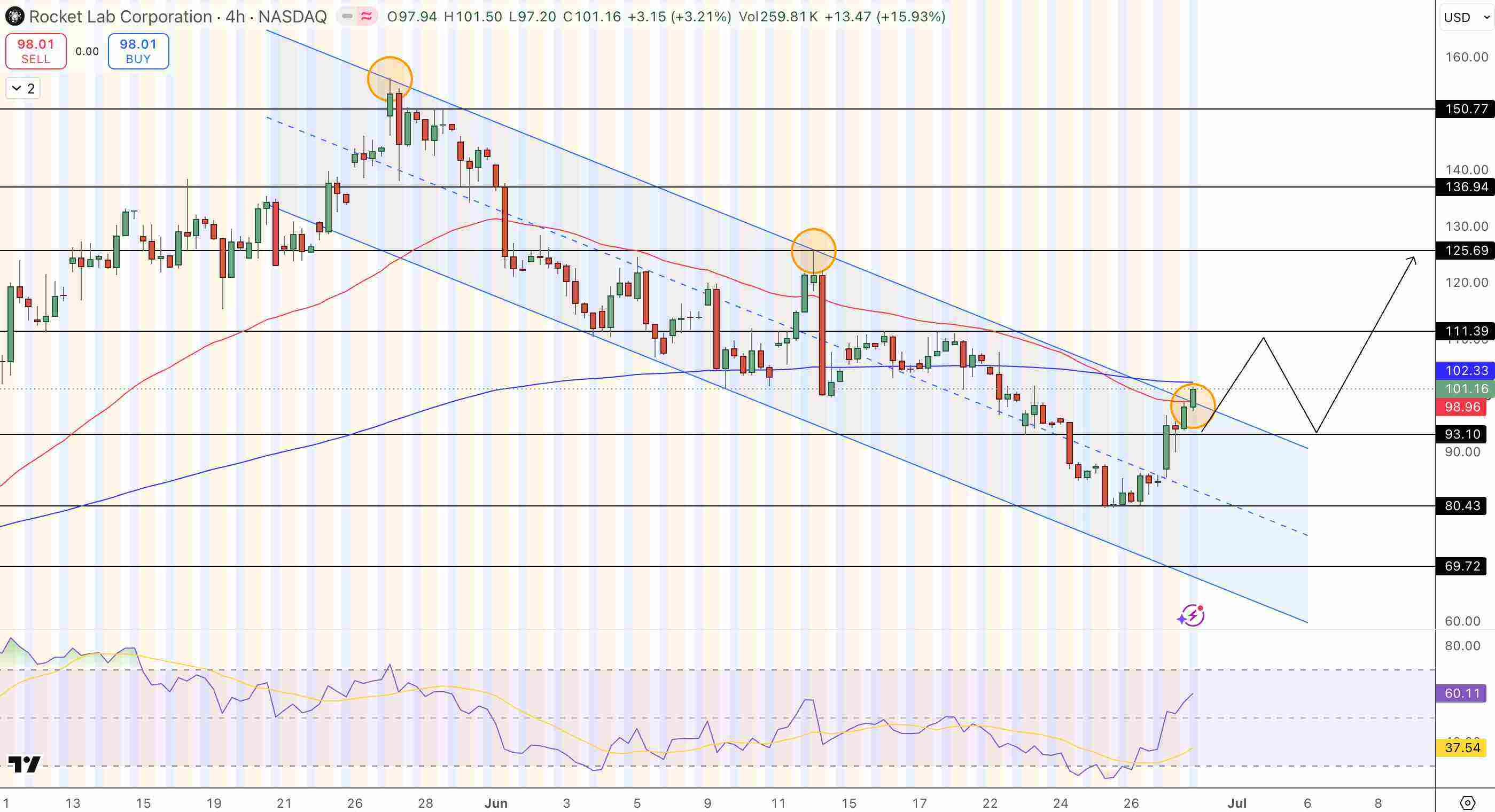
Rocket Lab Price Chart - Source: Tradingview
The Fibonacci roadmap from the $69.72 price low identifies resistance at the 1.0 retracement level at $101.33 which is right at the current price level and the 1.272 retracement level at $111.39, while the major upside targets are on the 1.618 retracement level at $125.69 and the 2.0 level at $136.94. A close above $111.40 on the Fib rebound will now target the $125.70 upside.
- Entry: Long above $111.40 — 1.272 Fib level cleared
- Target 1: $125.70 — 1.618 Fib level
- Target 2: $136.94 — 2.0 Fib level
- Stop Loss: Close below $93.10 — 0.618 Fib and trendline fails
- Backlog: $2.2B (+108% YoY); 36% expected to convert within 12 months
- Next catalyst: Neutron first flight targeted Q4 2026
Bottom Line
Rocket Lab ($101.16) was able to recoup the weakest pullback of any space sector company as a result of the IPO-driven sell off in SpaceX, in line with KeyBanc rating a “buy” on the name and giving a $135 price target noting that the stock decline is unjustified. Rocket Lab posted better than expected Q1 2026 results, exceeding revenue guidance at $200.3 million (+63.5% YoY), setting a new record backlog at $2.2 billion (+108% YoY) while announcing its largest contract yet extending to 2029.
The higher cost structure of Neutron at $50 to $55 million per mission versus $8.4 million per flight for Electron is the reason why investors are paying up for Rocket Lab. The catalyst is the Q4 2026 maiden flight. RSI at 60.11 is neutral with a bias to the upside. Trade above $111.40 for $125.70 and $136.94. Stop-loss below $93.10.
Recommended Articles


