


3 Magnificent Dividend ETFs That Could Supercharge Your Passive Income
Key Points
The Schwab U.S. Dividend Equity ETF's selection process acts as a natural vet for investors.
The Vanguard High Dividend Yield ETF is a good mix between yield and stock price growth potential.
The Vanguard Dividend Appreciation ETF contains more tech stocks than you'll find in a typical dividend ETF.
- 10 stocks we like better than Schwab U.S. Dividend Equity ETF ›
Passive income in the stock market almost always comes through dividends. Dividend stocks don't always get the same attention as growth stocks, whose measure of success is straightforward stock price appreciation, but many investors depend on dividends for cash on top of rising stock prices.
Thousands of stocks pay dividends, and many dividend ETFs bundle them together. But if you're looking for three you can add to your portfolio for consistent and reliable passive income, look no further than the Schwab U.S. Dividend Equity ETF (NYSEMKT: SCHD), Vanguard High Dividend Yield ETF (NYSEMKT: VYM), and Vanguard Dividend Appreciation ETF (NYSEMKT: VIG).
Where to invest $1,000 right now? Our analyst team just revealed what they believe are the 10 best stocks to buy right now, when you join Stock Advisor. See the stocks »

Image source: Getty Images.
The blue-chip dividend ETF
SCHD is off to a great start in 2026, up more than 15% and comfortably outperforming the S&P 500, Nasdaq Composite, and Dow Jones (as of market close on June 26).
It's known for its screening methodology, which requires a company to have 10 consecutive years of increases, reliable cash flow, and above-average return on equity to be included. These metrics act as a natural vetting process, ensuring it doesn't just chase high yields or companies with unsustainable dividends.
The focus on high-quality companies has made SCHD one of the premier dividend stocks in the market. Its 3.3% dividend yield is the highest of the three dividend ETFs mentioned, and that's likely to remain the case for the foreseeable future.
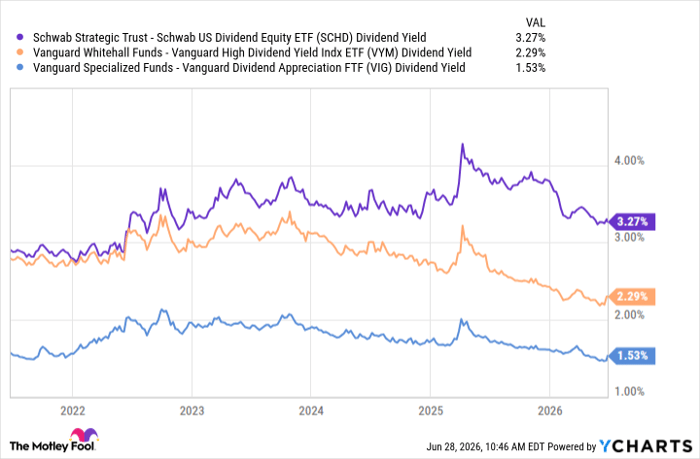
SCHD Dividend Yield data by YCharts
You don't have to second-guess SCHD, which makes it perfect to hold long-term for passive income. You gain access to mature companies that have stood the test of time and prioritize being shareholder-friendly. Its top five holdings are Home Depot, UnitedHealth Group, Merck, Abbott Laboratories, and Procter & Gamble.
A diverse mix of above-average dividend yields
VYM doesn't have as high a yield as SCHD, but it's much more diversified and offers a respectable 2.3% yield for a 605-stock ETF. It focuses on companies with above-average dividend yields but doesn't have as strict criteria, which leaves room to include more financial and tech companies.
It's not just its current dividend yield and payout, either. Over the past decade, VYM has more than doubled its dividend payout, a bonus for investors. You get the payout, (hopefully) stock price appreciation, and an increasing dividend over time.
The payout amount will fluctuate because its holdings pay out at different times, but you can count on the payout trajectory to move upward over time. VYM is a good middle ground between yield and growth opportunity. Its top holdings are Broadcom, JPMorgan Chase, and ExxonMobil.
A different twist to dividend ETFs
VIG is a good addition because it doesn't share the same makeup as many traditional ETFs, including SCHD and VYM. Take a look at VIG's top holdings and how they compare with the other two:
| Company Name | Amount of VIG | Amount of SCHD | Amount of VYM |
|---|---|---|---|
| Broadcom | 5.41% | 0% | 8.49% |
| Apple | 4.57% | 0% | 0% |
| Microsoft | 4.27% | 0% | 0% |
| Eli Lilly | 3.85% | 0% | 0% |
| JPMorgan Chase | 3.32% | 0% | 3.14% |
| ExxonMobil | 2.67% | 0% | 2.53% |
| Johnson & Johnson | 2.39% | 0% | 2.24% |
| Visa | 2.25% | 0% | 0% |
| Walmart | 2.23% | 0% | 0% |
| Cisco Systems | 2.09% | 3.58% | 1.97% |
Data sources: Vanguard and Charles Schwab.
VIG offers exposure to more growth-oriented stocks that just happen to pay a consistent dividend. It has the lowest dividend yield of the three, but its stock appreciation has far outpaced the others over the past decade, so its total returns, which account for dividends, are higher. It's up 251% in that time, compared with SCHD's 234% and VYM's 210% (as of the market close on June 26).
With 28.4% in tech stocks, VIG is a good complement to SCHD and VYM. It offers higher-than-normal growth opportunities, but it's also headed by industry leaders with tons of cash flow and impressive dividend records that are likely to only get more impressive with time.
Walmart and Johnson & Johnson, for example, are Dividend Kings, which are companies with at least 50 consecutive years of dividend increases. It has unconventional "dividend stocks," but it hasn't sacrificed quality and stability.
Should you buy stock in Schwab U.S. Dividend Equity ETF right now?
Before you buy stock in Schwab U.S. Dividend Equity ETF, consider this:
The Motley Fool Stock Advisor analyst team just identified what they believe are the 10 best stocks for investors to buy now… and Schwab U.S. Dividend Equity ETF wasn’t one of them. The 10 stocks that made the cut could produce monster returns in the coming years.
Consider when Netflix made this list on December 17, 2004... if you invested $1,000 at the time of our recommendation, you’d have $398,052!* Or when Nvidia made this list on April 15, 2005... if you invested $1,000 at the time of our recommendation, you’d have $1,181,688!*
Now, it’s worth noting Stock Advisor’s total average return is 892% — a market-crushing outperformance compared to 205% for the S&P 500. Don't miss the latest top 10 list, available with Stock Advisor, and join an investing community built by individual investors for individual investors.
See the 10 stocks »
*Stock Advisor returns as of June 30, 2026.
JPMorgan Chase is an advertising partner of Motley Fool Money. Stefon Walters has positions in Apple, Microsoft, Visa, and Walmart. The Motley Fool has positions in and recommends Abbott Laboratories, Apple, Broadcom, Cisco Systems, Eli Lilly, Home Depot, JPMorgan Chase, Merck, Microsoft, Vanguard Dividend Appreciation ETF, Vanguard High Dividend Yield ETF, Visa, and Walmart. The Motley Fool recommends Johnson & Johnson and UnitedHealth Group. The Motley Fool has a disclosure policy.
Recommended Articles


