


Musk’s Acquisition of Optical Module Maker Mesh Wins FTC Clearance, SpaceX’s Computing Power Footprint Expands Further
TradingKey - According to a filing disclosed by the U.S. Federal Trade Commission on June 25, Elon Musk's acquisition of the high-speed optical module startup Mesh Optical Technologies has received regulatory approval. The FTC completed its antitrust review by granting an "early termination" of the waiting period, allowing the transaction to bypass the statutory waiting period and proceed directly. The filing did not disclose the transaction amount, closing timeline, or equity structure, and the acquiring entity is registered as Musk personally, rather than SpaceX ( SPCX ).
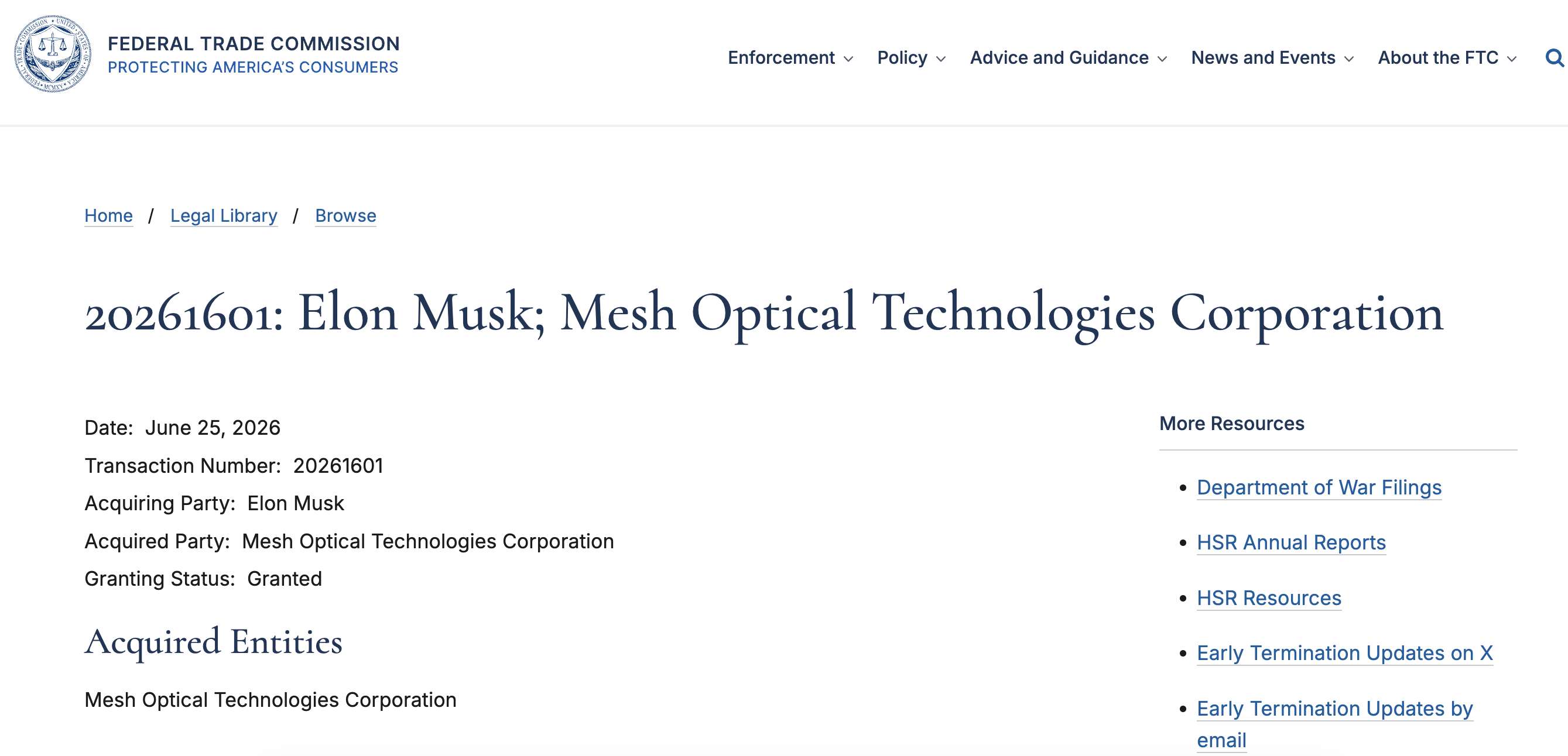
[Source: FTC Official Website]
Who is Mesh Optical?
Founded in 2025, Mesh Optical's three founders—Travis Brashears, Cameron Ramos, and Serena Grown-Haeberli—all hail from SpaceX, where they were involved in the development of the Starlink satellite laser communication system. This February, Mesh completed a $50 million Series A funding round led by Thrive Capital.
Mesh's core product is an optical transceiver named Alpha C1, which boasts a transmission rate of 1.6 Tbps and utilizes optical signals instead of traditional copper cabling to transmit data between servers and GPUs. At a time when AI training clusters routinely deploy tens of thousands of GPUs, the speed of data exchange between chips is increasingly becoming a more severe bottleneck than the computing chips themselves. As a core component for data transmission between servers, switches, and GPU clusters, high-speed optical transceivers have been deemed by the industry as a critical link in AI infrastructure.
Why is Musk acquiring Mesh?
Before and after completing its listing, SpaceX has signed multiple computing power cooperation agreements with Anthropic, Google ( GOOGL) and AI startup Reflection, with a total potential contract value exceeding $76 billion and currently locked-in annualized contract revenue of approximately $26 billion. To this end, SpaceX has invested in building data centers in Tennessee and Mississippi while advancing its space computing center plan. Previously, SpaceX had announced a $60 billion acquisition of the parent company of AI programming tool Cursor.
However, one of the core challenges of the computing power business lies precisely in the efficiency of data transmission within data centers. According to reports, SpaceX's data center in Memphis has had its AI training usage restricted due to latency issues and aging network infrastructure, forcing it to lease computing power to external customers.
Optical transceivers are the critical components that determine the communication speed between chips. Acquiring a team that has already solved optical communication challenges between Starlink satellites means SpaceX can subsequently resolve internally what previously had to be outsourced to Broadcom ( AVGO ), Coherent ( COHR) and other suppliers.
Mesh's long-term vision goes far beyond terrestrial data centers; it hopes to establish an optical network connecting humans, computers, spacecraft, and deep-space probes. SpaceX previously stated in its IPO filings that it plans to manufacture, launch, and operate up to 1 million AI computing satellites to build a distributed AI computing cluster in space. Elon Musk recently confirmed that the plan is codenamed "Starmind."
The Mesh founding team's experience with Starlink laser communications naturally aligns with this space computing strategy. Whether it is GPU interconnection in terrestrial data centers or data transmission between computing satellites in space, it is essentially the same issue: how to transmit data with lower power consumption and lower latency.
Of course, this concept is not without controversy. SoftBank founder Masayoshi Son recently stated bluntly at a shareholder meeting that space data centers "make little sense" and that the outcome of the AI competition will ultimately be decided by computing power on Earth. He noted that electricity expenses account for only about 7% of data center operating costs, while chip and hardware costs are as high as 93%, making the cost of launching equipment into orbit far exceed any potential electricity savings.
While this FTC approval clears regulatory hurdles, it remains unclear whether the deal has been signed or closed. Musk's acquisition of Mesh is a piece of the puzzle for his computing empire. With self-developed chips, terrestrial clusters, space satellites, and optical communication technologies interconnecting, a complete blueprint from computing power production to data transmission is becoming increasingly clear with this transaction.
In the race for AI infrastructure, Nvidia ( NVDA ), Broadcom, and other giants have already heavily deployed in the high-speed optical module sector. Musk's choice to "recycle" talent from the Starlink laser communication team and use in-house incubated technology to solve his own problems is indeed his classic playbook over the years.
As for whether the light of Mesh will ultimately illuminate terrestrial data centers, Starmind in space, or both, the answer may not take long to emerge.
Recommended Articles


