


AMD Just Acquired MEXT to Crack the Memory Optimization Problem. Should Micron and Sandisk Investors Be Nervous?
Key Points
AMD's acquisition of MEXT doesn't replace DRAM or HBM. It simply helps enterprises use those resources more efficiently.
Micron's HBM4 production is locked into multi-year contracts, so software-based memory optimization has little effect on AI training workloads.
Rather than hurting Sandisk, MEXT could increase demand for high-performance NAND flash.
- 10 stocks we like better than Sandisk ›
About two weeks ago, Advanced Micro Devices announced the acquisition of MEXT, a start-up that has built artificial intelligence (AI)-driven software designed to make NAND flash behave like dynamic random-access memory (DRAM).
The technology uses predictive algorithms to identify frequently accessed data and move it between flash storage and high-speed memory in real time, reducing the amount of expensive DRAM a data center needs to run AI workloads at scale. According to MEXT's own press release, the software can cut memory costs by nearly half while expanding usable memory capacity by two to four times.
Missed Nvidia in 2009? This Rare Signal Is Flashing Again. In 2009, a "Double Down" signal flashed for a little-known chipmaker called Nvidia. For the first time in years, that same "Total Conviction" signal is flashing for a company 1/100th the size of Nvidia. Continue »
For investors in Micron Technology (NASDAQ: MU) and Sandisk (NASDAQ: SNDK), the knee-jerk read is obvious: If AMD can teach flash to behave like DRAM, demand for high-bandwidth memory contracts declines. The knee-jerk read is terribly wrong.
What MEXT actually does (and doesn't do)
MEXT's technology operates in the software tier between existing storage and compute. It doesn't replace DRAM or HBM. Instead, it reduces the amount of high-speed memory certain workloads require by optimizing what lives in it at any given moment. That's a meaningful efficiency gain for enterprise customers running general-purpose AI workloads, where memory is a cost constraint.
What it cannot touch is the physics of training large AI models and running inference at the performance levels that hyperscalers require. An Nvidia Blackwell graphics processing unit (GPU) demands HBM4 not because no one has tried to work around it, but because the bandwidth requirements of training trillion-parameter models are architectural constraints, not software problems. No predictive tiering algorithm changes what the silicon needs.
MEXT is a tool for enterprises trying to stretch existing infrastructure. It is not a substitute for the memory products that Micron and Sandisk sell to massive tech companies.
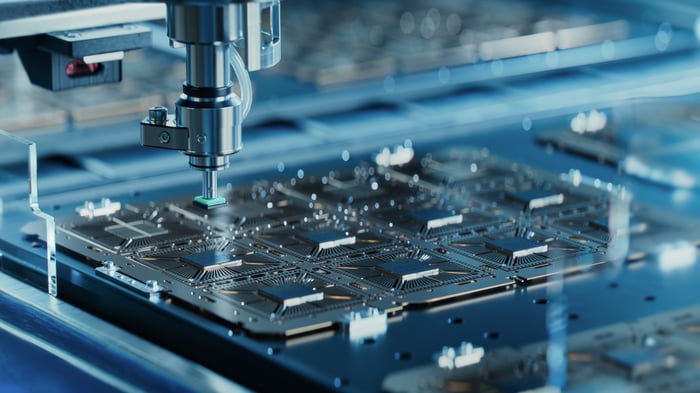
Image source: Getty Images.
Micron's position is structurally insulated
Micron Technology's entire 2026 HBM4 production is sold out under binding multi-year contracts. At COMPUTEX 2026 in May, the company laid out an end-to-end AI memory portfolio spanning data center to intelligent edge, all in high-volume production. Fiscal first-quarter 2026 revenue hit $13.64 billion, up 57% year over year, with gross margins around 56%, driven by HBM pricing power that comes from contracted scarcity.
The reason Micron's HBM business is immune to MEXT is the same reason it's immune to most software-layer interventions: The customers buying it aren't as price-sensitive as enterprise IT buyers. Hyperscalers building AI training clusters are optimizing for bandwidth and compute density, not TCO reduction. That's a different buyer with different priorities.
Sandisk is benefiting from the same trend AMD is targeting
Here's the counterintuitive part: MEXT's technology, which moves data between flash and DRAM, depends on high-performance NAND flash to function. The better and faster the flash tier, the more effective the tiering software becomes. Sandisk is the company building the flash tier.
In third-quarter fiscal 2026, Sandisk's data center segment revenue surged 233% sequentially to $1.47 billion, driven by enterprise SSDs built specifically for AI workloads. Full-year revenue jumped 61% to $3.03 billion, beating Wall Street consensus by 12%.
Sandisk's stock is up roughly 750% year to date at the time of this writing, the best-performing large-cap technology stock in the S&P 500 so far in 2026. AMD's bet on memory optimization software is, at its core, a bet that NAND flash will absorb more of the workloads traditionally handled by DRAM. That's a thesis that requires better, faster NAND -- which is exactly what Sandisk makes.
So no, neither Micron nor Sandisk is under meaningful threat from the MEXT acquisition. The market made that clear today, with both stocks flirting with 20% gains this week on June 25. The real risk for both has always been the same one that defines memory investing: If AI infrastructure spending slows faster than new capacity comes online, pricing power compresses, and margins follow.
Both companies are going to be just fine. AMD's MEXT acquisition is a smart move for its data center business, but it doesn't change the fundamental thesis for Micron or Sandisk. If anything, it might be a tailwind.
Should you buy stock in Sandisk right now?
Before you buy stock in Sandisk, consider this:
The Motley Fool Stock Advisor analyst team just identified what they believe are the 10 best stocks for investors to buy now… and Sandisk wasn’t one of them. The 10 stocks that made the cut could produce monster returns in the coming years.
Consider when Netflix made this list on December 17, 2004... if you invested $1,000 at the time of our recommendation, you’d have $398,052!* Or when Nvidia made this list on April 15, 2005... if you invested $1,000 at the time of our recommendation, you’d have $1,181,688!*
Now, it’s worth noting Stock Advisor’s total average return is 892% — a market-crushing outperformance compared to 205% for the S&P 500. Don't miss the latest top 10 list, available with Stock Advisor, and join an investing community built by individual investors for individual investors.
See the 10 stocks »
*Stock Advisor returns as of June 28, 2026.
Micah Zimmerman has no position in any of the stocks mentioned. The Motley Fool has positions in and recommends Advanced Micro Devices, Micron Technology, and Nvidia. The Motley Fool has a disclosure policy.
Recommended Articles


