


SoftBank Stock Analysis: Drops 13% on OpenAI IPO Delay — Is the $65B AI Bet Still Safe?
TradingKey - SoftBank Group Corp (TSE: 9984, all prices in Japanese yen) slid as much as 13% on June 26 to ¥6,132, wiping out weeks of gains, after a report by the New York Times said that OpenAI is leaning toward postponing its first public offering (IPO) until 2027. That drop in SoftBank’s stock comes amid a direct line to its stake in OpenAI, which is on track to total around $65 billion in October 2026, and a recent run in SoftBank shares, which had been boosted by hopes of a payday from OpenAI’s eventual listing, helped push the holding company’s market value to record levels above that of Toyota Motor Corp.
The delay report is not a corporate failure. OpenAI filed a confidential S-1 with the SEC on June 8, its business continues to grow, and Sam Altman, OpenAI’s chief executive officer, has previously said he wouldn’t take a valuation lower than $1 trillion at IPO. What matters now is the lack of certainty around the “when”, with SoftBank shares pricing in a “soon”.
What the OpenAI IPO Delay Report Actually Says — and What It Doesn’t
The New York Times piece, quoting three people familiar with the decision-making, says that OpenAI is leaning toward waiting until 2027, not listing in H2 2026 as had previously been signalled. The reasoning isn’t fundamental, but rather the timing, with OpenAI’s bankers reportedly warning in recent weeks that choppy tech stocks, which have included the volatile post-IPO experience of SpaceX, which saw SPCX drop from a $225.64 high to a $147.11 intraday low in three sessions, may be dampening appetite for a similarly scaled listing.
CEO Sam Altman has reportedly been pushing OpenAI’s advisers to hit $1 trillion. But OpenAI CFO Sarah Friar has reportedly advised waiting until 2027 as OpenAI continues to burn through cash at a high clip and is heavily invested in computing infrastructure while simultaneously preparing for public reporting. This tug-of-war is what the “delay” is referring to.
As the company told regulators when filing the confidential S-1, “We have not decided on timing yet; it may be a while because there are things we want to do that are likely easier as a private company.” This, the timing, was already baked into the S-1 when OpenAI filed. Right now, odds that OpenAI will not have an IPO by end-2026 according to the crypto-linked prediction markets platform Polymarket are at around 30 to 40%. That isn’t definitive; it’s just uncertainty, which is what the S-1 and the subsequent report are. According to the Times, that leaves two options for OpenAI. Either, wait until 2027 at a target price of $1 trillion valuation, or list sooner at a lower valuation. But that latter, lower valuation is a non-starter for Altman. Given that valuation target and the current environment, this is likely what 2027 will look like.
SoftBank’s $65 Billion OpenAI Bet — What a 2027 Delay Actually Costs
SoftBank’s investment into OpenAI is on track to total around $65 billion in October 2026. SoftBank isn’t walking away from its OpenAI stake. In Masayoshi Son’s mind, it’s a long-term bet, one he’s said on multiple occasions is a key part of his idea of SoftBank as an AI investment holding company. So a 2027 IPO does not represent writing down the position, it means pushing back the time when it will be monetised; this is a significant difference.
OpenAI is expanding its business, and it is aiming for a $1T valuation because revenue, technology, and customer adoption are growing; it could make as much or more money from an IPO in 2027 at a $1T valuation than a 2026 IPO at a lower valuation because Altman chose not to accept. On a purely financial basis, an IPO in 2027 at full valuation does not need to perform any less than a quick 2026 offering at a lower valuation.
The danger to SoftBank today is not an impaired investment, but the uncertainty around the timing of this liquidity event and the leverage built into the structure of SoftBank Group as a holding company. The holding has used margin loans, collar trades and portfolio recapitalisation to bridge the gap between recovering funds from earlier investments and making new bets, as management has said on public calls. Leverage performs its function effectively if the expected liquidation hits on schedule and can cause problems when those are missed.
If there’s a 12-month delay, that doesn’t mean a 12-month delay in the value of the investment, just 12 months of delay in that money’s redeployment to new investments; and in the setting of a for-longer-for-longer rates scenario, the cost of that delay is where the actual financial consequence will hit.
SoftBank 4H Technical Setup — Demand Zone at ¥5,619–¥6,132 JPY, Triangle Target ¥7,408
All levels in JPY. SoftBank is sitting at ¥6,132 JPY, the base of a symmetrical triangle’s demand zone after a 13% gap-down. Below the demand zone sits ¥5,619, where the EMA200 sits, as the key support floor to hold onto. RSI is at 38.24, sitting in neutral territory as it nears oversold levels, setting the opportunity for a tactical reversal if demand zone holds. The triangle’s upper resistance has been established at ¥9,074, the 52-week high.
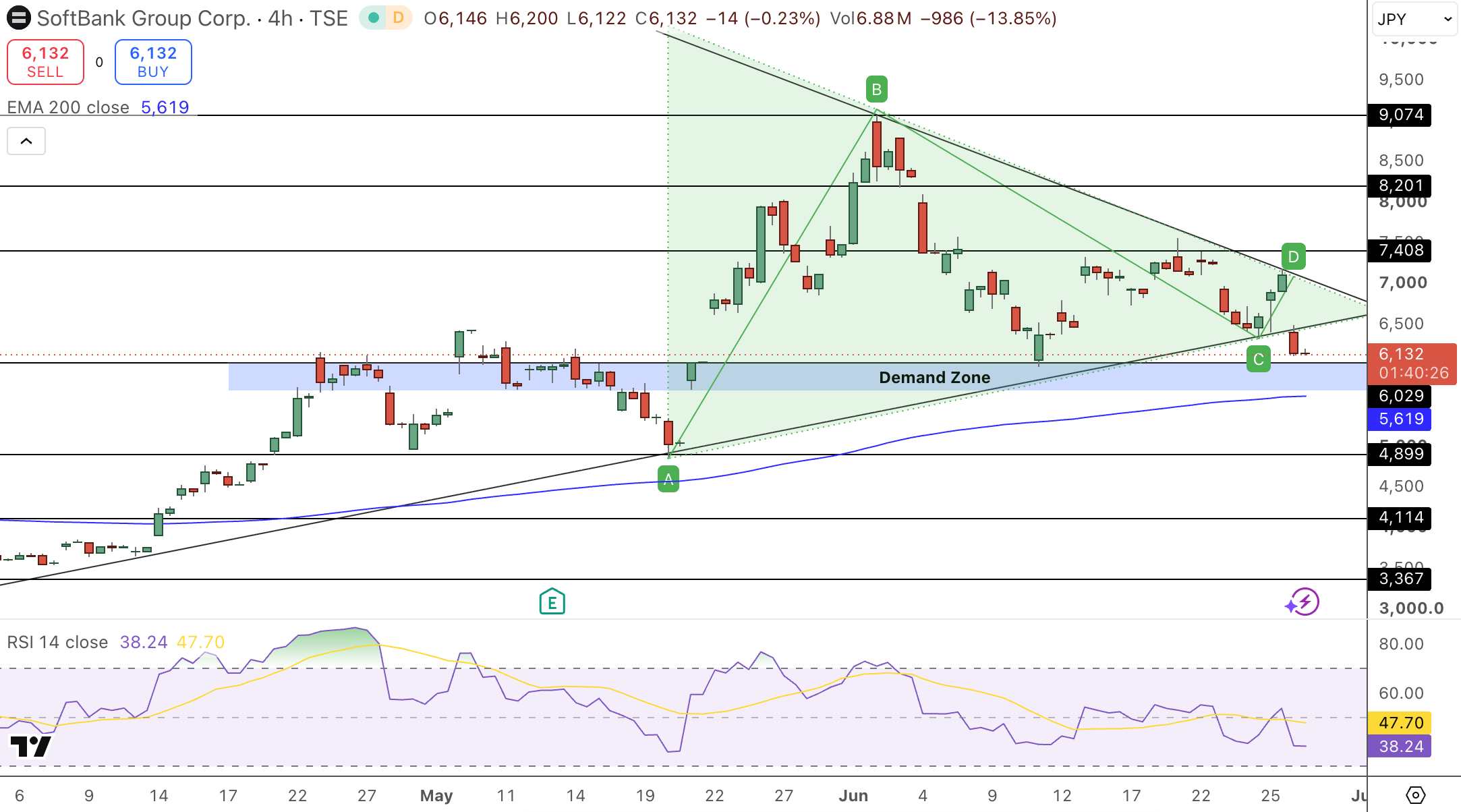
SoftBank Stock Price Chart - Source: Tradingview
For SoftBank to rebound to this level, both a rebound in the broader market and confirmation of a timeline for the OpenAI IPO will be required to happen. A hold above the ¥5,619 EMA200 with a breakout above ¥6,500 will aim for ¥7,408 in triangle recovery. If the price falls below the EMA200 at ¥5,619, then the price would be projected towards ¥4,899–¥4,114.
- Entry (JPY): Long above ¥6,500 — demand zone hold confirmed
- Target (JPY): ¥7,408 — triangle recovery extension
- Floor (JPY): ¥5,619 — EMA200, must hold for bull case to remain intact
- Stop Loss (JPY): Close below ¥5,619 — EMA200 and demand zone fail
- OpenAI stake: ~$65B by October 2026 — liquidity deferred to 2027 if delay confirmed
- Next earnings: August 11, 2026
The Bottom Line
SoftBank slid 13% to ¥6,132 in reaction to the news of OpenAI IPO delays; this is simply a liquidity postponement, not a write down of their position. SoftBank's $65 billion stake in OpenAI is worth $65 billion in 2026 and worth $65 billion in 2027; it is the timing of capital recycling that matters. And the carry cost of delaying capital recycling for a year in a higher-for-longer rate regime is not trivial.
OpenAI's S-1 filing on June 8 has kept the IPO option alive. Given a $1 trillion valuation floor, unsettled markets, and the lesson from the SpaceX IPO, 2027 is a good guess.
At the technical level, look for support at the demand zone and 200-day EMA, near ¥5,619. Holding that support and bouncing
Recommended Articles


