


The Fed's Preferred Inflation Metric Just Topped 4%. Here's What That Might Mean for Future Interest Rates
Key Points
The personal consumption expenditures (PCE) price index is the inflation gauge the Federal Reserve pays most attention to.
While inflation remains elevated, the PCE rose less than expected on a monthly basis.
The market has now slightly changed its view on the trajectory of interest rates this year.
- 10 stocks we like better than CME Group ›
Inflation continues to hit three-year highs, largely due to the Iran war.
The personal consumption expenditures (PCE) price index clocked inflation at a seasonally-adjusted 4.1% in May, the highest level since April 2023. That number, the headline year-over-year reading, came in line with economists’ estimates.
Where to invest $1,000 right now? Our analyst team just revealed what they believe are the 10 best stocks to buy right now, when you join Stock Advisor. See the stocks »
On a monthly basis, the PCE rose 0.4%, 10 basis points (0.1%) below consensus estimates.
Stripping out more volatile food and energy prices, core PCE in May came in 3.4% year over year and rose 0.3% from the prior month, both numbers that were in line with estimates.
"PCE price inflation remains too high and will keep the Fed on hold and mulling a potential rate hike at upcoming meetings," Scott Anderson, chief U.S. economist at BMO Capital Markets, said, according to Reuters. "Services inflation ... will not be easily tamed by falling energy prices. The fight between the hawks and the doves is sure to remain intense."
While the numbers are high, they aren’t entirely unexpected, given that data from earlier this month also showed elevated inflation.
Here’s what this might mean for future interest rates.

Image source: Getty Images.
Why the Fed prefers the PCE
There are several different inflation gauges that the market pays attention to.
While the Consumer Price Index (CPI) arguably garners the most attention from the broader market, the PCE is known as the Fed’s preferred gauge of inflation.
A previous report from the Federal Reserve Bank of Cleveland said, "The PCE price index offers a broader and more comprehensive measure of inflation and more quickly picks up adjustments in consumers' choices in response to price changes."
While the CPI looks at spending by all urban households, the PCE also incorporates goods and services purchased on behalf of households, so it considers costs by businesses or organizations for consumers.
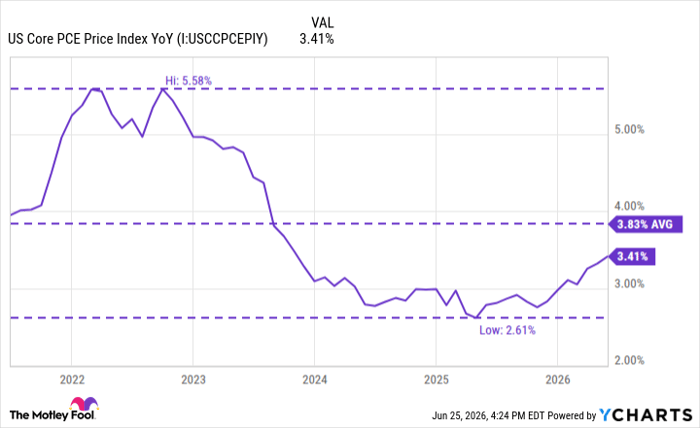
US Core PCE Price Index YoY data by YCharts
In May, some areas of the PCE that saw pressure, aside from energy, included services and healthcare prices.
What does this mean for interest rates?
While inflation is still well above the Fed’s 2% target, the good news is that the PCE rose at a smaller pace than expected on a monthly basis.
It may not sound like much, but the market is paying very close attention to these numbers, so even a small beat or miss is significant.
The report seemed to quell the market’s fears about inflation slightly, as investors are now only penciling in one rate hike between now and the end of 2027, according to the CME Group’s FedWatch tool. Recently, the market had been expecting two rate hikes in this time frame.
Looking at expectations for the Fed’s September meeting, yesterday the market placed a 34.3% chance on the rate-setting Federal Open Market Committee (FOMC) leaving interest rates unchanged.
Today, that percentage is close to 37%, meaning investors are more confident that the Fed will hold rates steady, even though there is still a 48.5% likelihood the Fed raises interest rates by a quarter point in September.
Keep in mind, these percentages change frequently.
Ultimately, the market is taking this report as slightly good news, although it doesn’t significantly alter the trajectory of the Fed.
Should you buy stock in CME Group right now?
Before you buy stock in CME Group, consider this:
The Motley Fool Stock Advisor analyst team just identified what they believe are the 10 best stocks for investors to buy now… and CME Group wasn’t one of them. The 10 stocks that made the cut could produce monster returns in the coming years.
Consider when Netflix made this list on December 17, 2004... if you invested $1,000 at the time of our recommendation, you’d have $387,428!* Or when Nvidia made this list on April 15, 2005... if you invested $1,000 at the time of our recommendation, you’d have $1,221,398!*
Now, it’s worth noting Stock Advisor’s total average return is 895% — a market-crushing outperformance compared to 205% for the S&P 500. Don't miss the latest top 10 list, available with Stock Advisor, and join an investing community built by individual investors for individual investors.
See the 10 stocks »
*Stock Advisor returns as of June 25, 2026.
Bram Berkowitz has no position in any of the stocks mentioned. The Motley Fool has positions in and recommends CME Group. The Motley Fool has a disclosure policy.
Recommended Articles


