


US Stocks Close: Three Major Indexes Diverge, MAG7 Fall Across the Board; Micron Rises 15% Post-Earnings, But Memory Shortage Brings Cost Pressure to Consumer Electronics Like Apple
TradingKey - Micron's financial results ignited investor sentiment for memory stocks, while also proving that the consumer electronics industry, including Apple, is facing cost pressures. The three major U.S. stock indices continued their divergent trends, with the Dow Jones Industrial Average hitting an intraday record high and memory stocks leading the gains.
At the close, the Dow Jones Industrial Average rose 0.14% to 51,920.62; the Nasdaq Composite Index fell 0.46% to 25,358.60; and the S&P 500 Index edged down 0.73 points to 7,357.49.
Tech stock performance
Micron (MU) surged 15.74% post-earnings to $1,213.56, bringing its latest market capitalization to $1.37 trillion, on the verge of surpassing Meta's market value.
According to the earnings report, Micron's third-quarter revenue grew by as much as 346%, with adjusted earnings per share increasing over 12-fold year-over-year, and its gross margin reaching an astonishing 84.9%. JPMorgan Chase raised its price target on Micron from $550 to $1,540, maintaining an 'Overweight' rating. The bank noted that Micron's performance and business outlook both exceeded market expectations, and the company has significantly expanded its 'Strategic Customer Agreements' from the single five-year contract announced last quarter to 16 signed agreements.
Apple (AAPL) fell 6.12% to $275.15.
Apple announced on Thursday that it is raising prices for its MacBook and iPad products. In a statement, Apple said: "The consumer electronics industry is facing unprecedented challenges. The rapid expansion of AI data centers has led to a surge in demand for memory and storage. The firm has never seen component prices rise so quickly in such a short period of time."
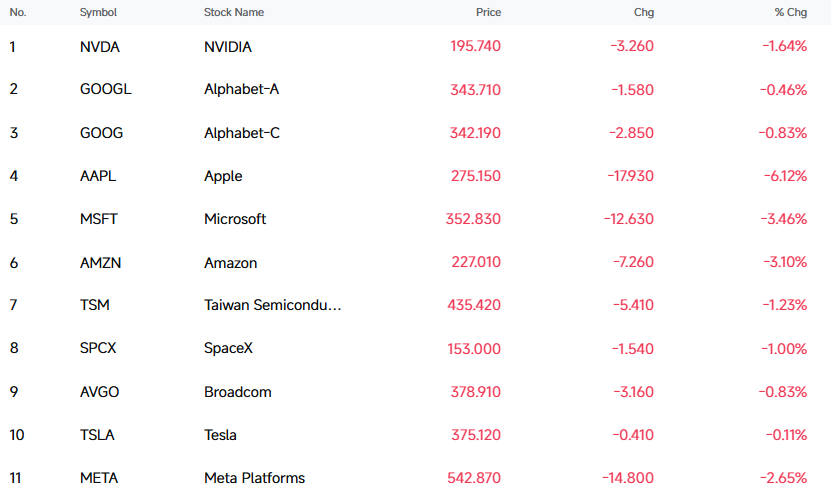
Large-cap tech stocks fell across the board, with Apple (AAPL) down 6.12%, Microsoft (MSFT) down 3.46%, Amazon (AMZN) down 3.10%, Meta Platforms (META) down 2.65%, NVIDIA (NVDA) down 1.64%, TSMC (TSM) down 1.23%, SpaceX (SPCX) down 1.00%, Broadcom (AVGO) down 0.83%, Google (GOOGL) down 0.46%, and Tesla (TSLA) down 0.11%.
[Source: FutuBull]
The Philadelphia Semiconductor Index closed up 3.59% at 13,940.87 points. Of its 30 constituents, 21 rose and 9 fell.
Memory stocks strengthened across the board, with SanDisk (SNDK) up 21.97%, Micron Technology (MU) up 15.74%, Western Digital (WDC) up 4.90%, and Seagate Technology (STX) up 3.23%.
Chinese concept stocks mostly declined, with Trip.com (TCOM) down 12.55%, GDS Holdings (GDS) down 6.17%, Kingsoft Cloud (KC) down 5.63%, Luckin Coffee (LKNCY) down 5.38%, Alibaba (BABA) down 4.71%, and Li Auto (LI) down 4.52%.
Corporate News
SpaceX plans to build a natural gas pipeline to fuel its Starship rocket
According to county regulatory filings, SpaceX plans to begin construction next month on a roughly 13-kilometer natural gas pipeline to its Texas launch facility, a project dubbed "Starpipe." The move is aimed at helping Elon Musk's company increase the launch frequency of its next-generation Starship rocket.
Apple significantly hikes prices for multiple Mac and iPad products
Apple has announced global price hikes for Macs, iPads, and various hardware products, marking the company's largest global pricing adjustment in recent years. An Apple spokesperson stated that "the rapid expansion of AI data centers has driven an unconventional surge in demand for memory and storage," and that the company has "never seen component prices rise so fast and by so much." The spokesperson added that while Apple had previously done its best to absorb rising cost pressures for consumers, "we have now reached the point where we must start raising prices."
Apple undergoes major shift in proprietary chip strategy, pivoting directly to AI-focused M7 series
Apple is embarking on a rare strategic shift in the history of its proprietary Mac chips, breaking the iterative cadence established since the M1—where each generation simultaneously spanned base, Pro, and Max tiers—to reallocate R&D resources toward AI computing power.
Under the new roadmap, Apple will lead with the base M6 chip this year, covering entry-level Macs and select iPad product lines. The originally planned high-end M6 Pro and Max models will be skipped entirely, with the next-generation high-end computing chips leapfrogging directly to the M7 generation. Slated for release in 2027, the M7 will focus on enhancing general computing, graphics rendering, and on-device AI performance. This adjustment is designed to accelerate the rollout of AI-related technologies that were previously deferred, matching the rapidly growing demand for on-device AI and high-load graphics software.
Microsoft to hike Xbox console prices in August
Following Apple’s official announcement of price hikes across its Mac and iPad lineups, Microsoft quickly followed suit by adjusting Xbox console pricing. Starting in August, prices for the entire lineup of consoles will increase, with the 512GB Xbox Series S rising by $100, the 1TB version by $150, and the starting price of the entry-level Series X climbing to $750. This marks Microsoft's second console price hike in a short span following an adjustment last October. The company stated that while it had previously done its best to absorb costs through supply chain coordination, the price increases ultimately became unavoidable.
Tesla plans to boost Berlin Gigafactory capacity by 20%
Tesla’s Berlin Gigafactory is kicking off a new round of production ramp-up, aiming to boost weekly output by 20% to 7,500 vehicles by this October. The electric vehicle maker will also hire an additional 1,000 employees to better meet market demand for the Model Y. To satisfy robust demand for the Model Y, the plant had already announced a capacity expansion in April; in May, Tesla also announced plans to step up investments in battery cell production at the facility.
Industry & Macro News
US Proposes AI Partnership Agreement with EU
The United States has proposed an AI partnership to the European Union, aiming to leverage AI industrial synergy to strengthen the transatlantic semiconductor supply chain alliance and consolidate its bloc's advantage in tech competition with China. This marks another U.S.-led transatlantic tech collaboration initiative, following the "Silicon Peace" initiative in the critical minerals sector.
Under the draft framework, the two sides will cooperate across three core areas: building an innovation-friendly regulatory system, jointly developing the AI technology stack and opening exports to partner countries, and co-directing industrial investment. The core logic of the proposal is to anchor the hardware foundations of AI—such as critical minerals, energy, and semiconductor manufacturing—to build a trustworthy AI industrial ecosystem based on shared values.
Iran Attacks Cargo Ship, Testing US-Iran Ceasefire Deal
According to the Wall Street Journal, two senior U.S. officials revealed that Iran's Revolutionary Guard Corps attacked a Singapore-flagged cargo ship in the Strait of Hormuz on Thursday, testing a deal signed last week between the U.S. and Iran aimed at ending hostilities and reopening the vital shipping lane.
According to the United Kingdom Maritime Trade Operations (UKMTO), the attack damaged the vessel's bridge but caused no casualties. The strike occurred off the coast of Oman, hours after Iran’s paramilitary navy warned vessels against using unauthorized sea lanes.
Trump Administration Pushes Expansion of Domestic Critical Minerals Capacity
To reduce reliance on foreign imports of critical minerals, the Trump administration has launched a new support model, opening national military bases to private companies for the first time to establish processing lines for strategic minerals like rare earths, graphite, lithium, and boron, supporting domestic capacity building through land access and guaranteed demand.
The U.S. has previously supported its domestic mining industry through policy loans and equity injections; integrating military assets into industrial planning marks another breakthrough in its supply chain autonomy strategy. Minerals like rare earths and lithium are critical raw materials for the electronics, clean energy, and defense sectors, meaning domestic capacity building directly impacts industrial security and defense self-reliance.
Moody’s Warns Data Centers Straining Water and Power Utilities, Posing Credit Risks for U.S. State and Local Governments
A new report from Moody’s warns that the energy- and water-intensive nature of data centers requires local governments to expand power and water infrastructure. If these costs are not fully covered by project developers, they will ultimately be passed on to local budgets or residents, creating a dual burden on public finances and taxpayers.
Local governments have historically competed for data center projects primarily through tax incentives, but the fiscal toll of these investment policies is now coming to light. In Virginia, home to the world's densest concentration of data centers, tax breaks have drained over $1 billion in annual revenue, forcing the state to levy the nation’s first dedicated tax on data center electricity usage. These tax concessions directly squeeze local revenues and, compounded by the hidden costs of supporting infrastructure, further widen credit exposure for local governments.
Recommended Articles


