


Prediction: This Stock Turned $10,000 Into $130,000 in 3 Years and Can Do It Again
Key Points
Carvana surprised many when it began scooping up brick-and-mortar automotive dealerships.
The strategic move will open new doors for additional revenue streams and higher-margin business.
Adding brick-and-mortar dealerships will help diversify its business and create opportunities for lucrative growth.
- 10 stocks we like better than Carvana ›
To say Carvana's (NYSE: CVNA) past five years have been a roller coaster could be the understatement of 2026. Carvana, one of the nation's largest used-car retailers, was on the brink of bankruptcy in late 2022 due to a pandemic-era decline in used-car demand, high interest rates, and a large acquisition that added to its debt pile.
The company pulled together, restructured its debt, which was a huge relief to near-term debt maturities and massive interest burdens on said debt, and has since thrived. In fact, if you had invested $10,000 in Carvana three years ago, the value of that investment would be approaching $130,000 today. Here's the wild part: Rather than being on the brink of bankruptcy, Carvana might be on the brink of disrupting a whole new business segment -- and its stock could soar again.
Missed Nvidia in 2009? This Rare Signal Is Flashing Again. In 2009, a "Double Down" signal flashed for a little-known chipmaker called Nvidia. For the first time in years, that same "Total Conviction" signal is flashing for a company 1/100th the size of Nvidia. Continue »
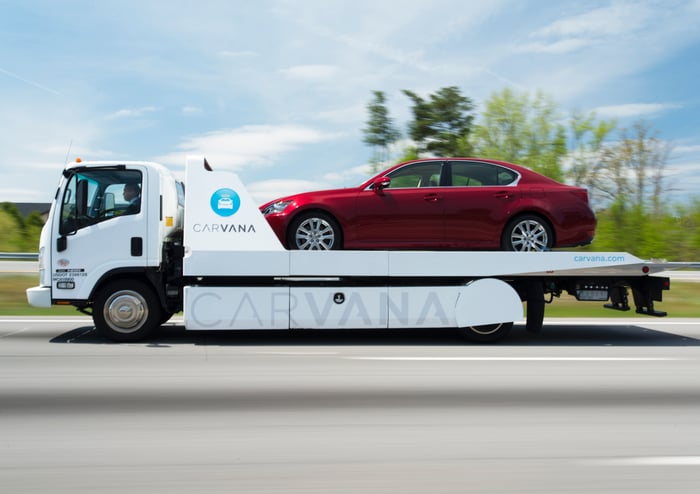
Image source: Carvana.
Carvana built a better mousetrap
Carvana surprised a whole bunch of investors when it announced it was buying a handful of brick-and-mortar automotive dealerships, seemingly at odds with the online-only business model that enabled it to thrive in recent years. Carvana dipping its toes into the brick-and-mortar world is far more complex and intriguing than simply beginning sales of new vehicles, and it could drive the business to new heights.
The more amusing part of the strategy is that it's still not going to sell you a new car at the brick-and-mortar dealership. Rather than merge into the world of dealerships, salesmen, and traditional new-vehicle sales methods, Carvana is using these dealerships as service locations and test-drive centers to connect with consumers in a new way and lead them to the online service for purchase.
If you're raising your eyebrow in skepticism, take a look at the next figures. Carvana's first new-car dealership, a Stellantis (NYSE: STLA) franchise in Casa Grande, Arizona, sold more than 700 new vehicles last month, CNBC reported. Not only did that dwarf the dealership's previous average of roughly 30 to 50 monthly sales before Carvana took over, according to The Wall Street Journal, but it also turned it into the nation's best-selling store.
This strategy not only opens the door to new revenue streams via new-car sales, but it is also much more than that. Purchasing dealerships opens the door for Carvana to bring in more vehicle inventory through trade-ins and/or buying vehicles from not only its customers but also through exclusive auctions only open to franchised dealers. This is a big deal and a cheaper way to turn inventory into bottom-line profits.
But wait, there's more
Automotive retail can generally be summarized into four distinct areas of value: new vehicle sales, used vehicle sales, parts and service (P&S), and finance and insurance (F&I). Previously, Carvana obviously was thriving on its used-car online business and also offered finance and insurance. Now it can cover all aspects of automotive retail, which includes the higher-margin parts and service segment.
Saying parts and service is a higher-margin business doesn't do it justice. Using AutoNation as a benchmark, as one of the largest publicly traded dealership groups, investors have great insight into how the numbers from revenue to gross profit flip completely in the auto retail business.
This first pie graph (revenue) probably splits the automotive retail pie roughly as investors expect, driven largely by, of course, new and used vehicle sales.
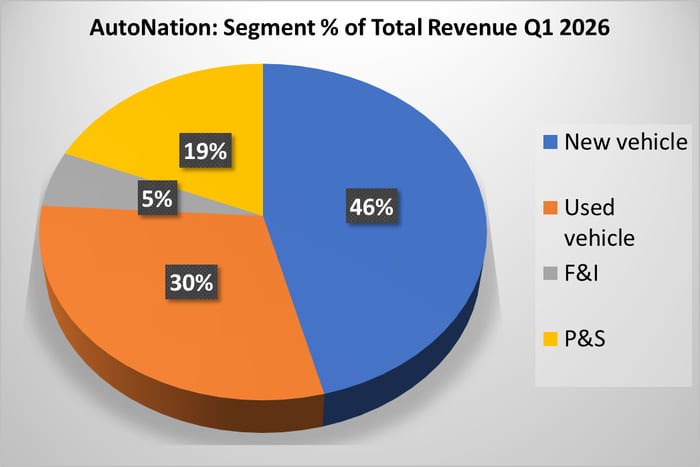
Data source: AutoNation Q1 2026 10Q. Chart: Author.
Here's where the auto retail business gets intriguing when looking at gross margins.
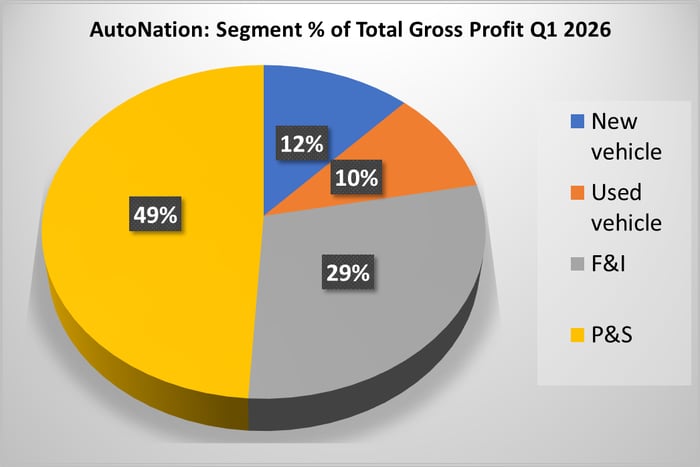
Data source: AutoNation Q1 2026 10Q. Chart: Author.
In other words, while AutoNation's P&S segment generated only 19% of first-quarter revenue, it generated almost half of the company's gross profit. Taking it a step further, while F&I and P&S are likely afterthoughts for many investors, the two combined accounted for 78% of AutoNation's gross profit during the first quarter.
Let's refocus
OK, that's a lot to digest, and for many investors it might be eye-opening. Let's refocus more broadly on why Carvana's strategic move to buy dealerships is a huge win and summarize three key points.
First, the move to buy dealerships gives Carvana access to new-car buyers with trade-in vehicles and to exclusive dealership vehicle auctions. Both are cheaper ways to acquire inventory, which, thanks to Carvana's online reach, only improves the company's economic moat and competitive advantages. Traditional dealerships can generally only sell local inventory to local customers, whereas Carvana can sell you a vehicle from one side of the nation to the other -- and now it has even more inventory access to offer, luring in more customers.
Second, this opens two new doors for Carvana's business. Yes, it had already been thriving in used-car sales and covered F&I, but now it covers the other two aspects of auto retail via new-car sales and P&S. These are incremental and additional revenue streams that will drastically boost its overall business.
Third, diversification plays a big role in Carvana's strategic decision to buy dealerships. Carvana was on the brink of bankruptcy in part due to a struggling used-car market. Adding new-vehicle sales to the mix helps diversify its top and bottom lines, because sometimes one sector of the auto retail business is hot, and one is not. And in cases when both of those sectors are not hot, P&S still does great business because if a car needs repairs, or warranty and recall work, it doesn't matter what the new and used retail markets are doing.
Time to buy?
Carvana could continue to buy brick-and-mortar dealerships while never selling a vehicle on-site ever, and it could still completely change the game, as shown by the instant success its Arizona dealership is having. That's because this strategy really isn't about traditional dealership sales. Consider that Carvana has roughly seven dealerships purchased out of about 16,990 retailers in the U.S. market. Those nearly 17,000 retailers generated $1.3 trillion in sales last year alone, leaving incredible growth ahead. Carvana's strategic pivot was wild, caught many off guard, and it's brilliant.
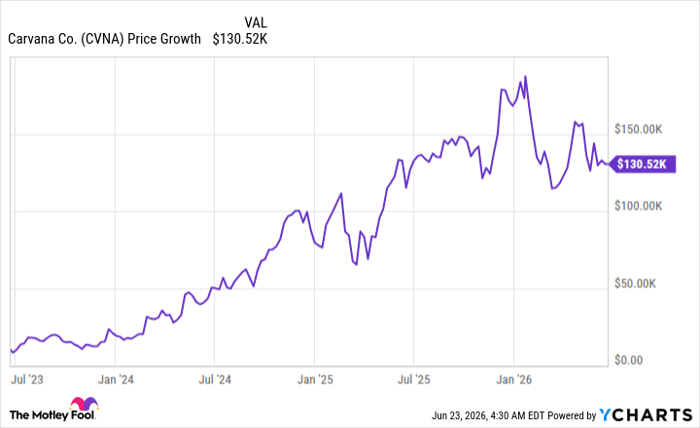
CVNA data by YCharts
It took three years for Carvana to turn a $10,000 investment into $130,000, and if the company continues to buy dealerships, it will likely take longer to build into a repeat scenario. But it may not be the last time Carvana turns a $10,000 investment into a 10-bagger.
Should you buy stock in Carvana right now?
Before you buy stock in Carvana, consider this:
The Motley Fool Stock Advisor analyst team just identified what they believe are the 10 best stocks for investors to buy now… and Carvana wasn’t one of them. The 10 stocks that made the cut could produce monster returns in the coming years.
Consider when Netflix made this list on December 17, 2004... if you invested $1,000 at the time of our recommendation, you’d have $392,713!* Or when Nvidia made this list on April 15, 2005... if you invested $1,000 at the time of our recommendation, you’d have $1,227,782!*
Now, it’s worth noting Stock Advisor’s total average return is 897% — a market-crushing outperformance compared to 208% for the S&P 500. Don't miss the latest top 10 list, available with Stock Advisor, and join an investing community built by individual investors for individual investors.
See the 10 stocks »
*Stock Advisor returns as of June 24, 2026.
Daniel Miller has no position in any of the stocks mentioned. The Motley Fool recommends Stellantis. The Motley Fool has a disclosure policy.
Recommended Articles


