


Japanese Yen sinks even after the BoJ hikes
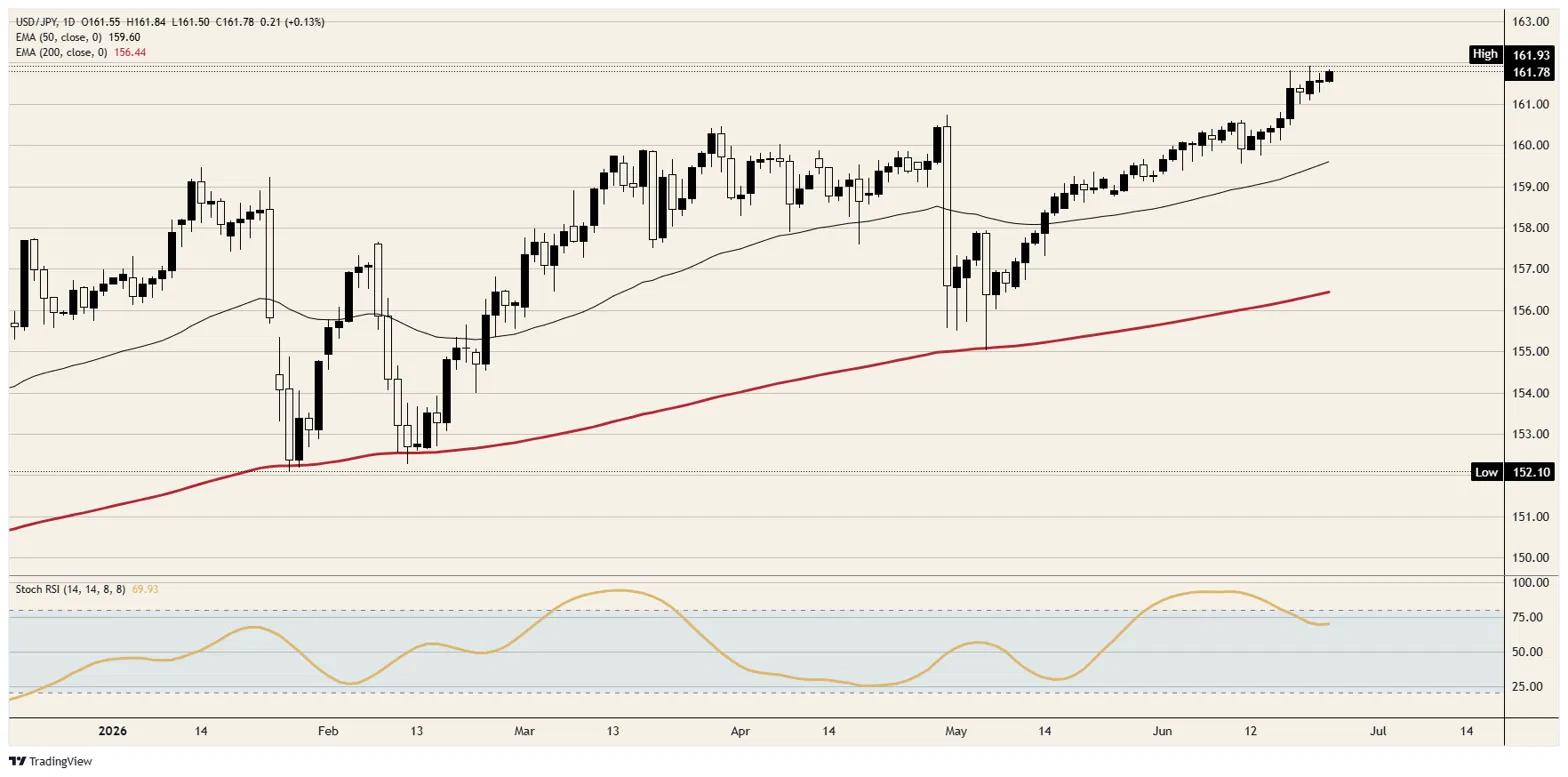
- USD/JPY extended its grind higher on Wednesday, closing within touching distance of its highest level in more than three decades.
- A BoJ rate hike has failed to lift the Yen, out-hawked by a firmer Fed on the other side.
- Thursday delivers US Core PCE and Tokyo CPI back to back, the only catalysts left this week.
USD/JPY spent Wednesday grinding higher again, which by rights should not be happening. The Bank of Japan (BoJ) raised its policy rate only last week, and a hike is meant to put a floor under a currency, not watch it slide toward generational lows. That the Yen keeps sinking regardless points straight at the Dollar side, where a Federal Reserve (Fed) that has just turned more hawkish is holding the rate gap brutally wide.
The gap swallowed the hike
The BoJ did its part, lifting rates to a 30-year high of 1.00%, but the market had long priced it in and the move bought the Yen nothing lasting. The reason is pure arithmetic: with the Federal Open Market Committee (FOMC) holding near 3.75% and its dot plot now flagging a hike rather than a cut, the gap between the two policy rates still sits near 275 basis points. At that spread a quarter-point from Tokyo barely dents the carry trade, and the Yen's direction stays set in Washington.
What a hike could not do, Yentervention might
That the hike failed to help is precisely why the next risk to the trade is not monetary but political. With the BoJ unwilling to sprint and its rate move already shrugged off, the finance ministry becomes the only actor capable of jolting the pair, and with the Yen at its weakest in a generation, its warnings about disorderly moves are growing louder. The carry trade keeps looking like free money right up until Tokyo reaches for Yentervention. Every step higher only sharpens that asymmetry.
Thursday's double bill
The week comes down to Thursday, and it lands in two parts. At 12:30 GMT the core Personal Consumption Expenditures Price Index (PCE) prints, the Fed's preferred inflation gauge, with consensus at 0.3% MoM and 3.4% YoY, each a tick above the prior month. A hot number widens the gap that is already doing the damage and likely pushes the pair through 162.00; only a clear miss looks able to stall it.
The second leg comes at 23:30 GMT with the Tokyo Consumer Price Index (CPI), which now reads differently after last week's move. A soft print near the recent 1.4% headline would tell the market the BoJ is in no rush to hike again, and even another move might not matter much, given how little the last one changed for the Yen.
Levels to watch
Resistance: The 162.00 handle is the immediate cap; a clean break opens room toward 163.00 with little in the way, though every leg higher stiffens the case for intervention.
Support: A pullback finds first footing near 161.50, with 161.00 below it; only a slide toward the 50-day Exponential Moving Average (EMA) around 159.50 would suggest the uptrend is finally tiring.
Bias: Higher. A hawkish Fed, a punishing rate gap and an uptrend that just shrugged off a BoJ hike all point the same way. The clearest threat to the long side is not the chart or the central bank but the finance ministry.
USD/JPY daily chart
Japanese Yen FAQs
The Japanese Yen (JPY) is one of the world’s most traded currencies. Its value is broadly determined by the performance of the Japanese economy, but more specifically by the Bank of Japan’s policy, the differential between Japanese and US bond yields, or risk sentiment among traders, among other factors.
One of the Bank of Japan’s mandates is currency control, so its moves are key for the Yen. The BoJ has directly intervened in currency markets sometimes, generally to lower the value of the Yen, although it refrains from doing it often due to political concerns of its main trading partners. The BoJ ultra-loose monetary policy between 2013 and 2024 caused the Yen to depreciate against its main currency peers due to an increasing policy divergence between the Bank of Japan and other main central banks. More recently, the gradually unwinding of this ultra-loose policy has given some support to the Yen.
Over the last decade, the BoJ’s stance of sticking to ultra-loose monetary policy has led to a widening policy divergence with other central banks, particularly with the US Federal Reserve. This supported a widening of the differential between the 10-year US and Japanese bonds, which favored the US Dollar against the Japanese Yen. The BoJ decision in 2024 to gradually abandon the ultra-loose policy, coupled with interest-rate cuts in other major central banks, is narrowing this differential.
The Japanese Yen is often seen as a safe-haven investment. This means that in times of market stress, investors are more likely to put their money in the Japanese currency due to its supposed reliability and stability. Turbulent times are likely to strengthen the Yen’s value against other currencies seen as more risky to invest in.
Recommended Articles


