


Lucid vs. Rivian: Which Is Winning the Only Race That Matters?
Key Points
Lucid has driven its top line higher with a surge in deliveries.
Despite top-line growth, Rivian has outpaced its rival in gross profitability.
Lucid's Gravity SUV and Rivian's R2 will determine how this race continues.
- 10 stocks we like better than Rivian Automotive ›
Roughly a decade ago, investors who either missed Tesla's high-risk, uncertain, rapid-growth phase and high-flying valuation or didn't believe in it spent much time trying to find the "next Tesla." Then many also missed BYD's rapid rise.
Fast-forward to today, and many wonder whether Rivian Automotive (NASDAQ: RIVN) or Lucid Group (NASDAQ: LCID) could deliver lucrative returns as the electric vehicle (EV) market slowly gains traction in the U.S. market. Some investors compare the two EV makers' top-line growth.
Where to invest $1,000 right now? Our analyst team just revealed what they believe are the 10 best stocks to buy right now, when you join Stock Advisor. See the stocks »
But which of these two, young EV makers is winning the race that actually matters?

Rivian's R2. Image source: Rivian.
Top-line momentum
Lucid had a bumpy beginning to its history, marred with supplier disruptions and production hiccups, sprinkled with recalls along the way. Then Lucid began smoothing out operations and put together an impressive streak of eight consecutive record-setting quarterly delivery totals. That streak ended, just falling short by a handful of vehicles in the first quarter of 2026, but the surge helped the young automaker match rival Rivian in top-line growth over the past three years.
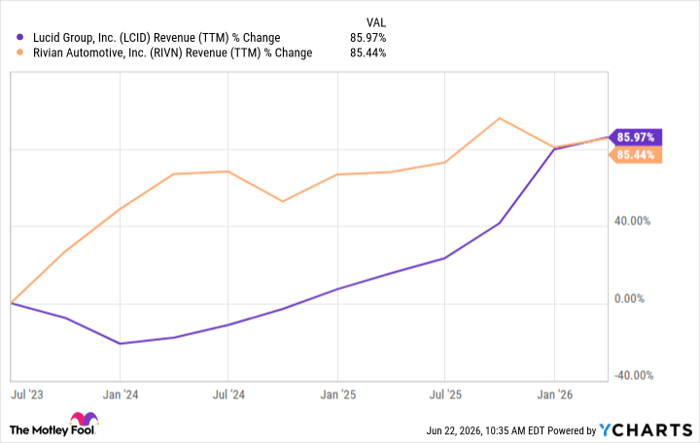
LCID Revenue (TTM) data by YCharts
Investors have reason to believe both EV makers' top-line growth will continue, as Lucid is still accelerating the production and deliveries of its latest launch, the Gravity SUV, and Rivian is doing the same with its potentially groundbreaking R2. Lucid's and Rivian's top-line growth is certainly a story and one to keep an eye on, but really, the race that matters is gross profitability improvements. That race has certainly favored Rivian.
The race that matters
Gross profitability, especially for young companies such as Lucid and Rivian, is incredibly important to investors because it measures the core efficiency of the production process. It shows you exactly how much value remains from sales after covering the direct costs of creating the product. If a young company can't make consistent progress on that aspect, there's little hope it'll ever churn out real bottom-line profits or long-term returns for investors.
Put more simply: Achieving gross profitability, or at least consistent improvement, proves to investors the company is a viable long-term investment. As you can see in the graph, Rivian is turning this race into a story of the tortoise and the hare.
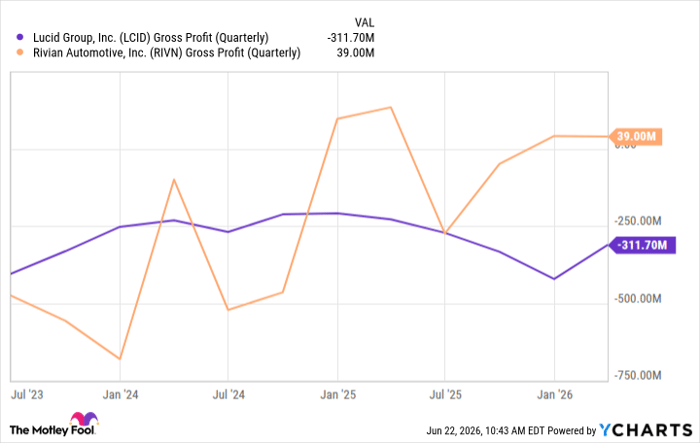
LCID Gross Profit (Quarterly) data by YCharts
Despite starting from a worse position three years ago, Rivian has posted both quarterly gross profits and consistent improvements when judged by its overall trajectory and past quarterly volatility and seasonality.
And the winner is....
There's reason to believe Rivian's gross profitability is here to stay, as the recently launched R2 offers significant reductions in vehicle material costs and complexity, along with growing revenue from higher-margin software and services. The latter is why Rivian's joint venture with Volkswagen is so valuable.
Regarding the former point, Rivian's material costs for the R2 are roughly 50% lower than those for its original R1 vehicle platform, and as its scale improves, those factors combine to drastically reduce fixed and variable costs per vehicle.
Both Rivian and Lucid face challenges in their own way going forward, especially considering policy changes that include removing the $7,500 federal EV tax credit, among others. Both still have to contend with a lucrative U.S. market where new-vehicle prices are continuing to rise -- currently averaging just over $50,000 -- making consumers more cautious, while the EV market is growing more slowly than originally anticipated.
That said, if you're again looking for the next Tesla, there may not be one. Investors who continue to look, however, should take top-line growth with a grain of salt and remember that gross profitability is the first of many required steps to becoming a more viable long-term investment, which increases demand for the stock and thus its valuation. Rivian is winning the important race, and Lucid has much work to do.
Should you buy stock in Rivian Automotive right now?
Before you buy stock in Rivian Automotive, consider this:
The Motley Fool Stock Advisor analyst team just identified what they believe are the 10 best stocks for investors to buy now… and Rivian Automotive wasn’t one of them. The 10 stocks that made the cut could produce monster returns in the coming years.
Consider when Netflix made this list on December 17, 2004... if you invested $1,000 at the time of our recommendation, you’d have $392,713!* Or when Nvidia made this list on April 15, 2005... if you invested $1,000 at the time of our recommendation, you’d have $1,227,782!*
Now, it’s worth noting Stock Advisor’s total average return is 897% — a market-crushing outperformance compared to 208% for the S&P 500. Don't miss the latest top 10 list, available with Stock Advisor, and join an investing community built by individual investors for individual investors.
See the 10 stocks »
*Stock Advisor returns as of June 24, 2026.
Daniel Miller has no position in any of the stocks mentioned. The Motley Fool has positions in and recommends Tesla. The Motley Fool recommends BYD Company. The Motley Fool has a disclosure policy.
Recommended Articles


