


VOOG vs. VYM: Which Vanguard ETF Is the Better Choice?
Key Points
The Vanguard S&P 500 Growth ETF has strongly outperformed the Vanguard High Dividend Yield ETF for 10 years -- but not in 2022, when tech stocks had a big downturn.
Investors who want passive income and are concerned about the high valuations of tech stocks might want to consider the Vanguard High Dividend Yield ETF.
The Vanguard High Dividend Yield ETF ranks among the best dividend index funds.
- 10 stocks we like better than Vanguard Admiral Funds - Vanguard S&P 500 Growth ETF ›
One big debate many investors might be wrestling with right now is whether to buy growth stocks or high-yield dividend stocks. Two Vanguard exchange-traded funds (ETFs) allow you to gain exposure to two very different parts of the U.S. economy.
The Vanguard S&P 500 Growth ETF (NYSEMKT: VOOG) offers a portfolio of 146 U.S. large-cap growth stocks, with a heavy weighting toward the tech sector -- 52.6% of the fund's assets are in tech stocks. It has strongly outperformed the S&P 500 index for the past 10 years.
Where to invest $1,000 right now? Our analyst team just revealed what they believe are the 10 best stocks to buy right now, when you join Stock Advisor. See the stocks »
The Vanguard High Dividend Yield ETF (NYSEMKT: VYM) is more diversified and puts your money to work in companies less involved with the U.S. artificial intelligence (AI) boom. This ETF offers a portfolio of 605 holdings, with a focus on large-cap value stocks. The types of companies it invests in tend to be financially strong, consistently profitable, and pay steady dividends.
This fund has underperformed the S&P 500 (and the Vanguard S&P 500 Growth ETF) for the past 10 years. But some investors might want to consider it because of its recent performance and the unique mix of stocks it holds.
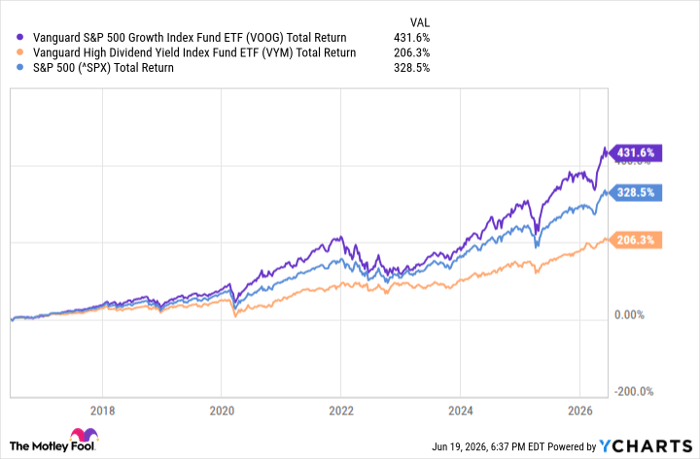
VOOG Total Return Level data by YCharts.
Let's take a closer look at these two Vanguard ETFs to see which could be a better buy for your investment goals.
Vanguard S&P 500 Growth ETF: 10 years of 18.2% annualized returns
The Vanguard S&P 500 Growth ETF is not a typical S&P 500 ETF. Instead of owning the entire benchmark index, this fund focuses only on growth stocks within the S&P 500. Like a Nasdaq-100 index tracking fund, such as the Invesco QQQ ETF, this Vanguard growth ETF allows investors to take a concentrated position in the U.S. tech sector.
The fund's top five holdings are Nvidia (14.3% of the fund), Alphabet (11.04% of the fund, combining Class A and Class C shares), Microsoft (9.3%), Apple (6.4%), and Broadcom (5.9%). The top 10 holdings make up about 60% of the fund.
Although it's top-heavy with major tech names and AI stocks, the fund has delivered strong results for investors. For the past 10 years, the Vanguard S&P 500 Growth ETF has earned annualized returns of 18.2%. It charges a low expense ratio of 0.07%.
With such excellent past performance, why would anyone not want to buy this fund? One reason could be high valuations. If you believe the U.S. tech sector is too richly valued and that the AI boom might turn to bust, buying this fund right now might feel too risky. The Vanguard S&P Growth ETF is trading at a price-to-earnings (P/E) ratio of 31.08, while the Vanguard High Dividend Yield ETF offers a lower P/E multiple of 20.83.
Vanguard High Dividend Yield ETF: 10 years of 11.85% annualized returns
If you're worried about a possible AI bubble, want to protect against a future tech downturn, or place a higher priority on high dividends instead of high growth, the Vanguard High Dividend Yield ETF could be a better fit for your goals. This Vanguard ETF lets you own a diversified portfolio of large-cap U.S. value stocks that tend to pay high dividend yields.
Instead of being tech-heavy like the other ETF, this fund is more broadly diversified across sectors. The top five sector holdings are:
- Financials (19.6% of the fund)
- Technology (16.9%)
- Industrials (13.9%)
- Healthcare (11.7%)
- Energy (9%)
Over the past 10 years, the Vanguard High Dividend Yield ETF has delivered annualized returns of 11.85% (by net asset value). This fund might not grow as fast as a tech-heavy ETF, but it might perform more steadily in case of a future downturn in the Nasdaq-100.
In 2022, during the most recent bear market in U.S. tech stocks, the Vanguard High Dividend Yield ETF strongly outperformed the Nasdaq-100 and the S&P 500. It also beat the Vanguard S&P 500 Growth ETF, which tracked closely with the tech-heavy Nasdaq-100.
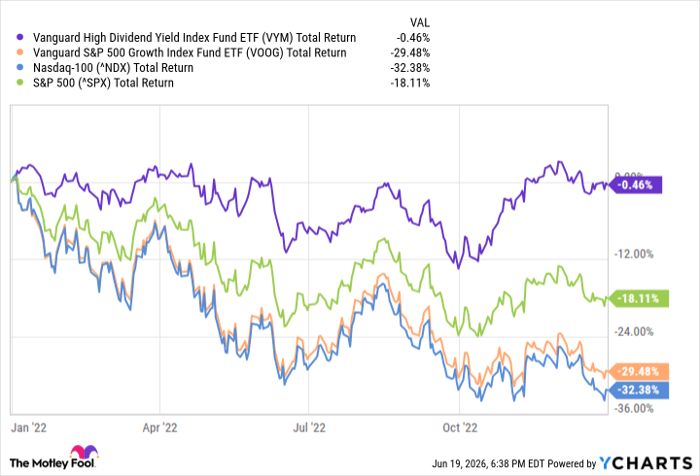
VYM Total Return Level data by YCharts.
The Vanguard dividend ETF could be a good defensive play in case today's highly valued tech stocks disappoint investors in the near future. And the Vanguard High Dividend Yield ETF offers a trailing-12-month dividend yield of 2.21% and charges a low expense ratio of 0.04%.

Image source: Getty Images.
Why buy one over the other?
Which ETF is a better buy depends on your investment strategy and what you believe about the future. If you want to invest for maximum growth potential and you have a strong level of conviction that U.S. tech stocks are likely to continue their momentum for years to come, then it might be worth making a concentrated investment in those companies. It's possible that U.S. growth stocks will keep outperforming value stocks for a long time.
But if you want passive income from dividend stocks, hopefully with less volatility than growth stocks, the Vanguard High Dividend Yield ETF could be a better choice. It ranks among the best dividend index funds. Instead of concentrating on a tech-heavy mix of 146 growth stocks, this Vanguard dividend ETF offers a more diversified approach that can gain from consistent dividend yields and possible future rotations out of tech stocks.
Should you buy stock in Vanguard Admiral Funds - Vanguard S&P 500 Growth ETF right now?
Before you buy stock in Vanguard Admiral Funds - Vanguard S&P 500 Growth ETF, consider this:
The Motley Fool Stock Advisor analyst team just identified what they believe are the 10 best stocks for investors to buy now… and Vanguard Admiral Funds - Vanguard S&P 500 Growth ETF wasn’t one of them. The 10 stocks that made the cut could produce monster returns in the coming years.
Consider when Netflix made this list on December 17, 2004... if you invested $1,000 at the time of our recommendation, you’d have $392,713!* Or when Nvidia made this list on April 15, 2005... if you invested $1,000 at the time of our recommendation, you’d have $1,227,782!*
Now, it’s worth noting Stock Advisor’s total average return is 897% — a market-crushing outperformance compared to 208% for the S&P 500. Don't miss the latest top 10 list, available with Stock Advisor, and join an investing community built by individual investors for individual investors.
See the 10 stocks »
*Stock Advisor returns as of June 24, 2026.
Ben Gran has no position in any of the stocks mentioned. The Motley Fool has positions in and recommends Alphabet, Apple, Broadcom, Microsoft, Nvidia, and Vanguard High Dividend Yield ETF. The Motley Fool has a disclosure policy.
Recommended Articles


