


US Chip Stocks Crash or Healthy Correction? Goldman Flags Rising ‘Narrative Sensitivity,’ JPMorgan Sees S&P 500 at 7,800
TradingKey - U.S. stocks plummeted again yesterday, with the Nasdaq Composite Index closing down 2.21%, the Nasdaq 100 ETF (QQQ) down 3.29%, and the Philadelphia Semiconductor Index falling as much as 7.87% in a single day.
This decline was dragged down by leading tech stocks. Yesterday, Micron ( MU) plummeted 13.18% to $1051.77. The market views the memory giant's upcoming earnings report as a 'touchstone' for the AI supply chain, which will influence investors' judgment on the AI hardware chain, semiconductor cycle, memory price-hike cycle, and valuations of high-flying tech stocks.
There is widespread market concern over the risk of over-revised earnings expectations. If valuations price in the positive earnings outlook too early, even strong current quarterly results could trigger a 'sell-the-news' sell-off once performance is delivered. Broadcom on June 4 ( AVGO )'s stock price movement is a typical reference case under this logic.
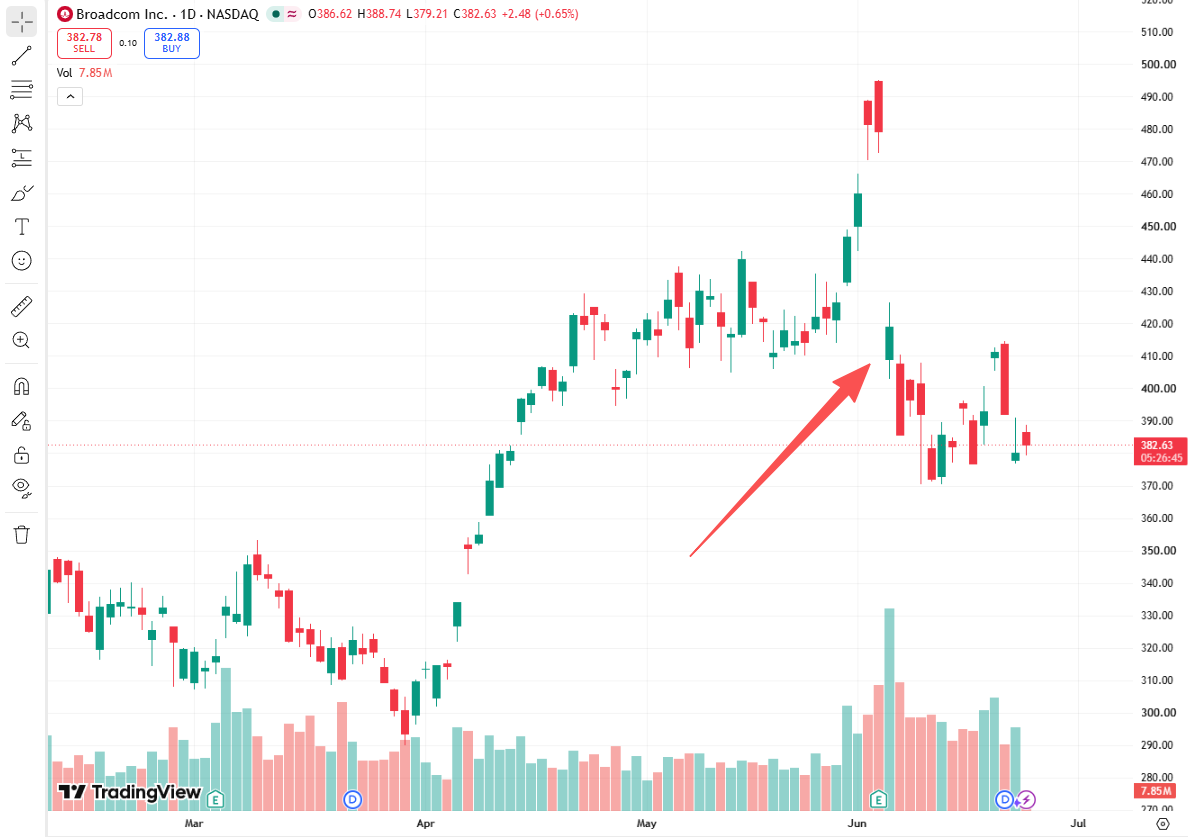
[Source: TradingView]
Meanwhile, the market is also filled with talk of an AI bubble, with one Wall Street analyst calling this stock market correction a 'chip crash'.
Goldman Sachs set the tone for the market correction, arguing that the AI rally is not a simple replay of the dot-com bubble era. The firm stated that the more critical issue now is that while earnings and capital expenditures are still being revised upward, market prices have already priced in a large amount of optimism, and investors' sensitivity to narrative shifts is rising.
The firm added that the main risk of the AI trade is no longer just a 'valuation bubble'. Forward P/E ratios have not spun out of control significantly because earnings expectations have been revised upward in tandem. What truly needs to be tested is whether the current strong earnings can be sustained after the capex cycle peaks.
Goldman's point is that current market valuations are not entirely unsupported, but they rely on multiple optimistic assumptions: accelerating AI penetration, productivity gains exceeding expectations, a higher share of capital returns, and U.S. companies capturing more global AI revenues. The report's optimistic scenario shows that current market cap growth can only be justified if U.S. companies capture 50% of global AI-related revenues, capital returns account for a high share, AI adoption accelerates, and the discount rate declines—all at the same time.
This is also why the market is susceptible to sell-offs. When productivity begins to accelerate, corporate profit shares tend to rise; but over time, as competition intensifies, companies expand capacity and invest, and new technologies iterate, excess profits are gradually eroded. Although the AI industry has a high concentration and its technological attributes favor capital owners, whether the competitive moats of current leading players can be maintained in the long term has not yet been definitively proven.
Goldman added that the AI investment boom itself is generating massive profits. Companies engaged in chip sales, computing power services, and data center construction are direct beneficiaries of rising industry-wide capital expenditures. As long as the peak of investment is not yet in sight, the momentum of continuous upward earnings revisions will likely continue to outweigh market worries about valuations.
However, if the market directly extrapolates the strong earnings of the next two to three years into the longer term, risks will rise. Capex cannot maintain its current growth intensity forever. Once the investment cycle peaks, the uncertainty of earnings trends for the companies most directly benefiting today will increase significantly.
JPMorgan, on the other hand, offered a more optimistic view, suggesting that U.S. stocks are approaching a 'blue-sky scenario' (the most optimistic expectation scenario). The firm stated that the upward path is naturally non-linear, and short-term pullbacks are a normal process of the market digesting obstacles. With previous earnings reports continuously raising the earnings baseline, the difficulty for companies to beat expectations in the Q2 earnings season has naturally risen, representing a healthy digestion of expectations.
Supported by both better-than-expected corporate earnings growth and progress on a U.S.-Iran peace agreement, JPMorgan raised its S&P 500 target to 7,800 points, representing about 6% upside from the current S&P 500 index.
The strong recovery on the earnings front is the core backing for the firm's upward target revision. Current market consensus expects average S&P 500 earnings growth of 20% over the next two years, matching the nearly doubled expansion pace of AI capex. Year-to-date, consensus earnings expectations for 2026–2027 have been revised upward by a cumulative 10%. Such continuous, substantial positive revisions are extremely rare and typically only occur after external shocks or during recession recovery phases.
The concentrated upward revision of capex by companies during the last earnings season, coupled with Anthropic's validation of the commercial viability of AI, serves as the core positive driver for this round of upward earnings revisions.
Recommended Articles


