


Kevin Warsh Makes Small but Important Changes at the Fed. Here's Why They Could Result in Significant Volatility Around Future FOMC Meetings
Key Points
The Fed has removed its guidance from meetings, and its policy statement is also much shorter.
Future Fed meetings could cause greater market volatility due to the added uncertainty.
Long-term investors could capitalize on opportunities to take advantage of wild swings in the market.
- 10 stocks we like better than S&P 500 Index ›
Kevin Warsh recently held his first Federal Open Market Committee (FOMC) meeting as Federal Reserve Chairman. While all eyes were on what would happen to interest rates (they remained unchanged), the bigger takeaway for investors is what changed in the Fed's overall approach to announcing its decisions, as that could have a more significant effect on the market this year.
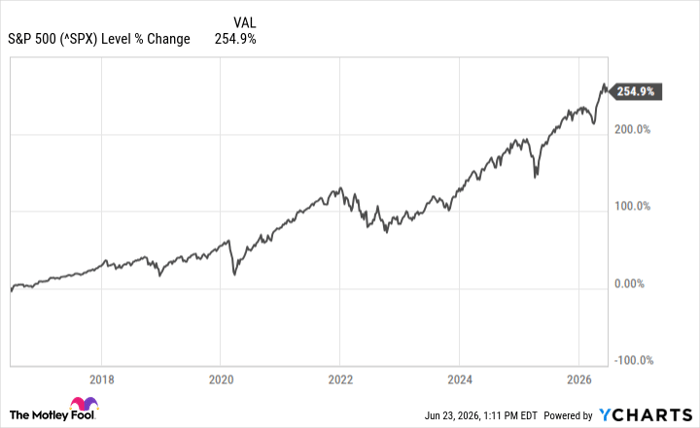
There are a couple of key changes that are worth noting, because while they seem modest, they could have significant ramifications for the S&P 500 (SNPINDEX: ^GSPC) and how it performs in the future.
Where to invest $1,000 right now? Our analyst team just revealed what they believe are the 10 best stocks to buy right now, when you join Stock Advisor. See the stocks »

Image source: Getty Images.
Guidance has been removed, and policy statements are shortened
As is often the case when companies report earnings, what's crucial for investors is the guidance and anticipating what might happen in the future. But under Warsh, the Fed will keep its cards close to its chest, and there will no longer be any forward guidance. And its policy statement will also be simplified and more brief, now around 130 words versus the 300-plus words it was before.
While these don't sound like earth-shattering changes, they give investors and analysts less information. And less information about the path forward means greater uncertainty and more question marks about what the Fed will do at future FOMC meetings. There will be a greater possibility that investors may be surprised by the Fed's announcements, which may result in greater volatility in the S&P 500 and the entire stock market.
^SPX data by YCharts
Why this could be great news for investors
If you're a long-term investor, then you don't have to worry about economic policies in the short run, because there can be a lot of noise within a span of a few months, even a year. What matters is the big picture, and that the stocks you invest in have solid fundamentals and can do well regardless of what happens with interest rates and Fed policy
At the same time, however, there could be more buying opportunities in the future. Traders and shorter-term investors may overreact to FOMC meetings and interest rate changes. And as that happens, quality stocks could become available at lower prices. Volatility can be a blessing in disguise, particularly if you're investing for the long haul, because buying stocks on short-term weakness can yield impressive results down the road.
This is why I suggest keeping not only a watch list of stocks you are considering buying, but also setting your own price targets for them that you'd buy them at, so that if they fall to those levels, even temporarily, you don't miss out on potentially fantastic buying opportunities.
Should you buy stock in S&P 500 Index right now?
Before you buy stock in S&P 500 Index, consider this:
The Motley Fool Stock Advisor analyst team just identified what they believe are the 10 best stocks for investors to buy now… and S&P 500 Index wasn’t one of them. The 10 stocks that made the cut could produce monster returns in the coming years.
Consider when Netflix made this list on December 17, 2004... if you invested $1,000 at the time of our recommendation, you’d have $393,037!* Or when Nvidia made this list on April 15, 2005... if you invested $1,000 at the time of our recommendation, you’d have $1,280,627!*
Now, it’s worth noting Stock Advisor’s total average return is 913% — a market-crushing outperformance compared to 208% for the S&P 500. Don't miss the latest top 10 list, available with Stock Advisor, and join an investing community built by individual investors for individual investors.
See the 10 stocks »
*Stock Advisor returns as of June 24, 2026.
David Jagielski, CPA has no position in any of the stocks mentioned. The Motley Fool has no position in any of the stocks mentioned. The Motley Fool has a disclosure policy.
Recommended Articles


