


First Post-Listing Earnings Disappoint: Cerebras Shares Fall Nearly 11% After-Hours, Deteriorating Profitability Sparks Concern
TradingKey - On June 23, Eastern Time, AI chipmaker Cerebras Systems ( CBRS) released its first earnings report since going public. Although its revenue significantly beat expectations, a bleak profitability outlook still caused the stock price to plunge in after-hours trading.
Cerebras' first-quarter core revenue surged 94% year-over-year to $193.4 million, far exceeding the $181.2 million expected by FactSet analysts. The midpoint of its full-year revenue guidance reached $860 million, representing a 69% annual growth rate, which was also higher than the market consensus of $825 million.
Chief Financial Officer Bob Komin stated that the first-quarter results "highlight the massive and rapidly growing market opportunity ahead of the company," adding that the firm is focused on "continuing to innovate at the pace of demand, supporting accelerated investments in growth, while effectively managing the capital structure."
The company, viewed as a potential challenger to Nvidia, debuted on the Nasdaq in May at an IPO price of $185. On its first trading day, the stock skyrocketed over 100% at one point, triggering a circuit breaker, before finally closing up 68% at $311.07.
In regular trading on Tuesday, Cerebras bucked the trend to close up at $226.72, representing a cumulative gain of 23% from its IPO price, completely ignoring a chip sector sell-off that saw the Philadelphia Semiconductor Index plunge 7.9%.
However, after the earnings release, market sentiment took a sharp downturn, with the post-market decline eventually settling at 11.33%, at $201.04.
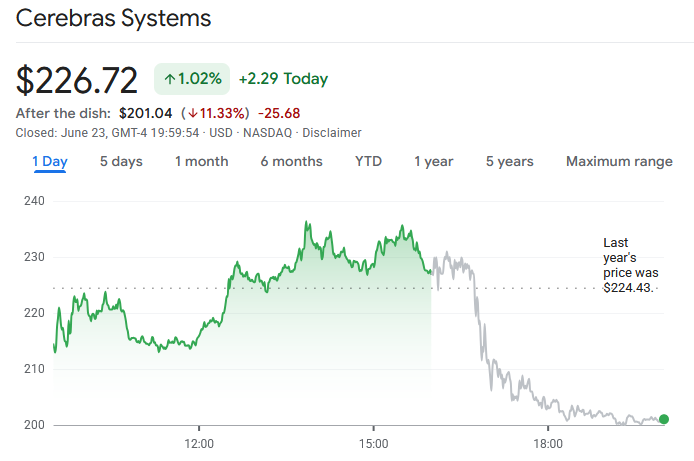
Source: Google Finance
Cerebras Faces Profitability Test
Deteriorating profitability has sparked investor concerns, as the company's latest guidance indicates that its second-quarter core gross margin will plunge to 36%-38% from 46.5% in the first quarter, while its full-year core operating margin is expected to remain in the range of -28% to -32%. Although revenue continues to grow rapidly, the outlook for improving profitability has become increasingly clouded.
As a potential challenger to Nvidia, Cerebras's core challenge lies in demonstrating to investors that its rapid revenue growth can translate into sustainable profitability. What investors expect to see is a clear and tangible path to profitability improvement.
In the current market environment, investors have grown accustomed to leading companies like Nvidia consistently beating earnings expectations, and revenue growth alone is no longer sufficient to support stock prices.
Cerebras continues to advance its footprint among major clients.
In January this year, Cerebras signed a multi-year compute procurement agreement with OpenAI valued at over $20 billion, under which OpenAI committed to purchasing 750 MW of AI inference compute, with an option to purchase an additional 1.25 GW. More notably, Cerebras is the only supplier supplying OpenAI on an upfront payment basis.
In addition, Cerebras has established a deep partnership with Amazon AWS in the inference space, and its WSE-3 chips have already entered Amazon Web Services data centers.
Cerebras's core competitive edge stems from its disruptive wafer-scale integration technology. In stark contrast to traditional chip manufacturing, which cuts an entire wafer into dozens or even hundreds of small dies, this Silicon Valley startup directly builds a single AI processor from an entire 12-inch wafer, completely shattering the physical boundaries of traditional chips.
In its June 8 report, Mizuho Bank noted that the SRAM memory capacity integrated on Cerebras's chips far exceeds that of Google's latest Tensor Processing Units, Nvidia's [chips] released in March, and Groq 3 LPU chips, providing it with an unparalleled performance advantage when running large AI models.
However, Cerebras also faces unique growth challenges. In an interview before the earnings release, CEO Andrew Feldman admitted that the biggest factor currently constraining the company's expansion is not technology, but rather the scarcity of physical space in data centers. He noted somewhat ironically: "A wonderful irony is that after we and Nvidia invented all this technology, buildings are the limiting factor."
Recommended Articles


