


Fed Tightening Ahead? This Dividend ETF Offers Protection.
Key Points
The Fidelity Dividend ETF For Rising Rates is an ETF can benefit investors if the Fed turns hawkish.
That's important because signs are pointing to a possible 2026 rate hike.
The ETF did its job in 2022 when rates soared.
- 10 stocks we like better than Fidelity Covington Trust - Fidelity Dividend ETF For Rising Rates ›
The first Federal Reserve meeting under new Chairman Kevin Warsh came and went with the central bank, as expected, not changing rates. But something potentially ominous is brewing beneath the surface of the no-change headlines.
Half of Fed officials polled expect the fed funds rate to exceed the current range of 3.5% to 3.75% by the end of this year. On predictions market operator Kalshi, fewer than one in five traders expect the Fed to cut rates this year, but nearly two-thirds are buying contracts that "win" if the central bank hikes before 2027. Translation: Odds of a rate hike are shortening while odds of a cut are getting longer.
Where to invest $1,000 right now? Our analyst team just revealed what they believe are the 10 best stocks to buy right now, when you join Stock Advisor. See the stocks »
This dividend ETF could offer shelter from a rising rates storm. Image source: Getty Images.
Investors often interpret higher interest rates as a negative sign, but some dividend stocks not only survive Fed tightening, they thrive. The Fidelity Dividend ETF For Rising Rates (NYSEMKT: FDRR) provides access to a broad basket of such names.
FDRR does its job
This $727.6 million ETF debuted in September 2016. While that's not ancient in ETF terms, the fund has been around for two Fed tightening regimes. The first was the seven-hike span, which ran from March 2017 to December 2018. The other was another round of seven rate increases in 2022, followed by a few more the following year.
So yes, the Fidelity ETF is battle-tested. Add to that the fact that it does its job, which is to protect against rising rates while helping investors remain engaged with equities during those tightening environments. There were other factors at play in 2018, when the dividend ETF performed worse than the S&P 500. Nonetheless, the Fidelity fund repeated that feat when rates spiked in 2022.
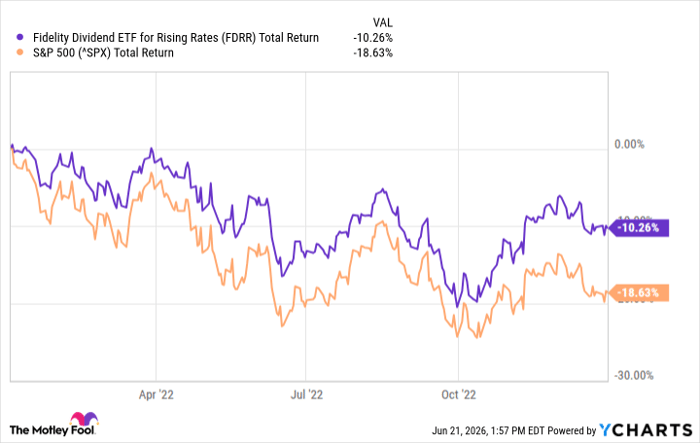
Data by YCharts.
So while the ETF didn't rise during a trying market environment, its drawdown was significantly shallower than the broader market's. That's crucial because drawdown math is brutal. If a $100 stock or ETF is cut in half, it needs to double for an investor to just break even.
For long-term investors, there's even more good news with this Fidelity ETF. The fund isn't dependent on rates rising to strut its stuff. This ETF has a knack for outpacing both the Russell 1000 Value Index and its peer group.
Why FDRR works when rates rise
This ETF has a trailing-12-month distribution rate of 2.2%, and while that's about double the dividend yield on the S&P 500, it's not so high as to imply dependence on high-yield dividend stocks that may be payout offenders.
That's to say some of this fund's advantages are derived from its sector allocations. It has no exposure to real estate equities and a scant position in utility stocks, both of which are important because those are capital-intensive sectors that are often punished by rising rates.
On the other hand, the ETF devotes 36.5% of its weight to tech stocks. That group isn't exactly rate-insensitive, but the sector's strong balance sheets provide some buffer against Fed tightening.
One more perk with this Fidelity ETF and one pertinent to frugal, long-term investors. The expense ratio is just 0.15% per year, or $15 on a $10,000 stake, making it one of the cheaper large-cap value ETFs on the market while putting it far below the category's median annual fee of 0.75%.
Should you buy stock in Fidelity Covington Trust - Fidelity Dividend ETF For Rising Rates right now?
Before you buy stock in Fidelity Covington Trust - Fidelity Dividend ETF For Rising Rates, consider this:
The Motley Fool Stock Advisor analyst team just identified what they believe are the 10 best stocks for investors to buy now… and Fidelity Covington Trust - Fidelity Dividend ETF For Rising Rates wasn’t one of them. The 10 stocks that made the cut could produce monster returns in the coming years.
Consider when Netflix made this list on December 17, 2004... if you invested $1,000 at the time of our recommendation, you’d have $393,037!* Or when Nvidia made this list on April 15, 2005... if you invested $1,000 at the time of our recommendation, you’d have $1,280,627!*
Now, it’s worth noting Stock Advisor’s total average return is 913% — a market-crushing outperformance compared to 208% for the S&P 500. Don't miss the latest top 10 list, available with Stock Advisor, and join an investing community built by individual investors for individual investors.
See the 10 stocks »
*Stock Advisor returns as of June 23, 2026.
Todd Shriber has no position in any of the stocks mentioned. The Motley Fool has no position in any of the stocks mentioned. The Motley Fool has a disclosure policy.
Recommended Articles


