


1 No-Brainer S&P 500 ETF to Buy Right Now for Less Than $500
Key Points
The Vanguard S&P 500 Growth ETF focuses on the S&P 500 growth stocks.
It's home to a slew of familiar names.
Its shares were recently split, making the stock's price tag more affordable, and it has a low fee.
- 10 stocks we like better than Vanguard Admiral Funds - Vanguard S&P 500 Growth ETF ›
The S&P 500 (SNPINDEX: ^GSPC) index is the most widely observed gauge of U.S. stocks, and one reason so many investors pay close attention to it is that it's easy to understand. It's home to 500 -- well, 503, to be precise -- of the leading U.S.-listed stocks, based on multiple criteria that ensure broad representation across the economy.
An easy-to-understand investment objective likely goes a long way toward explaining why the three largest exchange-traded funds (ETFs) listed in the U.S. all track the S&P 500. Still, it should be noted that there are other spins on the venerable index, including growth and value interpretations, among others.
Will AI create the world's first trillionaire? Our team just released a report on the one little-known company, called an "Indispensable Monopoly" providing the critical technology Nvidia and Intel both need. Continue »
This Vanguard ETF focuses on the S&P 500's growth names. Image source: Getty Images.
So let's meet one of the leaders in the S&P 500 Growth Index camp, the Vanguard S&P 500 Growth ETF (NYSEMKT: VOOG). This growth fund is a valid consideration for new investors and those with small stakes. Part of the reason for that is that Vanguard split the ETF's shares on a 6-for-1 basis in April, driving its price tag down, meaning $500 buys more than six shares based on the June 12 closing price of $81.15.
What investors get with this Vanguard ETF
As with a traditional S&P 500 ETF, this Vanguard growth ETF is easy to understand. It's home to 146 S&P 500 members that also meet certain growth standards. S&P Dow Jones Indices, the index provider, makes clear what those criteria are: momentum, the ratio of earnings change to price, and top-line growth.
Like its broader counterpart, this Vanguard ETF is market-cap-weighted, so Nvidia is its largest component. As of the end of April, the semiconductor stock commanded 14.6% of the growth ETF's weight, or about 550 basis points more than the weight assigned to Microsoft, the ETF's second-largest holding.
That gets into another need-to-know for newer investors. Whether it's this Vanguard ETF or another dedicated growth fund, market participants are likely to encounter above-average exposure to growth sectors. This Vanguard ETF allocates 68.8% of its portfolio to technology and communication services stocks, but those sectors combine for "just" 47.5% of the traditional S&P 500.
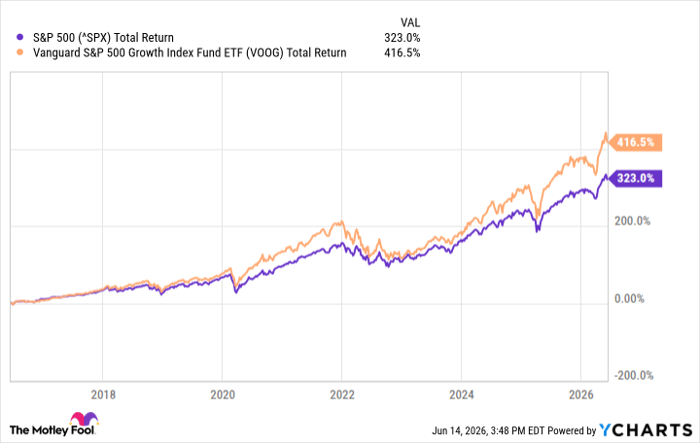
Data by YCharts.
As the chart above shows, this ETF's outsize exposure to tech stocks paid off over the past decade, as the fund easily outpaced the basic S&P 500. That doesn't mean investors can ignore potential risks. If value stocks come back into fashion in a big way, growth funds, including this Vanguard offering, could lag. Worse yet, if tech stocks enter a bear market, this ETF and its peers are likely to perform worse than the S&P 500 overall.
More pros than cons with this Vanguard ETF
Even when accounting for those risks, there's still a lot to like with this Vanguard ETF. For investors new to the game or those with smaller accounts, this fund is a solid choice. Likewise, it's a fine idea for any investor seeking megacap growth exposure without having to select individual stocks.
It's also a credible option for market participants seeking exposure to artificial intelligence (AI), as eight of the fund's top 10 holdings are either AI enablers or hyperscalers.
The Vanguard S&P 500 Growth ETF is a consideration for long-term investors seeking an aggressive but cost-effective position. The fund's annual expense ratio is 0.07%, or $7 in fees on a $10,000 stake. That compares very well with the average fee of 0.9% charged by competing funds.
Should you buy stock in Vanguard Admiral Funds - Vanguard S&P 500 Growth ETF right now?
Before you buy stock in Vanguard Admiral Funds - Vanguard S&P 500 Growth ETF, consider this:
The Motley Fool Stock Advisor analyst team just identified what they believe are the 10 best stocks for investors to buy now… and Vanguard Admiral Funds - Vanguard S&P 500 Growth ETF wasn’t one of them. The 10 stocks that made the cut could produce monster returns in the coming years.
Consider when Netflix made this list on December 17, 2004... if you invested $1,000 at the time of our recommendation, you’d have $440,440!* Or when Nvidia made this list on April 15, 2005... if you invested $1,000 at the time of our recommendation, you’d have $1,303,950!*
Now, it’s worth noting Stock Advisor’s total average return is 959% — a market-crushing outperformance compared to 211% for the S&P 500. Don't miss the latest top 10 list, available with Stock Advisor, and join an investing community built by individual investors for individual investors.
See the 10 stocks »
*Stock Advisor returns as of June 16, 2026.
Todd Shriber has no position in any of the stocks mentioned. The Motley Fool has positions in and recommends Microsoft and Nvidia. The Motley Fool has a disclosure policy.
Recommended Articles


