


The SpaceX IPO Just Handed Wall Street's Big Banks a Huge Payday. Here's What It Means for Their Stocks.
Key Points
SpaceX's IPO likely paid the highest underwriting fees on record.
The hot IPO has returned, with OpenAI and Anthropic filing for later this year.
High IPO activity is boosting investment bank performance.
- 10 stocks we like better than Goldman Sachs Group ›
SpaceX stock has finally gone public with the biggest initial public offering (IPO) ever, with a $75 billion share sale. The underwriting investment banks have made a fortune off the deal, even though their percentage payment was lower than usual.
The typical IPO pays 4% to 7% of gross IPO proceeds to the underwriters, going lower as the IPO size increases. According to PwC, IPOs worth $1 billion and up pay 4%, but SpaceX raised $75 billion, and according to reports, it paid 0.75% as an underwriting fee, worth $560 million.
Will AI create the world's first trillionaire? Our team just released a report on the one little-known company, called an "Indispensable Monopoly" providing the critical technology Nvidia and Intel both need. Continue »

Image source: Getty Images.
That's still the largest sum ever paid out in an IPO, and it's a huge payday for the investment banks involved in the deal. But the implications are more far-reaching than the amount that lands in their coffers.
The hot IPO returns
Before the 2022 bear market retreat, there were record IPO volumes two years in a row, driven by a strong bull market and the emergence of special purpose acquisition companies (SPACs). There were more than 1,000 IPOs in 2021, more than double 2020's record. The 2022 slump put the IPO train on hold, and there's been muted IPO interest since then, with just about a handful of highly anticipated IPOs each year.
Although there have been only 172 IPOs so far this year, including SpaceX, several IPOs or IPO filings of note have emerged, including Cerebras Systems, which went public in May, and the anticipated OpenAI and Anthropic IPOs.
IPOs are one way investment banks make money. They take care of the IPO process, getting the stock to the market, and marketing shares to their institutional wealth clients. IPOs are an important part of boosting revenue and creating an in-house cycle of business momentum as they attract investment partners and accounts.
Goldman Sachs (NYSE: GS) is the largest investment bank in the U.S., and it got the lead position in the SpaceX offering. Morgan Stanley (NYSE: MS) got second billing, while Bank of America (NYSE: BAC), Citigroup (NYSE: C), and JPMorgan Chase (NYSE: JPM) were part of the primary underwriting group. Altogether, there were 23 banks involved in the IPO.
Besides the initial underwriting fee, the banks get what's called an over-allotment of 15% if the demand is too high for the supply. Reports have indicated that the IPO was four times oversubscribed, suggesting there was about $250 billion in investor orders. This means that SpaceX, instead of the original 555.6 million shares planned for the IPO, sold the entire 15% reserve, meaning the company actually sold 683 million shares worth $86 billion.
Riding the IPO wave
Bank stocks as a group haven't been doing well this year. The S&P 500 bank index is little changed year to date, while the benchmark index is up about 8%, but the investment banks are doing much better than the consumer banks. Goldman Sachs tried its hand at consumer banking with the ill-fated Marcus venture that closed its doors, but investment banking is its bread and butter. Morgan Stanley is similar, although it offers consumer banking products through E*TRADE by Morgan Stanley. Both of these stocks are outperforming this year, while BofA and JPMorgan Chase are underperforming.
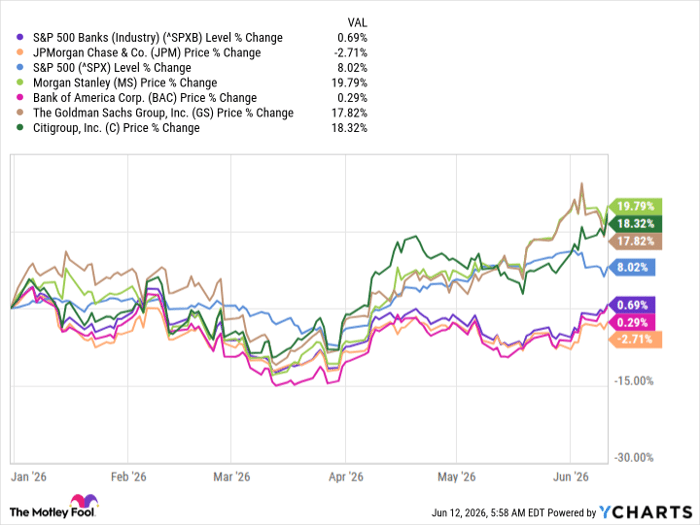
^SPXB data by YCharts
Bank stocks in general follow broader economic trends, and there are concerns about higher default rates as interest rates stay high within consumer banks, such as Bank of America. The positive jobs report last week sent the S&P 500 lower, and banks have acute exposure to potential rate increases.
Soaring IPOs and underwriting activity are leading to renewed confidence in investment banks, though. Goldman's investment banking fees rose 48% year over year in the first quarter to $2.8 billion, and Morgan Stanley's were up 24% to $396 million. JPMorgan Chase's were up 29% to $2.9 billion, but that was eclipsed by its other businesses.
New, large IPOs like Anthropic and OpenAI could continue to drive higher stock gains for investment banks in the near term. They're among the most important beneficiaries of the offerings, since IPOs qualitatively and quantitatively affect their fundamentals.
Over the long term, stable and growing investment banks are a key element of a thriving economy, which is why they offer value to investors.
Should you buy stock in Goldman Sachs Group right now?
Before you buy stock in Goldman Sachs Group, consider this:
The Motley Fool Stock Advisor analyst team just identified what they believe are the 10 best stocks for investors to buy now… and Goldman Sachs Group wasn’t one of them. The 10 stocks that made the cut could produce monster returns in the coming years.
Consider when Netflix made this list on December 17, 2004... if you invested $1,000 at the time of our recommendation, you’d have $433,268!* Or when Nvidia made this list on April 15, 2005... if you invested $1,000 at the time of our recommendation, you’d have $1,259,391!*
Now, it’s worth noting Stock Advisor’s total average return is 935% — a market-crushing outperformance compared to 207% for the S&P 500. Don't miss the latest top 10 list, available with Stock Advisor, and join an investing community built by individual investors for individual investors.
See the 10 stocks »
*Stock Advisor returns as of June 16, 2026.
Bank of America is an advertising partner of Motley Fool Money. Citigroup is an advertising partner of Motley Fool Money. JPMorgan Chase is an advertising partner of Motley Fool Money. Jennifer Saibil has no position in any of the stocks mentioned. The Motley Fool has positions in and recommends Goldman Sachs Group and JPMorgan Chase. The Motley Fool has a disclosure policy.
Recommended Articles


