


4 Stocks That Can Fund Decades of Passive Income -- Buy Them While They're Down
Key Points
Prominent consumer stocks don't typically fall much without facing adversity.
Nike, PepsiCo, Hershey, and Kimberly-Clark fall into that category today.
While there are risks, each stock offers a promising outlook for dividend-focused investors.
- 10 stocks we like better than Nike ›
There's only so much money to go around on Wall Street, so when some stocks go up, something else is usually going down. Investors have been all about technology and artificial intelligence stocks for the past several years, leaving some iconic consumer brand companies in the dust.
These four consumer stocks have rich histories of paying dividends and survived the test of time. They have all fallen 26% to 74% from their all-time highs. Sure, some of these companies have issues, but renowned brands don't typically drop without some adversity.
Will AI create the world's first trillionaire? Our team just released a report on the one little-known company, called an "Indispensable Monopoly" providing the critical technology Nvidia and Intel both need. Continue »
Here's why investors can buy each one while they're still down, and reasonably expect the dividends to continue pouring in for years to come.
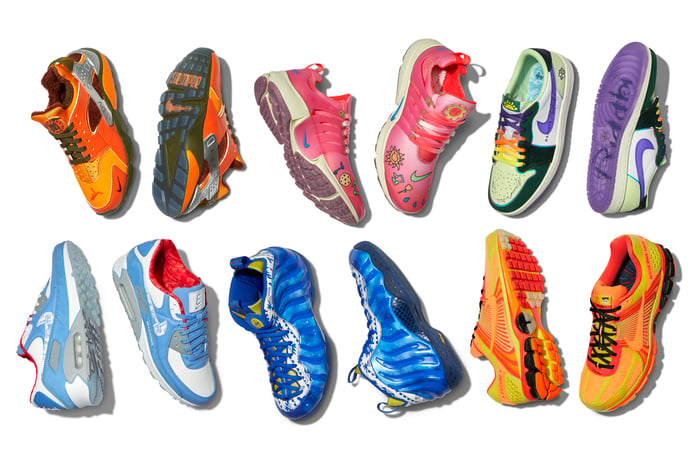
Image source: Nike.
1. Nike
Down 74%
Sporting apparel giant Nike (NYSE: NKE) has struggled for several years. Its misguided direct-to-consumer strategy opened the door for competitors and prompted Nike to fire its CEO in late 2024. Current CEO and longtime company veteran Elliott Hill is working to get Nike's wholesale relationships and product innovation back on track. China has remained a difficult market for Nike, and the stock has continued to grind lower from its 2021 high.
That said, Nike is still the top dog in the world of sports apparel. Although the company has paid and raised its dividend for 24 consecutive years, Nike's earnings have deteriorated to a troubling extent amid its struggles. The stock is more risky now, but investors have a rare opportunity to buy Nike at a 3.6% dividend yield. A yield trap? Perhaps not. Analysts see Nike's earnings rebounding to $2.40 per share by the end of its next fiscal year, which would bring that dividend back to a safe place.
2. PepsiCo
Down 26%
Food and beverages never go out of style. That simple truth has made PepsiCo (NASDAQ: PEP) a Dividend King with 54 consecutive annual increases. The company owns a vast portfolio of soda and snack food brands, including Pepsi, Mountain Dew, Gatorade, Lay's, Doritos, Cheetos, Quaker, and more. These are brands people recognize and tend to reach for in the grocery store. But despite the power of these brand names, PepsiCo has struggled to grow sales over the past couple of years.
The biggest culprit could be management, which raised prices too aggressively following the COVID-19 pandemic. PepsiCo has since realigned its pricing with consumer budgets and is seeing encouraging results. The stock is still well below its former high and trades at less than 17 times 2026 earnings estimates. It's an attractive valuation for a legendary dividend stock with a 4.1% dividend yield and analysts calling for 6% annualized earnings growth.
3. Hershey
Down 34%
Iconic confectionery giant Hershey (NYSE: HSY) is a staple of American chocolate. Consumers have faithfully bought its products for generations, but a severe cocoa shortage in recent years turned the company on its head. Soaring cocoa prices forced management to raise prices, while still crushing its profit margins. Hershey even had to refrain from raising its dividend last year, though it did hike the payout earlier this year.
Hershey brought in new CEO and President Kirk Tanner to replace Michele Buck, who retired last summer. Hershey will look for growth in salty snacks and nutrition bars, which are growing faster than the confectionery business. Hershey's traditionally steep valuation has fallen to roughly 21 times this year's earnings estimates. It's a fantastic entry point for investors looking for Hershey's core business to storm back as cocoa headwinds pass.
4. Kimberly-Clark
Down 35%
It's not every day you see a longtime blue chip company take a home run swing. But Kimberly-Clark (NASDAQ: KMB) is doing just that, merging with consumer staples peer Kenvue, a deal valued at $48.7 billion. Once the merger closes, the combined entity would be a global consumer products behemoth, with brands spanning across paper products, hygiene, infant care, and over-the-counter medicines -- staples people buy regardless of the economy.
So, why has the stock fallen? Such large mergers can be risky, as there are many moving parts to fit together. It could take years to strip out inefficiencies, cut costs, and so on. Plus, this deal is worth more than Kimberly-Clark's current market cap. On the plus side, both companies are Dividend Kings, so the combined entity will likely prioritize maintaining and growing the dividend. Investors may need to exercise patience, but Kimberly-Clark will pay a 5% dividend yield while the dust settles.
Should you buy stock in Nike right now?
Before you buy stock in Nike, consider this:
The Motley Fool Stock Advisor analyst team just identified what they believe are the 10 best stocks for investors to buy now… and Nike wasn’t one of them. The 10 stocks that made the cut could produce monster returns in the coming years.
Consider when Netflix made this list on December 17, 2004... if you invested $1,000 at the time of our recommendation, you’d have $433,268!* Or when Nvidia made this list on April 15, 2005... if you invested $1,000 at the time of our recommendation, you’d have $1,259,391!*
Now, it’s worth noting Stock Advisor’s total average return is 935% — a market-crushing outperformance compared to 207% for the S&P 500. Don't miss the latest top 10 list, available with Stock Advisor, and join an investing community built by individual investors for individual investors.
See the 10 stocks »
*Stock Advisor returns as of June 16, 2026.
Justin Pope has positions in PepsiCo. The Motley Fool has positions in and recommends Hershey, Kenvue, and Nike. The Motley Fool has a disclosure policy.
Recommended Articles


