


June 16 May be a Big Day for the Stock Market and Set the Stage for What Happens Next.
Key Points
The Federal Reserve meets on June 16 and 17 to consider the economic situation and potentially act on interest rates.
The last interest rate action took place in December, with a quarter-point decrease.
President Donald Trump criticized former Fed chair Jerome Powell for not cutting rates further.
- 10 stocks we like better than S&P 500 Index ›
The S&P 500's bull market has roared on in 2026, extending the gain of 78% over the past three calendar years. Investors, optimistic about the future of artificial intelligence (AI), have piled into tech giants, and the enthusiasm has spilled over into other growth sectors as well. The idea is that AI may help companies become more efficient and innovative, and save money -- and all of this is fantastic news for earnings growth over time.
But the S&P 500's path hasn't been completely smooth. In fact, various headwinds temporarily interrupted the momentum, from concern about the longevity of the AI revolution to worries about turmoil in Iran. This pushed the index to decline in the first quarter, though it's recently rebounded and is now heading for an increase of more than 8%.
Will AI create the world's first trillionaire? Our team just released a report on the one little-known company, called an "Indispensable Monopoly" providing the critical technology Nvidia and Intel both need. Continue »
Still, the jury is out when it comes to the index's performance for 2026. And this is because one particular headwind continues to weigh on investors' minds: the risk of rising inflation and an eventual interest rate hike to keep it under control. This is why June 16 may be a big day for the stock market -- and set the stage for what happens next.
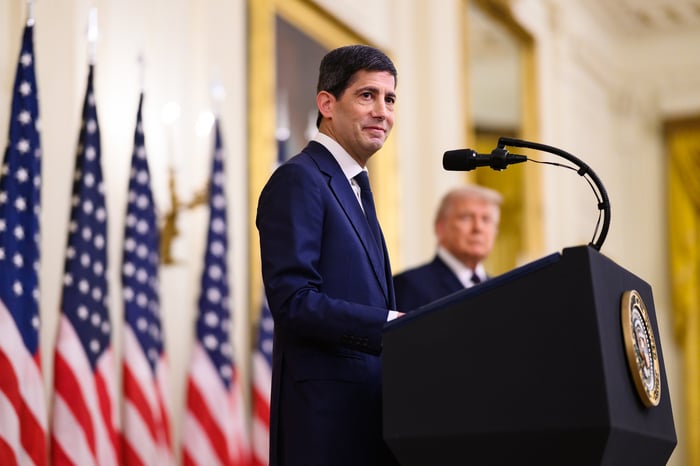
Image source: Official White House Photo by Daniel Torok.
Interest rates and inflation
So, first, let's look at the recent interest rate picture and the latest inflation report. To offer context, it's important to consider what's happened over the past few years. Rising inflation in 2022 prompted then Federal Reserve chair Jerome Powell to launch interest rate increases -- the move did its job of taming inflation, and Powell started lowering rates two years later. Though Powell continued to decrease rates by a quarter point during three of last year's meetings, including the one in December, President Donald Trump, calling for more rate cuts, criticized the Fed chief.
In recent times, an important shift has taken place -- one that makes June 16 a moment to watch. With Powell reaching the end of his term, Trump nominated Kevin Warsh to take on the role of Fed chair. And on June 16, Warsh will oversee his first Fed meeting in the role. The Federal Open Market Committee meets eight times a year to consider economic conditions and adjust monetary policy as needed.
Warsh has expressed views suggesting he might take a different path than the one Powell took. For example, Warsh has voiced his desire to reduce the Fed's balance sheet, which has soared to $6.6 trillion as the Fed made huge asset purchases to bolster the economy. The new Fed chair has also said the Fed has offered too many early forecasts -- and he might cut back that guidance.
Trump and rate cuts
As for interest rates, Trump may continue to champion the idea of cutting them -- but inflation data could complicate matters. Consumer prices rose 4.2% in May, according to recent data -- that's the highest in three years. So with inflation on the rise, policymakers may not favor cutting interest rates. In fact, CME Group's FedWatch predicts an interest rate increase during the December meeting.
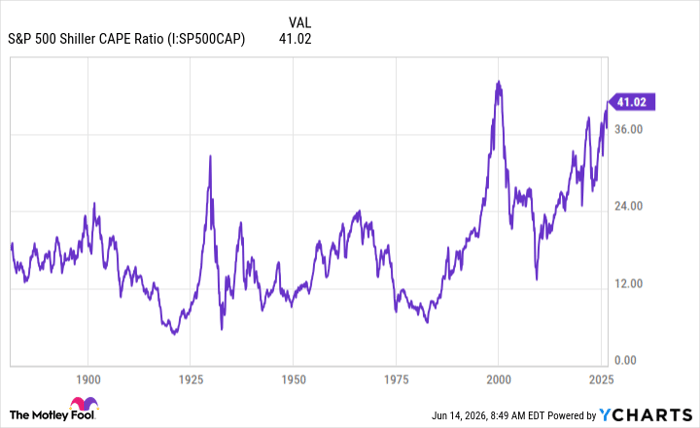
Considering all of this, what should we expect during the June 16 meeting? Forecasts suggest the Fed will leave rates unchanged this time around. But the meeting could offer Warsh a chance to share more details about his policies and suggest the direction the Fed might take in upcoming meetings. Any significant shifts, uncertainty, or signs that rate increases may indeed be on the horizon could weigh on the S&P 500, particularly given that stocks are historically expensive.
The S&P 500 Shiller CAPE ratio, an inflation-adjusted look at stock price in relation to earnings, has reached one of its highest levels on record.
S&P 500 Shiller CAPE Ratio data by YCharts
The good news is that, regardless of Warsh's message and the performance of the stock market over a few weeks or months, the Fed aims to maintain its dual mandate of balancing maximum employment and stable prices over time. So, while certain short-term decisions such as the increasing or cutting of rates may impact stocks in a negative or positive way -- this is temporary.
Over the long run, the Fed aims for a favorable economic environment, and this is fantastic for companies and their earnings prospects. All of this means that patient investors who hold onto quality stocks for at least five years are likely to weather any short-term storm and score an investing win.
Should you buy stock in S&P 500 Index right now?
Before you buy stock in S&P 500 Index, consider this:
The Motley Fool Stock Advisor analyst team just identified what they believe are the 10 best stocks for investors to buy now… and S&P 500 Index wasn’t one of them. The 10 stocks that made the cut could produce monster returns in the coming years.
Consider when Netflix made this list on December 17, 2004... if you invested $1,000 at the time of our recommendation, you’d have $433,268!* Or when Nvidia made this list on April 15, 2005... if you invested $1,000 at the time of our recommendation, you’d have $1,259,391!*
Now, it’s worth noting Stock Advisor’s total average return is 935% — a market-crushing outperformance compared to 207% for the S&P 500. Don't miss the latest top 10 list, available with Stock Advisor, and join an investing community built by individual investors for individual investors.
See the 10 stocks »
*Stock Advisor returns as of June 15, 2026.
Adria Cimino has no position in any of the stocks mentioned. The Motley Fool has no position in any of the stocks mentioned. The Motley Fool has a disclosure policy.
Recommended Articles


