


The 1 Sentence to Watch For in Next Week's Federal Reserve Statement
Key Points
The Fed has maintained a bias toward easing all year.
A strong labor market and rising inflation may change that next week.
- These 10 stocks could mint the next wave of millionaires ›
The Federal Reserve's monetary policy committee -- the Federal Open Market Committee (FOMC) -- meets next Tuesday and Wednesday, June 16-17, to discuss its next policy move.
We'll learn of any news from that meeting in the statement the FOMC issues on Wednesday afternoon at 2 p.m. ET.
Will AI create the world's first trillionaire? Our team just released a report on the one little-known company, called an "Indispensable Monopoly" providing the critical technology Nvidia and Intel both need. Continue »
The committee isn't expected to alter its target interest rate at the meeting. But something critical might happen, anyway. That critical news would be a change in the Fed's bias, from easing rates in the coming months to a neutral stance, or even a bias toward tightening, which could move markets significantly.
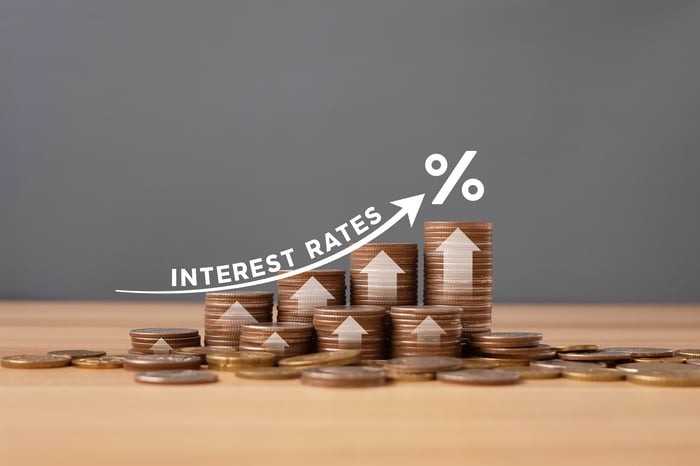
Image source: Getty Images.
For the past three meetings, the FOMC included the same exact sentence in its post-meeting statement. It is this: "In considering the extent and timing of additional adjustments to the target range for the federal funds rate, the Committee will carefully assess incoming data, the evolving outlook, and the balance of risks."
That may not sound like a strong bias toward a rate cut as the FOMC's next move, but it is. Because the last "adjustments" to the Fed's policy rate were cuts, "additional adjustments" implies changes in the same direction -- lower.
The market's interpretation of the sentence is that the next move for the Fed will be another rate cut -- and the Fed has not pushed back against that reading.
The economy has shifted toward rising inflation and strong job gains
Yet, the macroeconomic outlook has changed considerably in recent months. This week, we got the latest reading on inflation, the Consumer Price Index, and it was alarmingly high. Inflation rose 4.2% year over year in May, and by a bit less (2.9%) when volatile food and fuel prices were excluded from the calculation. Both numbers are well above the Fed's 2% inflation target.
In addition, last week brought the latest report on the employment situation, this one for May. The U.S. economy produced 172,000 net new jobs during the month, which is strong. That's not an anomaly. The three-month average of payroll gains is 188,000. In addition, the unemployment rate remains low at 4.3%. All those data points indicate that the labor market is very resilient right now.
The Fed's dual mandate suggests it should cut interest rates when inflation is tame and the labor market is struggling. But right now, it's the opposite: Inflation is surging, and the labor market is healthy. That suggests the next move for the FOMC should be a rate hike.
So, investors will be watching very closely to see if the FOMC cuts that easing bias sentence from next week's monetary policy statement. If the sentence is removed, it will be taken as a strong signal that the Fed is now prepared to increase its target interest rate in the coming months. That will likely send market indexes lower.
Where to invest $1,000 right now
When our analyst team has a stock tip, it can pay to listen. After all, Stock Advisor’s total average return is 926%* — a market-crushing outperformance compared to 203% for the S&P 500.
They just revealed what they believe are the 10 best stocks for investors to buy right now, available when you join Stock Advisor.
See the stocks »
*Stock Advisor returns as of June 11, 2026.
The Motley Fool has a disclosure policy.
Recommended Articles


