


Blockbuster Earnings but Shares Plunge Over 10%. Oracle Falls Below $180, Wall Street Panic Selling or Unjustified Selloff?
TradingKey - Oracle's massive capital expenditure triggers numerous risks, forcing investors to sell off shares in advance as a precaution.
During the pre-market session on June 11, Eastern Time, Oracle ( ORCL) plunged as much as 11%, hitting a low of $117, its lowest level since May 20. After the market closed yesterday, Oracle released earnings that exceeded expectations across the board; however, its capital expenditure guidance for the new fiscal year triggered market concerns.
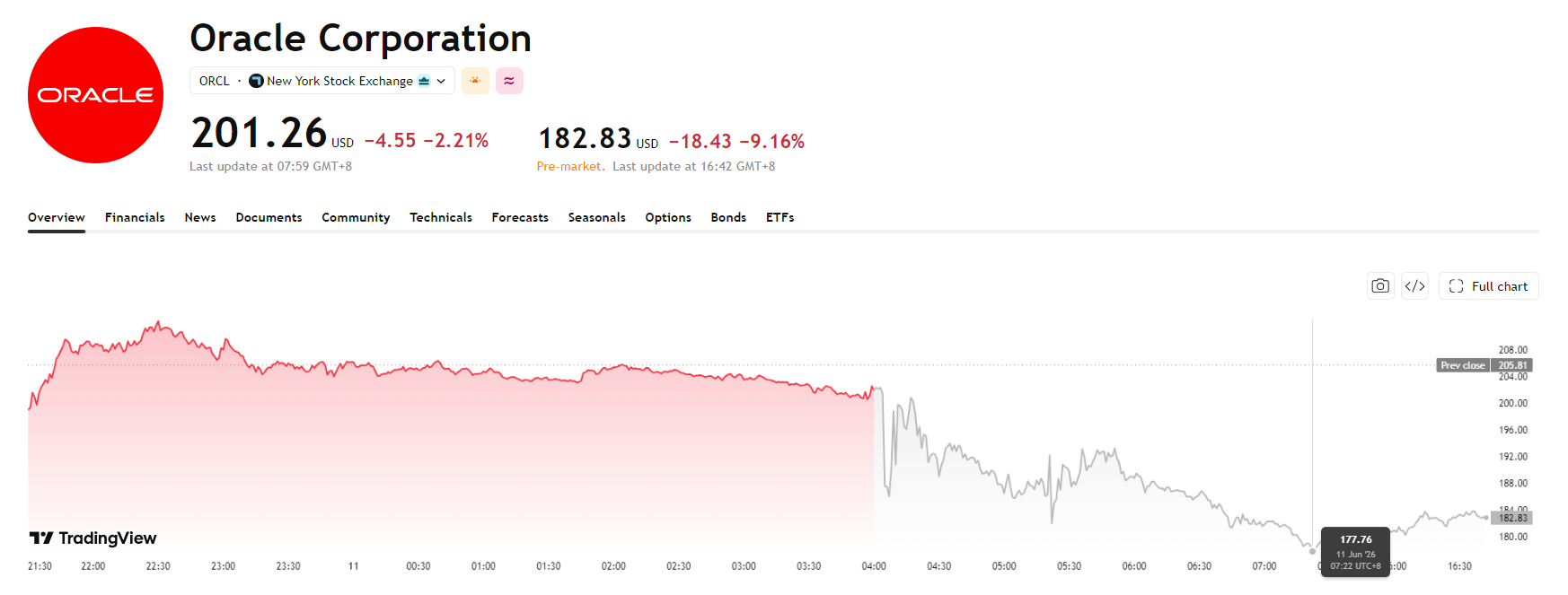
Oracle stock price chart, source: TradingView
According to financial report data, Oracle's fourth-quarter revenue for fiscal year 2026 reached $19.18 billion, slightly higher than the market expectation of $19 billion, while non-GAAP earnings per share (EPS) reached $2.11, significantly exceeding the analyst estimate of $1.89.
Unexpectedly, Oracle's total expenditure for fiscal year 2026 reached $55.7 billion, surpassing the previously estimated $50 billion. Even more startling is that the company expects total capital expenditure for fiscal year 2027 to soar to $95 billion (with net expenditure of approximately $70 billion after deducting customer prepayments), which is roughly 40% higher than the Wall Street estimate of $67.7 billion and nearly double the previous year's figure.
From a financial perspective, such aggressive capital expenditure by Oracle will inevitably have several negative impacts, which in turn will deal a significant blow to the stock price:
(1) Building AI data centers and purchasing Nvidia ( NVDA) chips require massive upfront cash payments, which will weaken cash flow. Under these circumstances, Oracle must issue debt or equity to sustain its heavy spending; the former increases fixed interest expenses, while the latter dilutes earnings per share and could even directly increase potential selling pressure in the market.
(2) Purchased servers and data centers are not immediately expensed but will be converted into depreciation expenses over the next three to five years, which will directly depress the company's net profit margin—a factor that will also be reflected in the stock price. In fact, the CFO has explicitly warned that 'with a large number of new data centers coming online, gross margins in fiscal year 2027 will see a structural decline.'
Furthermore, Oracle's massive capital expenditure could trigger non-financial risks, such as a credit rating downgrade by S&P or Moody's. Moreover, should an AI bubble actually burst, Oracle may face risks of overcapacity and rapid hardware depreciation, both of which would further suppress the stock price. Faced with these risks, Oracle investors are being forced to sell off shares in advance to mitigate potential losses.
Recommended Articles


