


If I Could Own Only 3 ETFs for the Next Decade, It Would Be These
Key Points
Picking individual stock winners can be time-consuming, exhausting, and challenging.
Sometimes the simplest solutions are the best ones.
Investing in just a few equity ETFs can give you a diversified, buy-and-hold portfolio that simply relies on long-term economic growth.
- 10 stocks we like better than Vanguard Total Stock Market ETF ›
Investing doesn't need to be that complicated. Instead of trying to pick dozens of winning stocks to fill out your portfolio, it's easier to choose a couple of logical long-term themes and buy the exchange-traded fund (ETF) that best targets them.
I think a great portfolio for someone who doesn't want to overthink things and keep it simple includes three ETFs. One for U.S. stocks, one for international stocks, and one for dividend stocks. It doesn't need to be more complex than that. The first two give you comprehensive coverage of the entire global equity market. The third provides extra exposure to a proven strategy that fits in almost any portfolio.
Will AI create the world's first trillionaire? Our team just released a report on the one little-known company, called an "Indispensable Monopoly" providing the critical technology Nvidia and Intel both need. Continue »
Here are the three ETFs I'd use today to build this portfolio.
Image source: Getty Images.
Vanguard Total Stock Market ETF
The Vanguard Total Stock Market ETF (NYSEMKT: VTI) is the best way to invest in the entire investable U.S. equity market. It's more expansive than just the S&P 500 (SNPINDEX: ^GSPC) by including roughly 3,000 additional mid- and small-cap stocks. Its 0.03% expense ratio means it costs next to nothing to own.
Vanguard Total International Stock ETF
The Vanguard Total International Stock ETF (NASDAQ: VXUS) is essentially the equivalent of the Vanguard Total Stock Market ETF, but for non-U.S. stocks. It holds an extraordinary 8,700 stocks, with a split of roughly 75% developed-market stocks and 25% emerging-market stocks. It has an expense ratio of just 0.05%.
Schwab U.S. Dividend Equity ETF
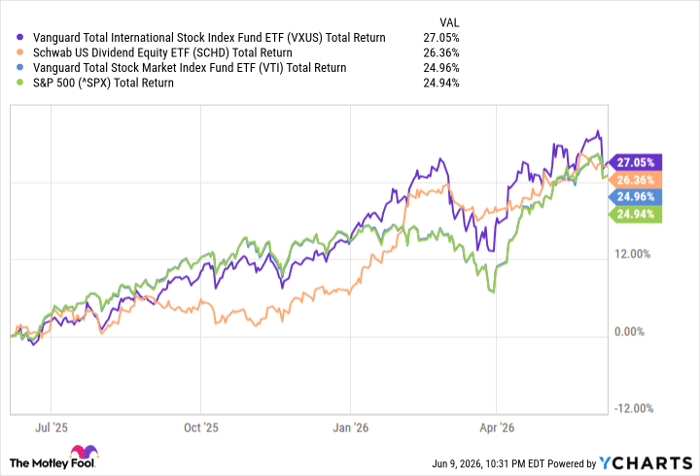
The Schwab U.S. Dividend Equity ETF (NYSEMKT: SCHD) uses a three-tier strategy that selects stocks based on their dividend history, the balance sheet health of the issuing company, and the stock's yield. By considering all of these factors, it's able to identify and invest in some of the best dividend stocks in the United States. It has a 0.06% expense ratio and a 3.3% dividend yield.
Data by YCharts.
A great combination
Combining the two Vanguard ETFs gives you what may be the simplest long-term investment strategy there is. Just buy the entire stock market and invest in the global economic growth story. By doing this, you would essentially own one of the cheapest long-term wealth creation machines in the markets.
The addition of the Schwab U.S. Dividend Equity ETF provides exposure to some of the most durable and financially healthy companies in the world. Plus, the high dividend yield provides an important source of income that can help offset share price losses in down markets.
The combination of these three ETFs would give you one of the best buy-and-hold portfolios available. It's got ultra-low fees, broad diversification, and the kind of exposure built to compound and grow over time.
Should you buy stock in Vanguard Total Stock Market ETF right now?
Before you buy stock in Vanguard Total Stock Market ETF, consider this:
The Motley Fool Stock Advisor analyst team just identified what they believe are the 10 best stocks for investors to buy now… and Vanguard Total Stock Market ETF wasn’t one of them. The 10 stocks that made the cut could produce monster returns in the coming years.
Consider when Netflix made this list on December 17, 2004... if you invested $1,000 at the time of our recommendation, you’d have $439,038!* Or when Nvidia made this list on April 15, 2005... if you invested $1,000 at the time of our recommendation, you’d have $1,277,804!*
Now, it’s worth noting Stock Advisor’s total average return is 942% — a market-crushing outperformance compared to 206% for the S&P 500. Don't miss the latest top 10 list, available with Stock Advisor, and join an investing community built by individual investors for individual investors.
See the 10 stocks »
*Stock Advisor returns as of June 11, 2026.
David Dierking has positions in Schwab U.S. Dividend Equity ETF, Vanguard Total International Stock ETF, and Vanguard Total Stock Market ETF. The Motley Fool has no position in any of the stocks mentioned. The Motley Fool has a disclosure policy.
Recommended Articles


