


SpaceX Is Going Public at a $1.77 Trillion Valuation. Here's What a $10,000 Investment Could Return.
Key Points
SpaceX will be valued at nearly 100 times sales when it goes public.
It could generate disappointing returns in the first year.
- 10 stocks we like better than Space Exploration Technologies ›
SpaceX (NASDAQ: SPCX), the aerospace and AI company founded by Elon Musk, will go public on June 12. It's set the IPO price at $135 per share and aims to raise $75 billion, valuing the company at about $1.77 trillion and making it the biggest IPO in history.
The IPO is already more than four times oversubscribed, suggesting it will start trading at an even higher price. So what could a $10,000 investment in SpaceX's IPO be worth in a year?
Will AI create the world's first trillionaire? Our team just released a report on the one little-known company, called an "Indispensable Monopoly" providing the critical technology Nvidia and Intel both need. Continue »
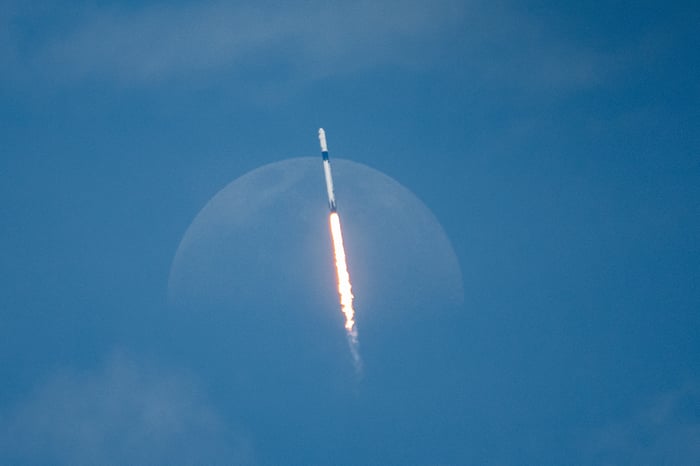
Image source: Getty Images.
The biggest problems with SpaceX's IPO
At its target valuation, SpaceX would trade at 95 times its 2025 revenue of $18.67 billion. That represented 33% growth from 2024, but it's still a lofty price-to-sales ratio.
SpaceX generates most of its revenue and all of its operating profits from Starlink. Its space division, which produces its Falcon rockets, is still unprofitable. Last year, SpaceX squeezed out a profit by using Starlink's profits to offset the space division's losses.
But this year, it integrated xAI (which owns X and Grok) into SpaceX as its new AI division. The AI division's massive losses ($4.3 billion in the first quarter of 2025) wiped out Starlink's profits. SpaceX plans to ramp up its AI investments after its public debut, which implies it will remain unprofitable for the foreseeable future. That's probably why it's so eager to raise fresh cash.
SpaceX is also offering less than 5% of its shares in its IPO, which shields Musk from big investors and allows him to maintain an 82% voting stake in the company. It's also allocating up to 30% of its shares to retail investors -- which indicates it's intentionally targeting the same "meme stock" investors that gobbled up stocks like GameStop.
How much will a $10,000 investment in SpaceX grow?
All of these issues are preventing me from chasing SpaceX's IPO. Instead, I think it's smarter to stick with its smaller peers -- like AST SpaceMobile and Rocket Lab -- until the smoke clears.
I believe SpaceX's stock will briefly skyrocket after its public debut, but then pull back as its IPO investors flip it for a quick profit. After that, the stock will likely stagnate and slump lower as it's revalued at a more sustainable price-to-sales ratio.
Let's assume SpaceX grows its revenue by 30% to $24.3 billion in 2026 and by another 30% to $31.5 billion in 2027. Even if it trades at a frothy 50 times its current-year sales by June 2027, its market cap would still be only $1.58 trillion -- an 11% decline from its target valuation.
Therefore, I expect a $10,000 investment in SpaceX's IPO to be worth less in a year. It might eventually bounce back, but too much growth has already been baked into its stock.
Should you buy stock in Space Exploration Technologies right now?
Before you buy stock in Space Exploration Technologies, consider this:
The Motley Fool Stock Advisor analyst team just identified what they believe are the 10 best stocks for investors to buy now… and Space Exploration Technologies wasn’t one of them. The 10 stocks that made the cut could produce monster returns in the coming years.
Consider when Netflix made this list on December 17, 2004... if you invested $1,000 at the time of our recommendation, you’d have $439,038!* Or when Nvidia made this list on April 15, 2005... if you invested $1,000 at the time of our recommendation, you’d have $1,277,804!*
Now, it’s worth noting Stock Advisor’s total average return is 942% — a market-crushing outperformance compared to 206% for the S&P 500. Don't miss the latest top 10 list, available with Stock Advisor, and join an investing community built by individual investors for individual investors.
See the 10 stocks »
*Stock Advisor returns as of June 10, 2026.
Leo Sun has no position in any of the stocks mentioned. The Motley Fool has positions in and recommends AST SpaceMobile and Rocket Lab. The Motley Fool has a disclosure policy.
Recommended Articles


