


Samsung and Nvidia Partnership Upgrade: HBM4E, HBM5 and Autonomous Driving Chip Foundry Enter Substantial Discussions
TradingKey - On June 8, Seoul time, Jun Young-hyun, head of Samsung Electronics' chip division, stated that the company has held extensive discussions with NVIDIA ( NVDA) CEO Jensen Huang regarding foundry cooperation for next-generation chips and future technologies such as HBM4E and HBM5. The two sides are collaborating on autonomous driving chips for 4nm and 8nm nodes, as well as NVIDIA's accelerator chip segment.
Just before the meeting, NVIDIA confirmed that the three memory giants—Samsung Electronics, SK Hynix, and Micron ( MU) Technology—have all passed HBM4 qualification and entered the mass production phase, and will supply HBM4 for NVIDIA's next-generation AI platform, Vera Rubin. Vera Rubin is now in full production, with deliveries scheduled to begin in the third quarter of this year.
From HBM4 to HBM5: Samsung Accelerates Strategic Positioning
Jun Young-hyun revealed that the two parties held in-depth discussions regarding long-term cooperation plans for HBM4E and HBM5. Samsung Electronics was the first in the world to mass-produce sixth-generation HBM4 in February this year, subsequently supplying seventh-generation HBM4E 12-layer samples to global customers in late May, taking only about three months from HBM4 mass production to HBM4E sample shipment.
Samsung officially disclosed that HBM4E achieves a maximum per-pin transfer speed of up to 16Gbps and a total bandwidth of 4TB/s per stack, and is expected to be equipped in NVIDIA's next-generation AI accelerators, such as the Vera Rubin Ultra, to be launched in the second half of next year.
At Computex Taipei 2026, Samsung showcased the eighth-generation HBM5 for the first time, and the built-in thermal solution for the accompanying HPB packaging has already completed field validation on HBM4E.
KB Securities analyst Lee Seung-woo previously projected that if Samsung secures an HBM4E supply agreement from NVIDIA, it could generate $8 billion to $10 billion in annual revenue for Samsung's memory business.
Foundry cooperation expected to expand
Currently, the U.S. AI inference chip unicorn Groq has commissioned Samsung to produce the Groq 3 LPU using its 4nm process. Han Jin-man, President of Samsung Foundry, stated, "Our 4nm process is by no means inferior." The two parties have discussed long-term cooperation, and the market expects Samsung to secure more AI chip foundry orders at 3nm and 2nm nodes in the future.
At the latest GTC conference, NVIDIA integrated the Groq 3 LPU into its Vera Rubin platform to create a "GPU+LPU" heterogeneous inference solution. During his visit to South Korea, CEO Jensen Huang emphasized that memory chip supply shortages will persist for several years, noting that "the entire industry supply chain, from wafers and packaging to silicon photonics, is facing supply shortages across the board." He also stated that AI-related stocks are currently very cheap and that long-term demand remains strong.
Samsung shares plunged more than 10% on Monday.
Samsung Electronics saw a deep correction on Monday, despite market anticipation of the partnership news. Impacted by Broadcom ( AVGO )'s disappointing AI chip guidance and stronger-than-expected U.S. May non-farm payrolls, the South Korean KOSPI index plummeted over 8% in early trading, triggering a circuit breaker and closing down 8.29%. Samsung Electronics finished at 295,500 won, down 10.18%.
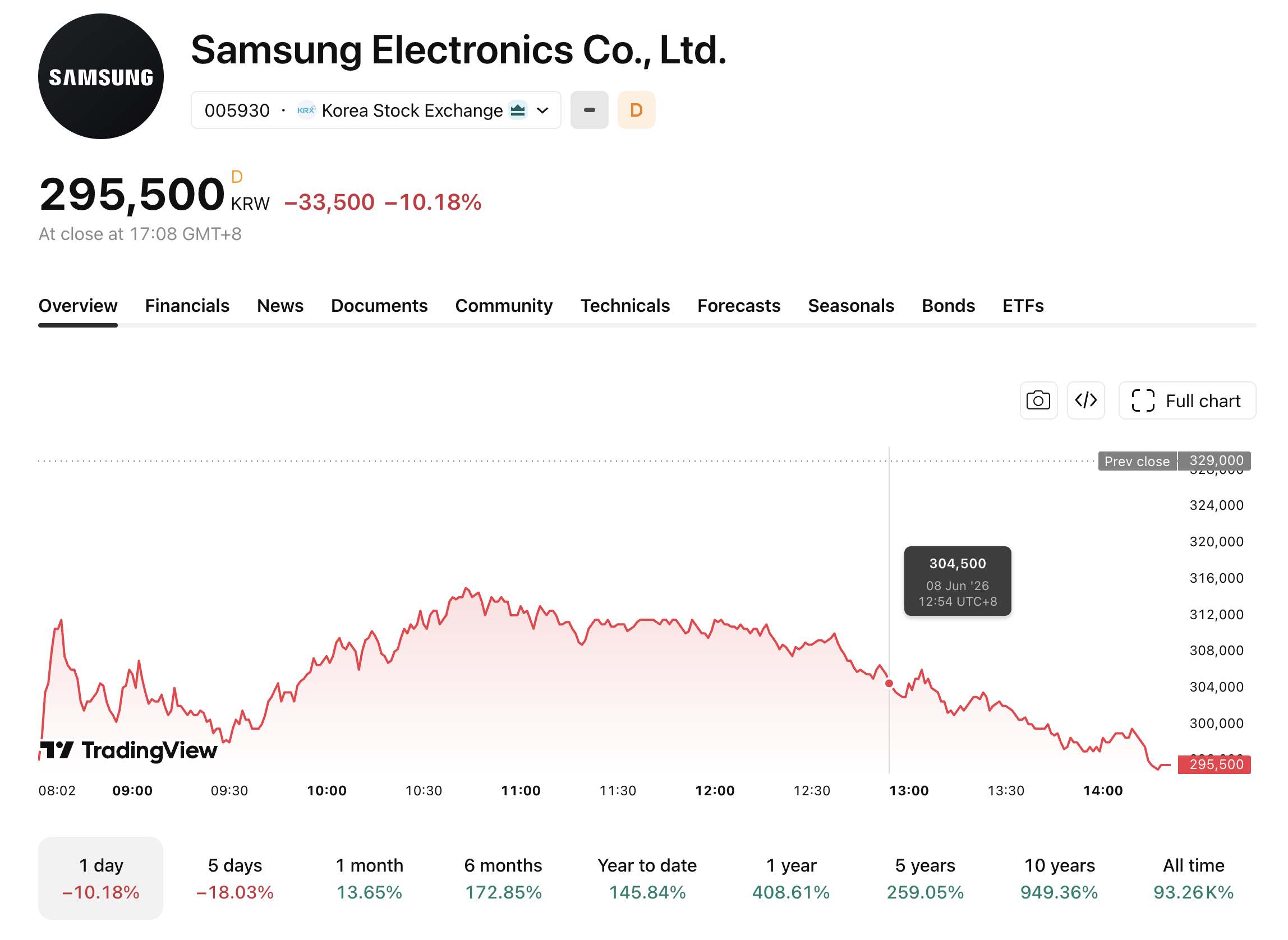
[Source: TradingView]
Recommended Articles


