


Prediction: After Micron and AMD, This Will Be the Next Tech Stock to Join the $1 Trillion Club
Key Points
AMD's valuation needs to rise 24% to join Micron, Broadcom, TSMC, Microsoft, Apple, and Nvidia as the seventh tech stock in the $1 trillion club.
ASML's highly advanced machines are equipped to handle the manufacturing requirements of next-generation chips.
ASML has an expensive valuation, but earnings growth should take it above $1 trillion in the coming years.
- 10 stocks we like better than ASML ›
The tech sector now makes up 35% of the S&P 500. And a big reason for that concentration is the growing number of tech stocks with massive market caps.
There are 11 companies with market caps over $1 trillion, and five of them are U.S. tech stocks. Micron Technology officially joined the $1 trillion club on May 26, while Eli Lilly, Walmart, and Samsung Electronics have all been in the club but are just below the threshold at the time of this writing.
Will AI create the world's first trillionaire? Our team just released a report on the one little-known company, called an "Indispensable Monopoly" providing the critical technology Nvidia and Intel both need. Continue »
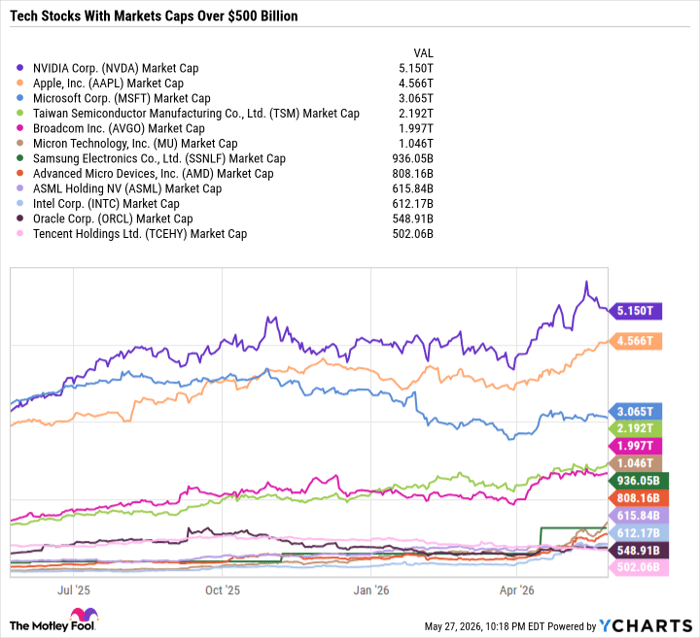
With a market cap of $808 billion, Advanced Micro Devices will probably be the next tech stock to join the $1 trillion club. Behind AMD is ASML (NASDAQ: ASML) at $616 billion and Intel at $612 billion.
Here's why ASML has the clearest path toward becoming the next tech stock to join the $1 trillion club and why it's a great buy now.

Image source: Getty Images.
ASML is ahead of the AI curve
ASML has quietly become Europe's most valuable company and is now worth more than double the market cap of second-place LVMH. ASML is also the most valuable semiconductor equipment company in the world, ahead of Lam Research, with a $399 billion market cap; Applied Materials, at $356 billion; and KLA, at $256 billion.
Data by YCharts.
ASML has a virtual monopoly on extreme ultraviolet (EUV) lithography machines, whereas Lam Research and Applied Materials compete in deposition, etching, and polishing equipment, and KLA dominates the process control market.
Many modern chip manufacturing processes use low numerical aperture (Low-NA) EUV machines, but next-generation chips for artificial intelligence (AI) workloads will rely on ASML High-NA EUV machines. The technology is so new, not to mention incredibly expensive, that ASML is only selling one or two High-NA machines per quarter.
High-NA is just getting started, but low-NA EUV is in full swing, as ASML's EUV sales (High-NA plus Low-NA) are now roughly double non-EUV sales. However, more than half of ASML's revenue still comes from general-purpose, less advanced deep ultraviolet sales plus services on its installed base of existing equipment in the field.
Going beyond the data center
ASML is a catch-all way to invest in AI rather than choosing between custom chip and AI networking companies such as Nvidia or Broadcom, memory giants such as Micron versus Samsung Electronics, or cloud computing titans such as Amazon, Microsoft, or Alphabet.
Data center server racks contain graphics processing units (GPUs), central processing units (CPUs), memory chips such as high-bandwidth memory (HBM) and dynamic random access memory (DRAM), and associated networking and interconnects. So one rack could theoretically contain Nvidia GPUs, AMD CPUs, Micron HBMs, and Cisco Systems networking and interconnects. Chip giants such as Nvidia and Broadcom are pushing to take rack-scale market share by designing custom AI chips and providing AI networking. But the point remains that there's a lot of competition for space on hyperscale data center server racks.
Rather than competing for market share within the data center, ASML exists further up the value chain at the manufacturing level. It doesn't mind if Broadcom takes market share from Nvidia or Micron gains on Samsung Electronics. And it's indifferent if a company is fabless, like Nvidia, AMD, and Qualcomm; designs and manufactures some of its own chips, like Intel and Samsung; or manufacturers the vast majority of its chips, like Micron and Texas Instruments. Rather, ASML wins so long as the broader industry continues to grow in size and sophistication, boosting demand for the commercial-scale precision manufacturing lithography equipment that only ASML can provide.
ASML breaks down its net system sales, which excludes servicing its installed base, by logic (processing) and memory (data storage). In the first quarter of 2026, logic made up 49% of net system sales, and memory was 51%. In the same quarter from 2025, logic was 58% and memory was 42%. Despite the shift from logic to memory, ASML's sales grew 10.5% year over year -- showcasing how the company benefits from AI-driven demand regardless of the ebbs and flows in logic and memory.
Looking ahead, ASML is also well positioned to benefit from the AI inferencing boom. ASML also stands to gain from growth in physical AI, such as robotics and self-driving cars, as those end markets would require advanced chips manufactured with ASML's machines.
An AI stock built for multidecade growth
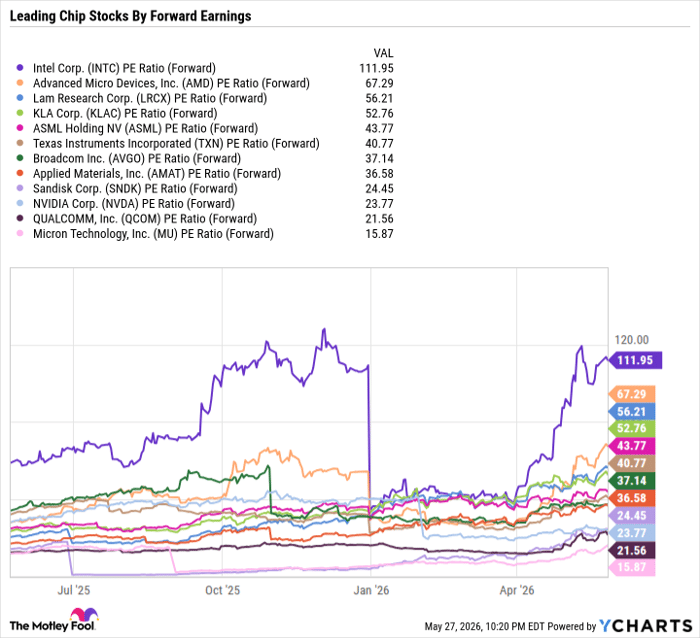
The biggest risk to ASML is that AI doesn't produce the return on investment that companies hope for, which leads to lower capital investment and, in turn, less need to expand chip manufacturing capacity. Another risk is that new competition emerges to challenge its market share and, in turn, its profit margins. And finally, that ASML's future returns will be underwhelming, given it already trades at a premium of 43.8 times forward earnings.
Data by YCharts.
However, no company has come close to replicating ASML's High-NA EUV technology. And ASML's high cash flow enables it to invest heavily in research and development to maintain its competitive advantage.
ASML is no stranger to enduring the semiconductor industry's cyclical slowdowns. It has the business model and balance sheet to ride them out and capitalize on the cycle when it shifts -- exiting first quarter 2026 with 7.97 billion euros in cash and cash equivalents, compared with just 2.71 billion euros in long-term debt.
ASML will be a clear winner from continued advancements in generative, agentic, and physical AI. If ASML continues to generate double-digit earnings growth, it's only a matter of time before it joins the $1 trillion club.
Should you buy stock in ASML right now?
Before you buy stock in ASML, consider this:
The Motley Fool Stock Advisor analyst team just identified what they believe are the 10 best stocks for investors to buy now… and ASML wasn’t one of them. The 10 stocks that made the cut could produce monster returns in the coming years.
Consider when Netflix made this list on December 17, 2004... if you invested $1,000 at the time of our recommendation, you’d have $463,900!* Or when Nvidia made this list on April 15, 2005... if you invested $1,000 at the time of our recommendation, you’d have $1,294,401!*
Now, it’s worth noting Stock Advisor’s total average return is 978% — a market-crushing outperformance compared to 211% for the S&P 500. Don't miss the latest top 10 list, available with Stock Advisor, and join an investing community built by individual investors for individual investors.
See the 10 stocks »
*Stock Advisor returns as of May 30, 2026.
Daniel Foelber has positions in ASML, LVMH Moët Hennessy-Louis Vuitton, Nvidia, and Oracle and has the following options: short July 2026 $200 calls on Oracle and short October 2026 $220 calls on Oracle. The Motley Fool has positions in and recommends ASML, Advanced Micro Devices, Alphabet, Amazon, Apple, Applied Materials, Broadcom, Cisco Systems, Eli Lilly, Intel, Lam Research, Micron Technology, Microsoft, Nvidia, Oracle, Qualcomm, Taiwan Semiconductor Manufacturing, Tencent, Texas Instruments, and Walmart. The Motley Fool recommends Lvmh Moët Hennessy-Louis Vuitton, Société Européenne. The Motley Fool has a disclosure policy.
Recommended Articles


