


Amazon vs. Microsoft: What Their Revenue Trends Tell Investors
Key Points
Amazon generates higher total revenue than Microsoft, though the latter demonstrates a much smoother and more consistent baseline growth pattern.
Amazon experiences distinct quarter-over-quarter revenue spikes during its fourth-quarter periods, while Microsoft maintains a steady, uninterrupted upward trajectory across all evaluated quarters.
Investors should carefully watch whether the wide absolute revenue gap between the two companies continues to fluctuate or begins to narrow in upcoming quarters.
- 10 stocks we like better than Amazon ›
Amazon: Managing Quarterly Revenue Volatility
Amazon (NASDAQ:AMZN) primarily generates its revenue through a vast network of online and physical retail sales, consumer subscription programs, and enterprise cloud computing services.
It recently launched a new supply chain service and faced an investigation into its planned Globalstar acquisition, while reporting an approximately 17% net income margin for the quarter ended March 31, 2026.
Microsoft: Steady Revenue Amid Restructuring
Microsoft (NASDAQ:MSFT) earns the majority of its revenue by licensing software products, selling hardware devices, and providing extensive cloud-based solutions to consumers and global enterprises.
It recently initiated a voluntary retirement program for a portion of its workforce and faced a new antitrust investigation in the United Kingdom, while reporting an approximately 38% net income margin for the quarter ended March 31, 2026.
Why Revenue Matters for Retail Investors
Revenue serves as the most fundamental measure of total incoming money before any operating expenses, taxes, or other costs are subtracted. It allows investors to evaluate raw business growth and the fundamental demand for a company’s core offerings.
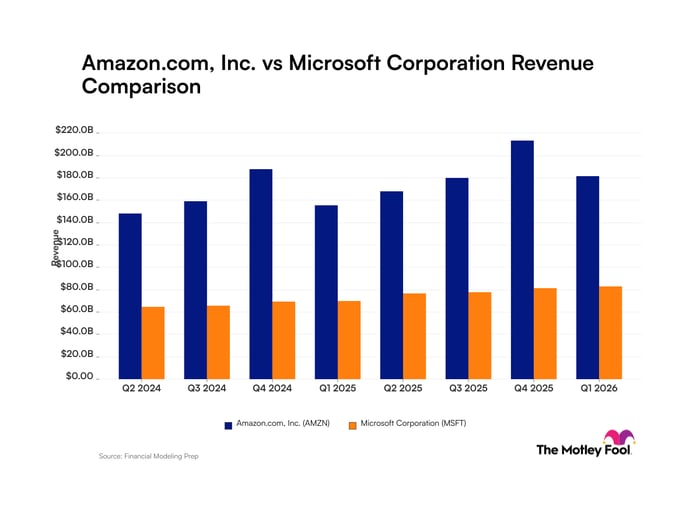
Image source: The Motley Fool.
Quarterly Revenue for Amazon and Microsoft
| Quarter (Period End) | Amazon Revenue | Microsoft Revenue |
|---|---|---|
| Q2 2024 (June 2024) | $148.0 billion | $64.7 billion |
| Q3 2024 (Sept. 2024) | $158.9 billion | $65.6 billion |
| Q4 2024 (Dec. 2024) | $187.8 billion | $69.6 billion |
| Q1 2025 (March 2025) | $155.7 billion | $70.1 billion |
| Q2 2025 (June 2025) | $167.7 billion | $76.4 billion |
| Q3 2025 (Sept. 2025) | $180.2 billion | $77.7 billion |
| Q4 2025 (Dec. 2025) | $213.4 billion | $81.3 billion |
| Q1 2026 (March 2026) | $181.5 billion | $82.9 billion |
Data source: Company filings. Data as of May 28, 2026.
Foolish Take
Amazon and Microsoft compete in the cloud computing sector, with the former taking the top spot in terms of market share while the latter is number two. This part of their businesses is key for investors because it’s where their artificial intelligence offerings reside.
Although the bulk of Amazon’s revenue is generated by its e-commerce operations, which is why sales spike in the fourth quarter from holiday shopping, the growth in the company’s cloud computing business, Amazon Web Services (AWS), helped its stock soar to a 52-week high of $278.56 on May 5.
Amazon invested heavily to upgrade AWS infrastructure in support of AI. This helped it capture customer demand, resulting in AWS sales skyrocketing 28% year over year in Q1 to $37.6 billion. The segment’s expansion handily out-performed Amazon’s retail division, leading to overall revenue rising 17% year over year to $181.5 billion.
Microsoft is no slouch in its sales growth, as revenue increased 18% year over year to $82.9 billion in its fiscal Q3 ended March 31. The tech titan reported its AI business experienced an annual revenue run rate increase of 123% year over year to $37 billion in the quarter.
While Microsoft’s overall sales numbers are nowhere near Amazon’s, they reveal the company’s AI business is enjoying growth comparable to its rival. Q3 cloud revenue rose 29% year over year to $54.5 billion. Consequently, Microsoft and Amazon are both compelling stocks to gain exposure to the AI market.
Should you buy stock in Amazon right now?
Before you buy stock in Amazon, consider this:
The Motley Fool Stock Advisor analyst team just identified what they believe are the 10 best stocks for investors to buy now… and Amazon wasn’t one of them. The 10 stocks that made the cut could produce monster returns in the coming years.
Consider when Netflix made this list on December 17, 2004... if you invested $1,000 at the time of our recommendation, you’d have $465,733!* Or when Nvidia made this list on April 15, 2005... if you invested $1,000 at the time of our recommendation, you’d have $1,313,467!*
Now, it’s worth noting Stock Advisor’s total average return is 985% — a market-crushing outperformance compared to 211% for the S&P 500. Don't miss the latest top 10 list, available with Stock Advisor, and join an investing community built by individual investors for individual investors.
See the 10 stocks »
*Stock Advisor returns as of May 29, 2026.
Robert Izquierdo has positions in Amazon and Microsoft. The Motley Fool has positions in and recommends Amazon and Microsoft. The Motley Fool has a disclosure policy.
Recommended Articles


