


Should You Buy the Vanguard S&P 500 ETF With the Stock Market at a Record High? History Offers a Clear Answer.
Key Points
The S&P 500 is a highly diversified stock market index, with exposure to a range of industries from AI to financial services.
The index is trading at a record high after recovering from a 9% dip earlier this year.
The Vanguard S&P 500 ETF tracks the index, and while history suggests it might be a buy, some risks are emerging.
- 10 stocks we like better than Vanguard S&P 500 ETF ›
The S&P 500 (SNPINDEX: ^GSPC) is a highly diversified stock market index. It tracks 500 companies across 11 sectors of the economy, so it often provides a broad representation of the performance of the American corporate sector.
The S&P 500 recently fell as much as 9% from its peak over concerns about how the conflict between the U.S. and Iran would affect the energy market. The index has since recovered fully, thanks to a ceasefire between the two countries, and it now boasts a year-to-date gain of 9.8%.
Will AI create the world's first trillionaire? Our team just released a report on the one little-known company, called an "Indispensable Monopoly" providing the critical technology Nvidia and Intel both need. Continue »
The Vanguard S&P 500 ETF (NYSEMKT: VOO) is an exchange-traded fund (ETF) that tracks the S&P 500 by holding the same stocks. Should investors buy it now that the index is at a record high? Here's what history says.

Image source: Getty Images.
Diversified exposure to the AI revolution
The S&P 500 has strict entry criteria. To qualify for inclusion, a company must be profitable and have a market capitalization of at least $22.7 billion. But even after ticking those boxes, a special committee still gets the final say over which companies make the cut, ensuring the index maintains a high-quality portfolio composition.
The S&P is weighted by market capitalization, so the largest companies in the index have a greater influence over its performance than the smallest. Below are the top five sectors ranked by weighting, along with the three most valuable companies in each.
|
S&P 500 Sector |
Sector Weighting |
Most Valuable Companies |
|---|---|---|
|
Information technology |
35% |
Nvidia, Apple, Microsoft |
|
Financials |
12% |
Berkshire Hathaway, JPMorgan Chase, Visa |
|
Communication services |
11% |
Alphabet, Meta Platforms, Netflix |
|
Consumer discretionary |
10% |
Amazon, Tesla, Home Depot |
|
Industrials |
8.8% |
Caterpillar, GE Aerospace, GE Vernova |
Data source: Vanguard. Sector weightings are accurate as of April 30, 2026, and are subject to change.
Information technology has such a dominant weighting because Nvidia, Apple, and Microsoft are three of the world's largest companies, with a combined market capitalization of $12.8 trillion. However, the sector is also home to other giants like Broadcom, Advanced Micro Devices, and Micron Technology. These companies are benefiting from the explosive demand for artificial intelligence (AI) chips, software, and cloud services.
If you exclude the information technology sector, the five-year return of the S&P 500 drops from 78% to just 47%, underscoring the importance of the AI industry to the current bull market.
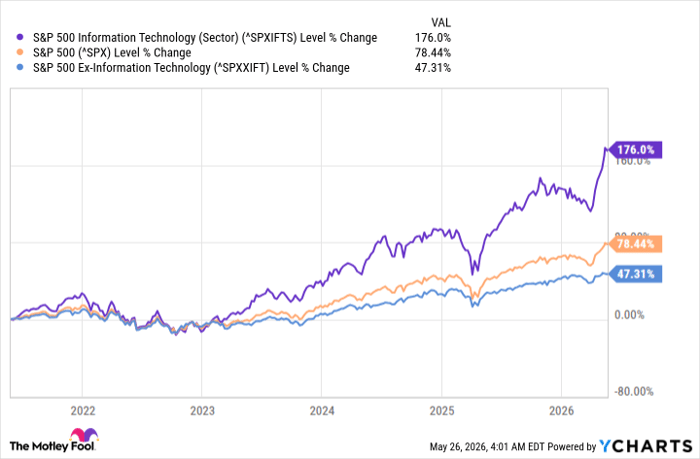
Data by YCharts.
Sectors like communication services and consumer discretionary also have exposure to AI, thanks to holdings such as Alphabet, Meta, Amazon, and Tesla. Even the industrial sector is playing a role in the AI boom, with companies like GE Vernova helping data center operators meet their energy needs. However, these sectors are far more diversified than the information technology sector.
History points to more upside, but risks are emerging
Volatility is a normal part of the investing journey. But despite every sell-off, correction, and bear market along the way, the S&P 500 has still generated an average compound annual return of 10.5% since its inception in 1957 (assuming all dividends were reinvested). From that perspective, there is never a bad time to invest in the Vanguard S&P 500 ETF.
But there are some risks to consider, and the first is valuation. The S&P 500 is currently trading at 21.8 times forward earnings, and according to J.P. Morgan, history suggests it's likely to deliver below-average annual returns of less than 5% over the next decade.
The second risk relates to the broader macroeconomic environment. The U.S. economy is facing an inflation spike due to elevated oil prices. According to the CME Group's FedWatch tool, Wall Street is now predicting at least one interest rate hike before the end of 2026, which could disrupt the stock market's bullish momentum.
Third, concerns are emerging about the sustainability of the AI boom. To offset soaring expenses, companies like Anthropic and Microsoft recently shifted some of their products from fixed- to usage-based pricing, resulting in a significant increase in customer costs. This change is forcing some companies to rethink their AI usage, which could hurt the industry's momentum.
There is never a risk-free time to invest, but going all-in might not be the best strategy in the current environment. Instead, it might be better for investors to scale into the Vanguard S&P 500 ETF gradually with small, consistent monthly deposits. This will allow them to dollar-cost average at lower prices if the index does suffer a correction.
Should you buy stock in Vanguard S&P 500 ETF right now?
Before you buy stock in Vanguard S&P 500 ETF, consider this:
The Motley Fool Stock Advisor analyst team just identified what they believe are the 10 best stocks for investors to buy now… and Vanguard S&P 500 ETF wasn’t one of them. The 10 stocks that made the cut could produce monster returns in the coming years.
Consider when Netflix made this list on December 17, 2004... if you invested $1,000 at the time of our recommendation, you’d have $472,852!* Or when Nvidia made this list on April 15, 2005... if you invested $1,000 at the time of our recommendation, you’d have $1,317,207!*
Now, it’s worth noting Stock Advisor’s total average return is 984% — a market-crushing outperformance compared to 210% for the S&P 500. Don't miss the latest top 10 list, available with Stock Advisor, and join an investing community built by individual investors for individual investors.
See the 10 stocks »
*Stock Advisor returns as of May 28, 2026.
JPMorgan Chase is an advertising partner of Motley Fool Money. Anthony Di Pizio has no position in any of the stocks mentioned. The Motley Fool has positions in and recommends Advanced Micro Devices, Alphabet, Amazon, Apple, Berkshire Hathaway, Broadcom, CME Group, Caterpillar, GE Aerospace, GE Vernova, Home Depot, JPMorgan Chase, Meta Platforms, Micron Technology, Microsoft, Netflix, Nvidia, Tesla, Vanguard S&P 500 ETF, and Visa. The Motley Fool has a disclosure policy.
Recommended Articles


