


Goldman Sachs Says ASICs Will Match GPU Demand by 2027. 2 AI Chip Stocks to Load Up on Right Now.
Key Points
The hardware behind the next generation of AI data centers won't be the same mix that launched the industry.
Data center owners and operators are finding greater cost-effectiveness by requesting custom-built processors.
Expect to pay a well-deserved premium for exposure to this fast-growing sliver of the AI chip business.
- 10 stocks we like better than Broadcom ›
Like most other technological revolutions, the bullishness resulting from the advent of artificial intelligence (AI) was rather indiscriminate. Stocks of most companies in the business performed pretty well during its infancy.
As is also the case with most new technologies, however, as AI matures, the market is separating its leaders from the laggards. Every investor needs to become better-versed in what makes this industry tick, and what will define its next big evolution.
Will AI create the world's first trillionaire? Our team just released a report on the one little-known company, called an "Indispensable Monopoly" providing the critical technology Nvidia and Intel both need. Continue »
The research arm of investment bank Goldman Sachs appears to have figured this out last year, suggesting ASICs would soon surpass GPUs as the preferred computing platform deployed in artificial intelligence data centers. This is exactly what has materialized in the meantime.
The thing is, there are only two big names making ASICs, both of which are already performing phenomenally well as this paradigm shift progresses.
What are ASICs?
It's an acronym for "application-specific integrated circuit," although even that doesn't necessarily tell the average non-techie much. ASICs are custom-built processing chips that are an alternative to processors like GPUs (graphics processing units) made by Nvidia, or CPUs (central processing units) manufactured by the likes of Intel. While GPUs were ideally suited to handle the heavy-duty work required by AI in its early days, CPUs have shown promise on this front of late.
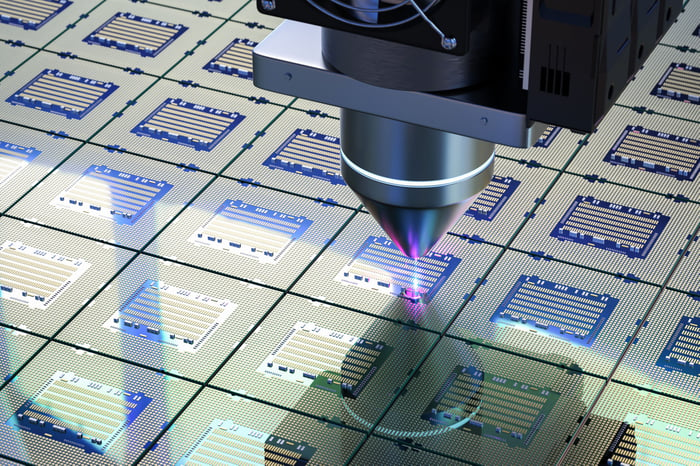
Image source: Getty Images.
As could have been expected, though, it didn't take artificial intelligence data center owners and operators very long to figure out that they'd be better served -- in terms of price and performance -- by using processing chips custom-built for their needs rather than accommodating the architecture dictated by off-the-shelf CPUs and GPUs.
Alphabet's Tensor Processing Units (or TPUs) at work for some Google Cloud customers are ASICs, for instance, as are Amazon's Inferentia and Trainium chips. And these are just a couple of the hyperscalers now opting for customized processing chips rather than more conventional silicon made by the likes of Nvidia.
This still only scratches the surface, though. Last year, Goldman predicted that AI-driven demand for ASICs would match the industry's demand for GPUs by 2027, while Bloomberg Intelligence expects demand for custom-built processors to grow at an average annual rate of 27% through 2033. And so far, it looks like these predictions are right on target.
Picks of the litter
Given the opportunity at hand, one would think several technology companies would be moving in this direction. And to be fair, some are. Even Nvidia is moving in this direction by facilitating more customized use of its hardware. As it stands right now, though, there are really only two big players in the ASIC space.
One of these is Broadcom (NASDAQ: AVGO). While you most likely know it as an AI data center networking and connectivity specialist, Broadcom has quietly become quite a bit more. As CEO Hock Tan commented of the company's impressive first-quarter results reported in March, "Q1 AI revenue of $8.4 billion grew 106% year-over-year, above our forecast, driven by robust demand for custom AI accelerators and AI networking."
For more perspective on the impact of its ASIC efforts, Counterpoint Research expects Broadcom to retain its 60% share of the custom-built processor market at least through 2027, although its commanding lead could certainly last far longer than that.
It's also worth noting that Broadcom designed Google's aforementioned Tensor Processing Units, and is also working with Microsoft, Apple, OpenAI, and others to develop custom silicon for artificial intelligence data centers.
The other noteworthy player in the ASIC business is much smaller Marvell Technology (NASDAQ: MRVL). Like Broadcom, you may know Marvell best as a provider of high-performance networking hardware. Also like Broadcom, Marvell is moving deeper into the custom chip arena, and is even serving some of the same customers (albeit for different purposes).
For instance, Google is utilizing Marvell's know-how to improve the performance of its Broadcom-designed TPUs. Ditto for Amazon's AI training and inference chips. Microsoft has partnered with Marvell Technology to upgrade its existing Azure offerings as well. That's why the company's custom chip business doubled last fiscal year. Management expects 2026 to be another good year.
It's admittedly difficult to determine whether Marvell is competing with Broadcom, or if there's more than enough business for both of them. The analyst community still overwhelmingly seems to feel it's the latter. Despite the stock's red-hot run-up just since early March, on Wednesday, a handful of analysts, including those with Oppenheimer, Wells Fargo, and RBC Capital, raised their price targets on this stock. Each analyst cited continued, growing demand for AI computing hardware as the top reason for their decision.
Just hold your nose and dive in for the long haul
Neither stock can be bought cheaply at this time. Indeed, even investors who are willing and able to hold out for a better price may never get an entry point they truly love.
But this is a scenario where being a bit too picky about your long-term entry point could work against you more than it helps you. ASICs are the next big thing in AI, according to Goldman Sachs, Bloomberg, and others. And they will be for a while. Although other players will certainly enter the business, Marvell's and Broadcom's joint lead of this market is big enough that a newcomer isn't a serious threat to either one.
Bottom line? Don't be afraid to take a swing here. Just keep in mind that any purchase of either stock should be seen as a long-term investment. Ignore any volatility in the meantime.
Should you buy stock in Broadcom right now?
Before you buy stock in Broadcom, consider this:
The Motley Fool Stock Advisor analyst team just identified what they believe are the 10 best stocks for investors to buy now… and Broadcom wasn’t one of them. The 10 stocks that made the cut could produce monster returns in the coming years.
Consider when Netflix made this list on December 17, 2004... if you invested $1,000 at the time of our recommendation, you’d have $477,813!* Or when Nvidia made this list on April 15, 2005... if you invested $1,000 at the time of our recommendation, you’d have $1,320,088!*
Now, it’s worth noting Stock Advisor’s total average return is 986% — a market-crushing outperformance compared to 208% for the S&P 500. Don't miss the latest top 10 list, available with Stock Advisor, and join an investing community built by individual investors for individual investors.
See the 10 stocks »
*Stock Advisor returns as of May 25, 2026.
Wells Fargo is an advertising partner of Motley Fool Money. James Brumley has positions in Alphabet. The Motley Fool has positions in and recommends Alphabet, Amazon, Apple, Broadcom, Goldman Sachs Group, Intel, Marvell Technology, Microsoft, and Nvidia. The Motley Fool has a disclosure policy.
Recommended Articles


