


How Toyota's Challenging U.S. Business Could Result in a New Ford Maverick Rival
Key Points
Toyota was one of the few automakers to approach EVs more cautiously.
Toyota's North America business is challenging others by having the U.S. industry's tightest inventory.
Toyota's need for additional capacity and perhaps a new product makes a new U.S. factory a smart move.
- 10 stocks we like better than Toyota Motor ›
Toyota (NYSE: TM) doesn't get applauded enough for standing its ground years ago, while other global automakers touted tens of billions of dollars in electric vehicle (EV) investments. Those investments turned out poorly in some cases, including Ford Motor Company (NYSE: F), which took massive write-offs for overestimating the EV market.
Despite Toyota standing strong in support of a multi-pronged approach that shows a lot of love for hybrid vehicles, it still faces tariff challenges in its historically strong profit engines. Toyota has plans, however, and it looks to include a new factory that would help its North America business in a few ways.
Will AI create the world's first trillionaire? Our team just released a report on the one little-known company, called an "Indispensable Monopoly" providing the critical technology Nvidia and Intel both need. Continue »
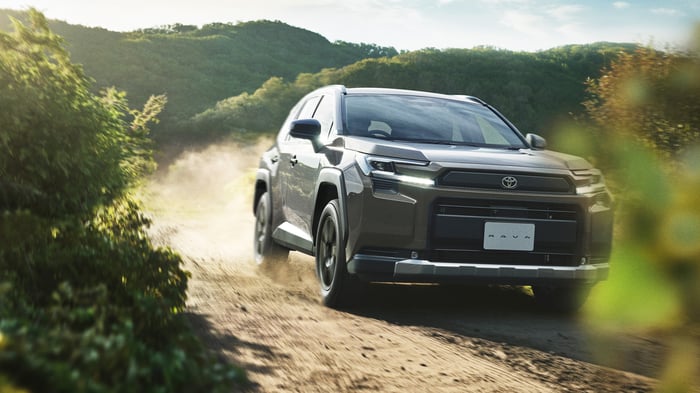
Image source: Toyota.
Is Toyota expanding in Texas?
While full details about Toyota's potential upcoming Texas plant are undisclosed, more than a hint of what could be coming has leaked, and investors can discern its importance from what has been reported. Toyota filed for tax incentives in Texas for a $2 billion assembly plant next to its existing San Antonio truck factory. According to the filing, the new factory would add roughly 2,000 jobs and become Toyota's sixth U.S. assembly site, with production slated for 2030.
Toyota's current North America business is challenging. On one hand, the automaker recorded U.S. sales topping 2.5 million vehicles last year for the first time since 2007. On the other hand, in part due to a massive tariff bill, the automaker's North American profit engine flipped to a loss in fiscal 2025.
One challenging aspect of Toyota's business in the U.S. is that it's already operating at record plant efficiency levels. That means there's not much room for additional production capacity, new vehicle lines, or expanding output.
At a time when Toyota is selling well in the U.S., the lack of additional output means lost profits. The Japanese automaker is already feeling the pinch, with Lexus having its best sales year in the U.S. last year, and Toyota having its fourth-best. This made the automaker's retail inventory the tightest in the industry. That forced Toyota to limit fleet sales to 10%-12% in favor of retail sales and enabled it to spend a fraction of the incentives its competitors spent to move vehicles.
What it all means
Toyota does need an additional factory in the U.S., especially considering constrained capacity and the newly implemented tariffs it would prefer to avoid. While we don't have confirmation of what would be produced at this factory a few years down the line, Automotive News and its close relations to dealerships noted that Toyota dealers have been begging for a compact pickup to rival the Ford Maverick, with a design based on Toyota's highly popular RAV4 SUV.
That possibility would do a couple of things overall for Toyota. It would give the company greater production capacity and flexibility to introduce new products, such as a Ford Maverick rival. If that is the course the company takes, it could also take another step in turning its increasing sales into more profits, since trucks carry stronger margins than sedans. This would also enable the company to find a better balance without leaving fleet sales on the table, and to intelligently use incentives to drive sales even higher with additional production capacity.
Toyota's need for a new factory and new products seems clear, and it looks like a smart move for the automaker, which generally makes the right decisions about its global automotive empire.
Should you buy stock in Toyota Motor right now?
Before you buy stock in Toyota Motor, consider this:
The Motley Fool Stock Advisor analyst team just identified what they believe are the 10 best stocks for investors to buy now… and Toyota Motor wasn’t one of them. The 10 stocks that made the cut could produce monster returns in the coming years.
Consider when Netflix made this list on December 17, 2004... if you invested $1,000 at the time of our recommendation, you’d have $481,750!* Or when Nvidia made this list on April 15, 2005... if you invested $1,000 at the time of our recommendation, you’d have $1,352,457!*
Now, it’s worth noting Stock Advisor’s total average return is 990% — a market-crushing outperformance compared to 206% for the S&P 500. Don't miss the latest top 10 list, available with Stock Advisor, and join an investing community built by individual investors for individual investors.
See the 10 stocks »
*Stock Advisor returns as of May 20, 2026.
Daniel Miller has positions in Ford Motor Company. The Motley Fool has no position in any of the stocks mentioned. The Motley Fool has a disclosure policy.
Recommended Articles


