


Better Buy: AMD Versus Nvidia Stock
Key Points
AMD isn't as focused on data centers as much as Nvidia is.
Nvidia is growing faster than AMD despite being much larger.
In addition, Nvidia's stock looks cheap compared to AMD's.
- 10 stocks we like better than Nvidia ›
Advanced Micro Devices (NASDAQ: AMD) and Nvidia (NASDAQ: NVDA) are two stocks that are often compared. Each makes computing devices, although AMD's product catalog is a lot larger. Both are also heavily involved in the artificial intelligence (AI) build-out, leading to massive growth rates.
However, there can be only one top buy. So which stock is the better buy between the two?
Will AI create the world's first trillionaire? Our team just released a report on the one little-known company, called an "Indispensable Monopoly" providing the critical technology Nvidia and Intel both need. Continue »

Image source: Getty Images.
AMD's business is more diversified
AMD makes graphics processing units (GPUs) like Nvidia, but also makes central processing units (CPUs), embedded processors, and other data center components. In the first quarter of 2026, about 56% of revenue came from its data center division. That makes AMD a lot more diversified than Nvidia, which is basically a data center build-out boom-or-bust investment.
In Nvidia's latest quarter, over 90% of revenue came from its data center division. That's an extreme concentration, and if the AI build-out were to suddenly cease, Nvidia's business would collapse. While that sounds scary, the reality is that the data center build-out is ramping up and will be going on for several more years. Nvidia, being highly concentrated in this area, will have better growth rates than AMD.
However, being a more diversified business is usually a better thing over the long haul, so I'm going to give this category to AMD.
Winner: AMD
Nvidia is capitalizing on its data center concentration
As mentioned above, the data center build-out is booming, which is boosting Nvidia. For Q1, Wall Street analysts expect nearly 80% revenue growth. Next quarter, they expect 86%. That's an incredible figure considering Nvidia's size, and it showcases how much demand there is for Nvidia's products.
AMD is doing quite well itself. Its revenue rose 38% year over year in Q1, with its data center division increasing 57%. However, that's nowhere close to where Nvidia is growing. Looking ahead, Wall Street analysts project 47% growth in Q2 and 34% in Q3. Nvidia is clearly growing faster, so it's impossible to give the growth category to AMD.
Winner: Nvidia
Nvidia's stock is far cheaper despite its faster growth rate
It's all tied up entering the last category, but this one could be the most important. The best company bought at the wrong price is still a bad investment, so investors must balance strong companies with reasonable prices. I'll be using the forward price-to-earnings ratio to analyze both companies, as I think that's the best valuation measure when a company is growing rapidly (as both of these are).
From this standpoint, Nvidia is far cheaper than AMD.
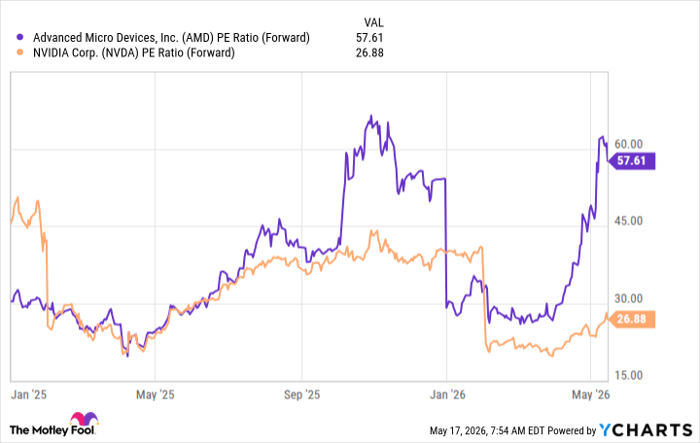
AMD PE Ratio (Forward) data by YCharts
Nvidia is half the price of AMD, despite its superior growth. This doesn't make a ton of sense and showcases that Nvidia is a far better bargain. Even if you look at next year's earnings projections, Nvidia is still a much better value.
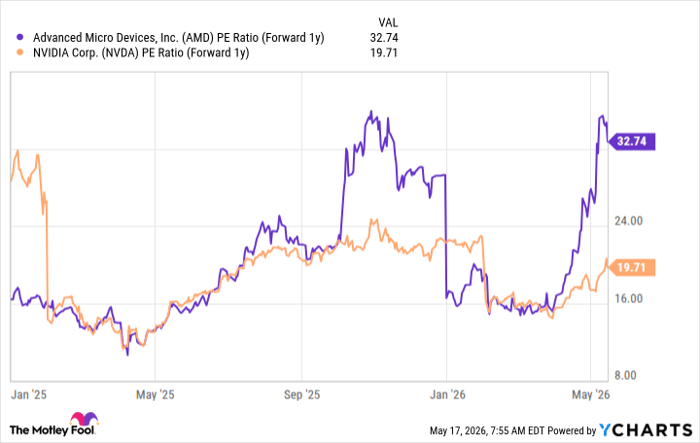
AMD PE Ratio (Forward 1y) data by YCharts
Winner: Nvidia
Nvidia is the runaway winner
Nvidia is cheaper and growing faster than AMD, and it holds a far greater market share. The one leg AMD has to stand on is its diversification. Still, with its data center divisions growing far faster than its other business units, it won't be long before AMD's revenue makeup looks a lot like Nvidia's. This eliminates the one advantage AMD could have, making Nvidia the much smarter stock to buy and hold over the long term.
Should you buy stock in Nvidia right now?
Before you buy stock in Nvidia, consider this:
The Motley Fool Stock Advisor analyst team just identified what they believe are the 10 best stocks for investors to buy now… and Nvidia wasn’t one of them. The 10 stocks that made the cut could produce monster returns in the coming years.
Consider when Netflix made this list on December 17, 2004... if you invested $1,000 at the time of our recommendation, you’d have $481,750!* Or when Nvidia made this list on April 15, 2005... if you invested $1,000 at the time of our recommendation, you’d have $1,352,457!*
Now, it’s worth noting Stock Advisor’s total average return is 990% — a market-crushing outperformance compared to 206% for the S&P 500. Don't miss the latest top 10 list, available with Stock Advisor, and join an investing community built by individual investors for individual investors.
See the 10 stocks »
*Stock Advisor returns as of May 20, 2026.
Keithen Drury has positions in Nvidia. The Motley Fool has positions in and recommends Advanced Micro Devices and Nvidia. The Motley Fool has a disclosure policy.
Recommended Articles


