


Is This AI Stock a Buy at 24 Times Earnings -- or a Value Trap in Disguise?
Key Points
Oracle's new funding model suggests that it could clock stronger-than-expected earnings growth by keeping a handle on its capital expenses.
The tech giant has been raising its revenue guidance, suggesting that it is successfully converting its massive backlog into revenue.
Oracle's earnings growth potential suggests it could see a significant share price increase in the long run.
- 10 stocks we like better than Oracle ›
Less than a year ago, Oracle (NYSE: ORCL) was the blue-eyed boy of Wall Street, racking up a massive backlog amid strong demand for its artificial intelligence (AI) compute infrastructure. The stock reached a 52-week high on Sept. 10, 2025, following an impressive 97% jump since the beginning of the year.
The phenomenal jump in Oracle stock last year was fueled by the stunning growth in the company's remaining performance obligations (RPO). Major hyperscalers and AI companies were awarding Oracle massive contracts to secure AI computing capacity in its data centers, which explains why its RPO was growing faster than its revenue.
Will AI create the world's first trillionaire? Our team just released a report on the one little-known company, called an "Indispensable Monopoly" providing the critical technology Nvidia and Intel both need. Continue »
However, it wasn't long before Wall Street started casting doubts on Oracle's ability to convert its huge revenue backlog into revenue. Its multibillion-dollar deals with OpenAI came under scrutiny, as investors wondered whether the AI start-up would be able to raise the money to pay Oracle. Additionally, Oracle's debt-fueled AI infrastructure build-out has been another cause for concern.
These factors explain why this AI stock has retreated 43% from its 52-week high in September last year. However, savvy investors may be wondering if it is worth buying Oracle following its steep pullback, especially considering its attractive valuation.
Let's see whether you should buy Oracle now or keep away from the stock.
Image source: The Motley Fool.
Oracle's valuation makes the stock an attractive investment
The tech-laden Nasdaq Composite index has an average earnings multiple of 42.7. Oracle is trading at a significantly cheaper 35 times earnings right now. Its forward earnings multiple of 24 is even more attractive. These multiples suggest that Oracle stock is too cheap to ignore right now, especially given its healthy revenue and earnings growth despite significant capital investments in AI infrastructure.
The company's revenue in the third quarter of fiscal 2026 (which ended on Feb. 28, 2026) increased 22% year over year to $17.2 billion. Oracle's non-GAAP earnings increased by 21% year over year to $1.79 per share. Importantly, Oracle anticipates 20% revenue growth in the current quarter, along with a 16% jump in its non-GAAP earnings.
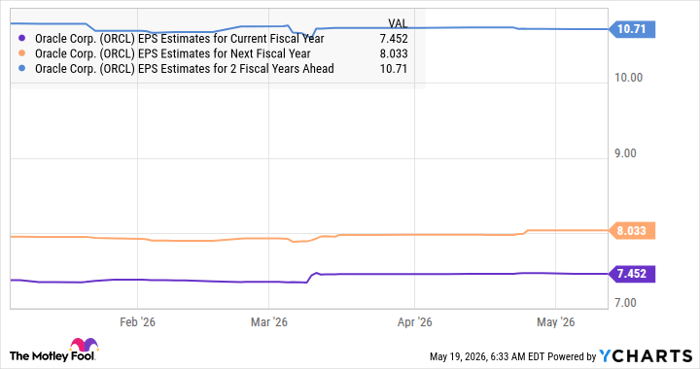
These are solid growth rates, considering that Oracle's capital expenditure is poised to jump to $50 billion in the current fiscal year from $21.2 billion in the previous one. Analysts are expecting Oracle's earnings to grow by 23% in fiscal 2026 to $7.45 per share. However, consensus estimates project a slowdown in Oracle's bottom-line growth in the next fiscal year, followed by an acceleration in fiscal 2028.
Data by YCharts
However, there are a couple of solid reasons why Oracle could easily crush consensus expectations and deliver much stronger earnings growth.
The company can easily surpass expectations, paving the way for a nice jump in the stock price
We have already seen that there are two reasons why Oracle stock has been under pressure.
The first concern has been its ability to convert its massive RPO into revenue. The good news is that Oracle is indeed making progress on this front. The company raised its fiscal 2027 revenue guidance to $90 billion in March this year, up from the $85 billion estimate it issued in October 2025. The updated guidance points to a potential 34% jump in its top line next year, a remarkable improvement over the 17% growth it is on track to deliver this year.
More importantly, Oracle is addressing the second concern that has weighed on its stock price in recent months. The company is now taking upfront payments from customers before building cloud computing hardware for them. Additionally, it now allows customers to bring their own hardware, which further reduces the tech giant's expenses.
The good part is that Oracle customers are willing to enter into contracts under these models that will reduce strain on the company's balance sheet. As CEO Clay McGouyrk noted on the March earnings call:
On our last earnings call, I shared multiple ideas for how we can incrementally grow our AI infrastructure without Oracle Corporation raising more debt or issuing equity. We have signed more than $29 billion of contracts since then, across multiple customers using that new model.
A combination of bring-your-own-hardware and upfront customer payments enables us to continue expanding without any negative cash flow from Oracle Corporation. Of course, this $29 billion is in addition to other deals we signed this quarter.
Oracle could deliver a bigger-than-expected earnings jump next year by keeping a handle on capital expenses. Moreover, the company is confident that its earnings growth will accelerate once it has built enough infrastructure to convert the huge $553 billion RPO into revenue. As RPO refers to the total value of a company's contracts yet to be fulfilled at the end of a quarter, building more infrastructure will enable Oracle to deliver the computing power to customers and recognize the RPO as revenue.
So, don't be surprised to see Oracle indeed achieve its target of $21.00 in earnings per share in fiscal 2030. If the company maintains its forward earnings multiple of 24 at that time, its stock price could jump to $504. That represents a potential 170% jump in just over four years, suggesting that Oracle is indeed a value stock worth buying following its recent slide.
Should you buy stock in Oracle right now?
Before you buy stock in Oracle, consider this:
The Motley Fool Stock Advisor analyst team just identified what they believe are the 10 best stocks for investors to buy now… and Oracle wasn’t one of them. The 10 stocks that made the cut could produce monster returns in the coming years.
Consider when Netflix made this list on December 17, 2004... if you invested $1,000 at the time of our recommendation, you’d have $483,476!* Or when Nvidia made this list on April 15, 2005... if you invested $1,000 at the time of our recommendation, you’d have $1,362,941!*
Now, it’s worth noting Stock Advisor’s total average return is 998% — a market-crushing outperformance compared to 207% for the S&P 500. Don't miss the latest top 10 list, available with Stock Advisor, and join an investing community built by individual investors for individual investors.
See the 10 stocks »
*Stock Advisor returns as of May 20, 2026.
Harsh Chauhan has no position in any of the stocks mentioned. The Motley Fool has positions in and recommends Oracle. The Motley Fool has a disclosure policy.
Recommended Articles


