


Is It Too Late to Buy Micron Stock?
Key Points
Micron Technology is thriving from a memory chip shortage.
The company's shares have soared over the past year.
But Micron still appears to be trading at a cheap price tag.
- 10 stocks we like better than Micron Technology ›
Few stocks have had a better one-year performance than Micron Technology (NASDAQ: MU). If you were smart (or lucky) enough to invest $10,000 into Micron's stock one year ago, that's now worth around $75,000. With a run like that, it would be logical to question whether it can continue.
So, is Micron's rally over? Or does it have a lot further to go?
Will AI create the world's first trillionaire? Our team just released a report on the one little-known company, called an "Indispensable Monopoly" providing the critical technology Nvidia and Intel both need. Continue »

Image source: Getty Images.
Micron's rally has come from factors out of its control
Micron makes memory chips, which go in nearly every electronic device. Lately, the biggest consumer of memory chip capacity has been artificial intelligence, which has eaten up nearly all available memory production capacity, causing memory prices to spike across the board.
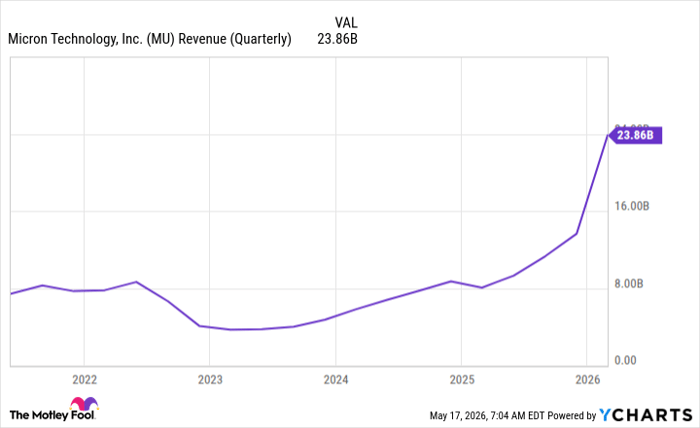
It's a matter of simple economics: Demand is high and supply is low. With memory prices spiking, Micron can charge a premium for its product, which has caused its revenue to soar. Before the end of 2025, Micron's typical quarterly revenue was anywhere from $4 billion to $8 billion. In its most recent quarter, it was nearly $24 billion.
MU Revenue (Quarterly) data by YCharts
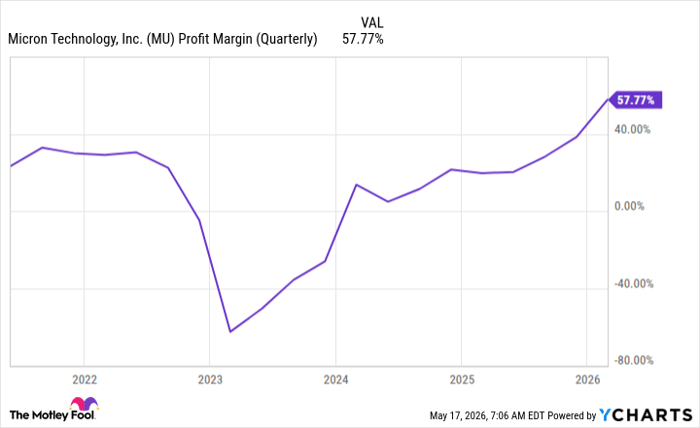
For next quarter, management projects about $33.5 billion in revenue. Nothing has changed in Micron's core business; it's just that the price of the product it sells has skyrocketed. This translates into soaring profits for Micron as well.
MU Profit Margin (Quarterly) data by YCharts
With rising prices and a lack of supply, Micron and its peers are racing to build production facilities to meet demand. If the market is flooded with new supply, the price of memory chips could collapse and ruin the economics of Micron's business.
However, Micron projects that the total addressable market for high-bandwidth memory will increase from $35 billion in 2025 to $100 billion by 2028. That's triple today's level, so it's pretty clear that even if Micron and its peers triple production capacity, demand could remain elevated.
That bodes well for Micron's future, and may project that it's not too late to buy the stock. From another standpoint, Micron's stock still looks cheap.
MU PE Ratio (Forward) data by YCharts
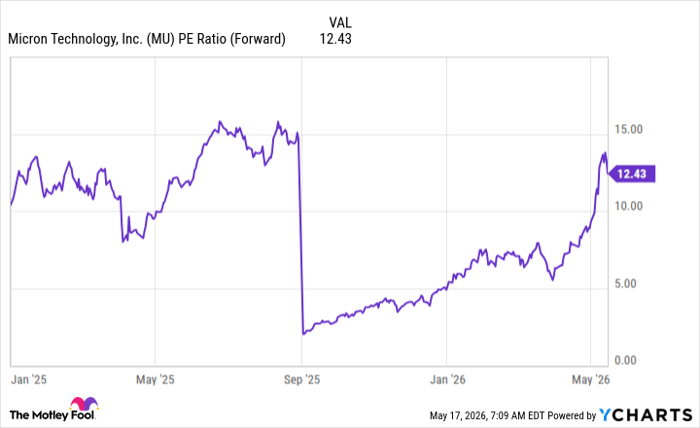
Micron stock trades for about 12 times forward earnings, which is far cheaper than your average AI stock. However, its cheap stock price stems from the cyclical nature of the memory chip industry, and some skeptics will always be there surrounding the longevity of memory chip demand.
If you missed out on Micron and are bullish on AI spending prospects, it could still be a solid buy today. However, you must keep an eye on it, because if demand for memory chips starts to fall or production is increased enough to stabilize the price, the stock could quickly sell off.
Should you buy stock in Micron Technology right now?
Before you buy stock in Micron Technology, consider this:
The Motley Fool Stock Advisor analyst team just identified what they believe are the 10 best stocks for investors to buy now… and Micron Technology wasn’t one of them. The 10 stocks that made the cut could produce monster returns in the coming years.
Consider when Netflix made this list on December 17, 2004... if you invested $1,000 at the time of our recommendation, you’d have $483,476!* Or when Nvidia made this list on April 15, 2005... if you invested $1,000 at the time of our recommendation, you’d have $1,362,941!*
Now, it’s worth noting Stock Advisor’s total average return is 998% — a market-crushing outperformance compared to 207% for the S&P 500. Don't miss the latest top 10 list, available with Stock Advisor, and join an investing community built by individual investors for individual investors.
See the 10 stocks »
*Stock Advisor returns as of May 19, 2026.
Keithen Drury has no position in any of the stocks mentioned. The Motley Fool has positions in and recommends Micron Technology. The Motley Fool has a disclosure policy.
Recommended Articles


