


Amazon vs. Walmart: AI Is Reshaping the Retail Battlefield
Key Points
Walmart currently holds a higher revenue baseline across most reported periods.
Over the last eight quarters, Amazon experienced distinct quarter-over-quarter volatility with seasonal peaks, while Walmart demonstrated a steadier upward trend.
Both companies have launched AI shopping assistants and seeing positive early results.
Investors should watch whether the two companies maintain their current trajectories or if the revenue gap starts to narrow in upcoming quarters.
- These 10 stocks could mint the next wave of millionaires ›
Amazon (NASDAQ:AMZN) has dominated the e-commerce market for many years, but Walmart (NASDAQ:WMT) still has a commanding presence with its massive physical store base. Amazon’s quarterly revenue has been more lumpy than Walmart’s, but it generates far higher margins thanks to strong growth in non-retail services like cloud computing.
What’s becoming more evident is that artificial intelligence (AI)-powered shopping assistants are gaining traction with their customers. The retailer that can better integrate AI into the online shopping experience will have the upper hand over the next decade.
Amazon: Seasonal Peaks in Revenue
Amazon primarily retails consumer products, manufactures electronic devices, and provides cloud computing services globally.
It agreed to acquire Globalstar and partnered with OpenAI, while reporting an approximately 17% net income margin for the quarter ended March 31, 2026.
Walmart: Steady Revenue Trajectory
Walmart operates retail supercenters, warehouse clubs, and digital payment platforms for consumers worldwide.
It opened a new milk processing facility to reduce supply chain costs and is increasingly investing in AI. For the quarter ended Jan. 31, 2026, Walmart reported a net income margin of approximately 2%.
Why Revenue Matters for Retail Investors
Revenue is the most fundamental measure of a company’s performance. Changes over time can reveal opportunities and challenges in expanding its addressable market and reaching new customers. Comparing revenue between companies in the same industry can be very helpful in assessing competitive positioning.
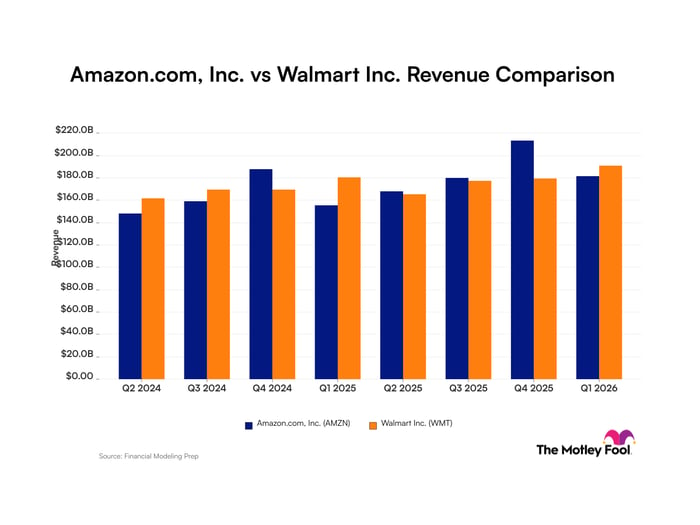
Image source: The Motley Fool.
Quarterly Revenue for Amazon and Walmart
| Quarter (Period End) | Amazon Revenue | Walmart Revenue |
|---|---|---|
| Q2 2024 | $148.0 billion (period ended June 2024) | $161.5 billion (period ended April 2024) |
| Q3 2024 | $158.9 billion (period ended Sept. 2024) | $169.3 billion (period ended July 2024) |
| Q4 2024 | $187.8 billion (period ended Dec. 2024) | $169.6 billion (period ended Oct. 2024) |
| Q1 2025 | $155.7 billion (period ended March 2025) | $180.6 billion (period ended Jan. 2025) |
| Q2 2025 | $167.7 billion (period ended June 2025) | $165.6 billion (period ended April 2025) |
| Q3 2025 | $180.2 billion (period ended Sept. 2025) | $177.4 billion (period ended July 2025) |
| Q4 2025 | $213.4 billion (period ended Dec. 2025) | $179.5 billion (period ended Oct. 2025) |
| Q1 2026 | $181.5 billion (period ended March 2026) | $190.7 billion (period ended Jan. 2026) |
Data source: Company filings. Data as of May 10, 2026.
Foolish Take
Walmart has benefited from its massive store base, reaching $713 billion in trailing-12-month revenue. But Amazon just hit an important milestone. Over the last four quarters, the e-commerce and cloud leader hit $742 billion in trailing revenue, eclipsing Walmart for the first time.
However, in retail alone, Walmart still enjoys far greater scale and customer reach. Amazon’s total retail sales (including online and physical stores) came to $70 billion in the recent quarter, trailing Walmart’s most recent quarterly revenue of $191 billion.
But overall, Amazon’s total revenue grew 17% year over year last quarter to reach $181 billion, far outpacing Walmart’s 5.6% increase.
Both companies are investing heavily in AI initiatives, having launched AI shopping assistants for their respective online stores. Walmart’s Sparky AI assistant is driving higher-order values, while Amazon says customers using its Rufus assistant have doubled.
This shows that AI may increasingly define the e-commerce shopping experience. Future retail winners may come down to those able to deliver the most capable AI-powered tools and services that attract and retain shoppers.
Watch whether Amazon’s total revenue starts to pull ahead of Walmart in the next few quarters. Amazon’s main advantage is its fast-growing non-retail services, including Amazon Web Services, which is seeing accelerating growth as demand for AI services takes off. The AI Amazon develops for enterprise services can influence how it invests in the rest of the business, including its online store.
Don’t miss this second chance at a potentially lucrative opportunity
Ever feel like you missed the boat in buying the most successful stocks? Then you’ll want to hear this.
On rare occasions, our expert team of analysts issues a “Double Down” stock recommendation for companies that they think are about to pop. If you’re worried you’ve already missed your chance to invest, now is the best time to buy before it’s too late. And the numbers speak for themselves:
- Nvidia: if you invested $1,000 when we doubled down in 2009, you’d have $572,674!*
- Apple: if you invested $1,000 when we doubled down in 2008, you’d have $56,187!*
- Netflix: if you invested $1,000 when we doubled down in 2004, you’d have $472,744!*
Right now, we’re issuing “Double Down” alerts for three incredible companies, available when you join Stock Advisor, and there may not be another chance like this anytime soon.
See the 3 stocks »
*Stock Advisor returns as of May 13, 2026.
John Ballard has positions in Amazon. The Motley Fool has positions in and recommends Amazon and Walmart. The Motley Fool has a disclosure policy.
Recommended Articles


