


After Weeks of Extreme Fear, the Market Sentiment Index Just Jumped 20 Points. Here's What Comes Next.
Key Points
Greed is now driving the market, according to CNN's Fear and Greed Index.
A month ago, the index was showing extreme fear.
Greed isn't a clear signal, but it can mean that stocks are overbought.
- 10 stocks we like better than S&P 500 Index ›
Two emotions drive the stock market above all others: fear and greed.
For as much time as investors spend parsing quarterly reports and valuations, decisions are often driven by emotions. In the last few weeks, stocks have soared to record highs in response to cooling tensions in the Middle East, and investor sentiment has also swung aggressively positive.
Will AI create the world's first trillionaire? Our team just released a report on the one little-known company, called an "Indispensable Monopoly" providing the critical technology Nvidia and Intel both need. Continue »
According to CNN's Fear and Greed Index, sentiment has swung from extreme fear a month ago to greed, gaining 55 points on the 100-point index to 70. In the last week, it's up 28 points. The index is made up of seven indicators, including the S&P 500's (SNPINDEX: ^GSPC) performance versus its 125-day moving average; the number of 52-week highs and 52-week lows; and the ratio of put options to call options.
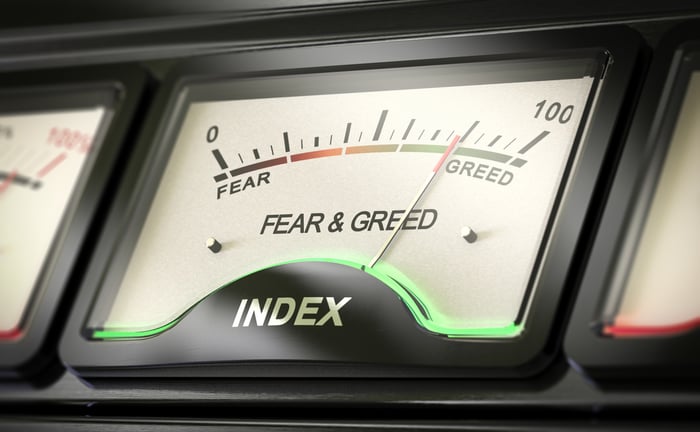
Image source: Getty Images.
What the fear and greed index means
Warren Buffett famously advised investors to be fearful when others are greedy, and greedy when others are fearful. By that logic, the rating of 70 on the fear and greed index, meaning greed, would seem to be a sell signal.
However, nothing in investing is that simple, and neither is the fear and greed index. There's no ironclad rule with the index, but it can serve as a guideline for investors.
For example, a sudden rise in the index, represented by the surge in recent weeks, could signal that stocks are on the verge of being overbought. However, investor sentiment can drive a short-term rally for longer than you might expect due to FOMO, or fear of missing out.
There's also reason to be skeptical of the rally beyond the fear and greed index. Stocks have jumped to all-time highs even as the outcome of the war in Iran is uncertain. While President Trump is pushing for a peace deal, it's unclear if the terms will be satisfactory. Additionally, the S&P 500 is expensive at a price-to-earnings ratio of 28, and the headwinds from before the war started, including risks from AI, a weak labor market, and stretched valuations, remain. In light of that, it makes sense that the sentiment has jumped into greed.
A year ago, the fear and greed index experienced a similar surge after the Liberation Day tariffs were reversed, and stocks continued to surge. However, that sell-off was much deeper than the current one, and stocks are already at all-time highs.
How to use the fear and greed index
While it's worth remembering that the fear and greed index is not a direct guide to whether to buy and sell, it can inform those decisions, especially when the index is in extreme fear or extreme greed.
The index has fallen into extreme fear three times in the last year, in April after the Liberation Day tariffs, in a brief period last November, and in March after the Iran war broke out. Buying during any of those periods would have been a smart move.
Alternatively, the index only edged into extreme greed briefly over the past year. One of its highest points came in Nov. 2021, shortly before the market peaked and began a decline into a bear market.
The bottom line here is that extreme fear may be more of a clear sign to buy than extreme greed is to sell. Still, keeping an eye on the index among other factors makes sense, especially at a time when investor sentiment is moving significantly.
Should you buy stock in S&P 500 Index right now?
Before you buy stock in S&P 500 Index, consider this:
The Motley Fool Stock Advisor analyst team just identified what they believe are the 10 best stocks for investors to buy now… and S&P 500 Index wasn’t one of them. The 10 stocks that made the cut could produce monster returns in the coming years.
Consider when Netflix made this list on December 17, 2004... if you invested $1,000 at the time of our recommendation, you’d have $524,786!* Or when Nvidia made this list on April 15, 2005... if you invested $1,000 at the time of our recommendation, you’d have $1,236,406!*
Now, it’s worth noting Stock Advisor’s total average return is 994% — a market-crushing outperformance compared to 199% for the S&P 500. Don't miss the latest top 10 list, available with Stock Advisor, and join an investing community built by individual investors for individual investors.
See the 10 stocks »
*Stock Advisor returns as of April 20, 2026.
Jeremy Bowman has no position in any of the stocks mentioned. The Motley Fool has no position in any of the stocks mentioned. The Motley Fool has a disclosure policy.
Recommended Articles


