


Prediction: The Biggest Winner From Agentic AI Won't Be Nvidia. It Will Be This Other Chip Stock That No One Talks About.
Key Points
Nvidia's Blackwell and Vera Rubin chips hold a dominant share of the hugely expanding GPU market.
But agentic workflows require more sophisticated processing and energy capabilities beyond what GPUs provide.
Devices using CPUs from Arm Holdings are positioned to multiply once agentic AI becomes commercialized.
- 10 stocks we like better than Arm Holdings ›
A seismic shift is underway in the evolving world of artificial intelligence (AI). While Nvidia remains the archetype of the current boom, I think Arm Holdings (NASDAQ: ARM) is positioned to emerge as the biggest winner of the agentic AI wave.
Agentic AI isn't about which company sells the most chips today. The technology is about where intelligence will actually live and operate tomorrow. Arm's infrastructure provides the company with a structural edge the market has not yet priced in.
Will AI create the world's first trillionaire? Our team just released a report on the one little-known company, called an "Indispensable Monopoly" providing the critical technology Nvidia and Intel both need. Continue »
The rise of agentic AI: From chatbots to autonomous operators
Agentic AI represents the progression from passive chatbot responders to systems proactively doing tasks. Generative models are simple: They answer prompts that are entered into their engines. Agentic systems are capable of planning, reasoning across multiple steps, and subsequently using tools to adapt to new data inputs and execute tasks without constant oversight from an end user.
Agentic workflows shift AI from occasional interactions to constant collaboration. Knowledge workers, business processes, and consumer devices gain a digital counterpart operating around the clock. The opportunity to compound productivity is enormous since agents create and implement new behaviors and efficiencies.
What investors are overlooking is that the agentic AI revolution needs more than just cloud power. It demands distributed intelligence across billions of low-latency endpoints -- precisely where centralized compute hits its limit.
Image source: Getty Images.
Nvidia's GPUs power the heavy lifting of training AI models
Nvidia's GPUs are unmatched for the parallel processing needed to train AI models. Augmented with high-speed inference solutions like Groq, Nvidia's chipsets power complex reasoning in data centers at blazing speeds.
However, the routine decisions, memory lookups, and execution steps that comprise the majority of agentic workflows require low-latency, cost-effective, always-on compute processing. Centralized GPU clusters get strained here -- running up energy costs and privacy concerns as trivial tasks get outsourced to the cloud.
Arm's competitive edge lives in customer lock-in and product efficiency
The biggest value proposition from agentic AI is its ability to operate on devices, at the edge, or in the infrastructure that people and businesses already own. Arm's CPU designs power a large and growing share of consumer electronics, networking equipment, and Internet-of-Things (IoT) devices. As agentic AI moves from niche pilots to ubiquitous deployment across smartphones, tablets, autonomous vehicles, and robotic sensors, the volume of Arm-powered endpoints is set to explode.
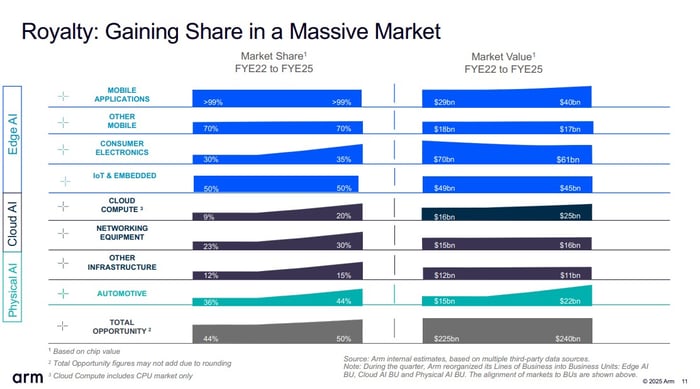
Image source: Arm's Investor Relations.
What's most lucrative about Arm's business model is that the company enjoys decades of lock-in across the computing stack. This makes switching costs virtually unthinkable for Arm's partners. This structure positions Arm to earn royalties on shipped agentic devices at scale. This model creates a virtuous cycle that Nvidia's hardware-centric data center business won't replicate as competing accelerators and ASICs rise in popularity.
Wall Street isn't talking about this paradigm shift because the narrative remains obsessed with Nvidia's headline growth and GPU procurement from the hyperscalers. Smart investors understand that markets often follow visible trends -- ultimately undervaluing the invisible partners under the radar.
But when agentic AI becomes an everyday reality, the biggest winners won't be the companies competing to power these tasks. It will be the business whose architecture is already sitting inside the devices where agents will live, work, and scale. Arm isn't chasing the agentic wave; it is the panorama capturing the beach and sea line as far as the eye can see.
Should you buy stock in Arm Holdings right now?
Before you buy stock in Arm Holdings, consider this:
The Motley Fool Stock Advisor analyst team just identified what they believe are the 10 best stocks for investors to buy now… and Arm Holdings wasn’t one of them. The 10 stocks that made the cut could produce monster returns in the coming years.
Consider when Netflix made this list on December 17, 2004... if you invested $1,000 at the time of our recommendation, you’d have $556,335!* Or when Nvidia made this list on April 15, 2005... if you invested $1,000 at the time of our recommendation, you’d have $1,160,572!*
Now, it’s worth noting Stock Advisor’s total average return is 975% — a market-crushing outperformance compared to 193% for the S&P 500. Don't miss the latest top 10 list, available with Stock Advisor, and join an investing community built by individual investors for individual investors.
See the 10 stocks »
*Stock Advisor returns as of April 14, 2026.
Adam Spatacco has positions in Nvidia. The Motley Fool has positions in and recommends Nvidia. The Motley Fool has a disclosure policy.
Recommended Articles


