


Opportunity Beckons With This Vanguard Value ETF and It's Not The One You're Thinking Of
Key Points
With value stocks on the mend, the Vanguard Mid-Cap Value ETF should be turning more heads.
It's outperforming its large- and small-cap Vanguard counterparts.
The combination of mid-cap and value is underrated.
- 10 stocks we like better than Vanguard Index Funds - Vanguard Mid-Cap Value ETF ›
If there's one constant about mid-cap stocks relative to their larger and smaller counterparts, it's that stocks in the middle often go overlooked. It's a case of perception becoming reality, albeit flawed.
Many investors perceive mid-caps as lacking the comfort and familiarity of large caps and the return potential of small caps. The reality is that mid-cap stocks can offer better return profiles than their larger peers while delivering superior volatility traits compared to small-caps. Those are among the reasons market participants may want to take a closer look at the Vanguard Mid-Cap Value ETF (NYSEMKT: VOE).
Will AI create the world's first trillionaire? Our team just released a report on the one little-known company, called an "Indispensable Monopoly" providing the critical technology Nvidia and Intel both need. Continue »
Long-term investors may want to give this mid-cap ETF a close look. Image source: Getty Images
To be certain, this exchange-traded fund (ETF) doesn't toil in obscurity. It turns 20 years old in August and has $22.3 billion in assets under management, but at a time when value stocks are outperforming, it's fair to say the mid-cap fund deserves more love.
A lot to like with this Vanguard ETF
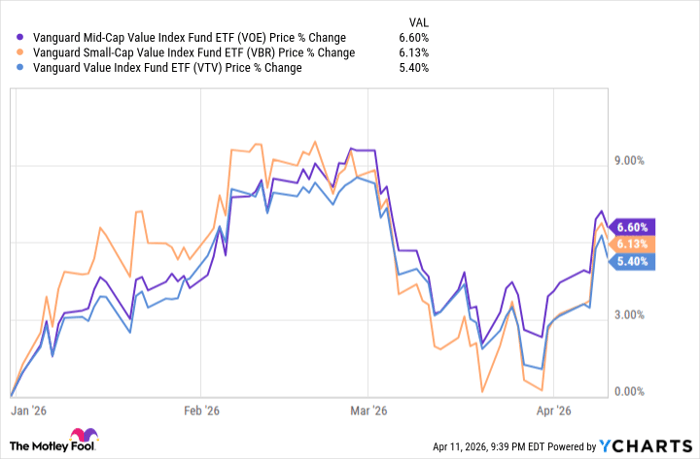
Looking at returns, this mid-cap value ETF has beaten its Vanguard large- and small-cap stablemates since the start of this year.
Data by YCharts.
That's nice, but astute investors know that three months and some change of outperformance doesn't mean a whole lot, particularly when it comes to value stock ETFs. Regardless of market capitalization segment, market participants typically embrace value funds as long-term holdings. Fortunately, this Vanguard ETF can be credibly viewed through that lens.
Think about what you're getting with mid-cap stocks. In many cases, these companies are far more established than smaller peers and have dependable, seasoned executive teams. Some companies in the middle also offer the potentially potent combination of better earnings growth prospects than large-caps while trading at lower valuations.
Something else to consider, particularly at a time when the war in Iran sent the March reading of the Consumer Price Index to 3.3%, the highest level in nearly two years. Mid-caps have a reputation as inflation fighters, and if energy prices remain the culprit behind elevated inflation, this Vanguard ETF may benefit, as it allocates 10.8% of its portfolio to the energy sector.
Charting a different course with mid-cap value
In investing, it's often said that a rising tide lifts all boats, but an interesting, perhaps underrated feature of mid-cap value is that this segment isn't dependent on previous market leaders as a driver of future returns. Interestingly, there have been periods when large-cap growth stocks faltered while mid-cap value stocks surged.
That doesn't mean buyers of this Vanguard ETF need to root for a technology bear market, but this isn't a tech-dependent ETF, as it allocates just 9% to that sector, confirming it's less concentrated in that sector than many supposedly diverse large-cap funds.
Add to that the Vanguard Mid-Cap Value ETF offers diversification that's almost nonexistent in large-cap cap-weighted funds. It features double-digit allocations across five sectors, and none of its 178 holdings exceed 2.43%, indicating single-stock risk is benign.
Plus, this ETF is a frugal long-term investor's friend because it charges just 0.05% per year, or $5 on a $10,000 position.
Should you buy stock in Vanguard Index Funds - Vanguard Mid-Cap Value ETF right now?
Before you buy stock in Vanguard Index Funds - Vanguard Mid-Cap Value ETF, consider this:
The Motley Fool Stock Advisor analyst team just identified what they believe are the 10 best stocks for investors to buy now… and Vanguard Index Funds - Vanguard Mid-Cap Value ETF wasn’t one of them. The 10 stocks that made the cut could produce monster returns in the coming years.
Consider when Netflix made this list on December 17, 2004... if you invested $1,000 at the time of our recommendation, you’d have $555,526!* Or when Nvidia made this list on April 15, 2005... if you invested $1,000 at the time of our recommendation, you’d have $1,156,403!*
Now, it’s worth noting Stock Advisor’s total average return is 968% — a market-crushing outperformance compared to 191% for the S&P 500. Don't miss the latest top 10 list, available with Stock Advisor, and join an investing community built by individual investors for individual investors.
See the 10 stocks »
*Stock Advisor returns as of April 14, 2026.
Todd Shriber has no position in any of the stocks mentioned. The Motley Fool has positions in and recommends Vanguard Value ETF. The Motley Fool has a disclosure policy.
Recommended Articles


