

1 Glimmer of Hope for Hard-Hit Nike Stock: Teens Love Nike

Source The Motley Fool

Key Points

  • A recent survey shows that Nike ranks No. 1 with U.S. teens for top footwear and apparel brands.

  • Nike’s sales in China dropped 7% in the last quarter and are expected to decline by 20% in the current quarter.

  • Chinese consumers might have more influence over Nike stock than U.S. teens.

  • 10 stocks we like better than Nike ›

People who grew up in the 1990s might remember Nike (NYSE: NKE) as one of the coolest brands on Earth, with trend-setting designs in athletic footwear and apparel. This is the company that created Air Jordans and made athletic shoes into the new casual wear for everyday life.

With its iconic swoosh logo, this company didn't just make sports gear -- it shaped the culture and inspired human performance. Wearing Nike was like social media for young people before social media existed.

Will AI create the world's first trillionaire? Our team just released a report on the one little-known company, called an "Indispensable Monopoly" providing the critical technology Nvidia and Intel both need. Continue »

But in the past few years, NKE has fallen behind the best apparel stocks. The company is facing tighter competition for what's now called "athleisure" and new entrants into the market for casual shoes. Nike's share price is down 68% in the past five years and has fallen about 75% from its all-time high in November 2021.
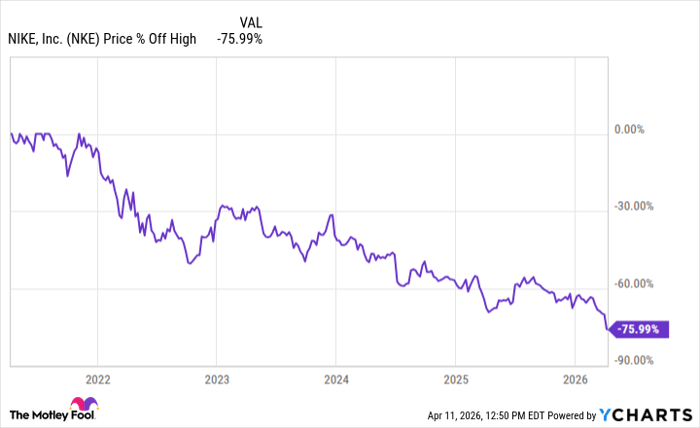
NKE Chart

NKE data by YCharts

Can anything turn NKE around? A recent survey from Piper Sandler shows one surprising sign of hope: Young American consumers still love the Nike brand.

Let's see if this company's popularity with U.S. teenagers could be enough to turn the stock around.

Piper Sandler survey: Nike is No. 1 with teens

The most recent Piper Sandler Taking Stock With Teens® survey was published in October 2025, based on the opinions of nearly 11,000 U.S. teenagers about their favorite retail brands and how they like to shop. Nike ranked No. 1 among teens for top clothing brand and top footwear brand.

Teenage shoppers smile at the mall.

Image source: Getty Images.

According to the survey, 26% of teens said Nike was their favorite clothing brand, compared to 12% for Hollister, the second-ranked brand. And 46% of teens said Nike was their favorite footwear brand, which far outpaced Adidas (14%) and New Balance (8%).

Nike even ranked favorably among teens for online shopping. Although e-commerce giant Amazon ranked No. 1 for teens' favorite shopping website with 54% of teens, Nike tied for a distant second with Shein (5% each).

This company has a powerful brand that has staying power with today's young generation of teenagers. But is that enough to save NKE stock?

China might matter more than U.S. teenagers

Here's the problem for NKE shareholders: No matter how popular the company is with U.S. teenagers, it is struggling to keep up with changing consumer preferences in one of its most important markets: China.

In its latest quarterly earnings report on March 31, Nike reported a disappointing 7% year-over-year decline in revenue from the Greater China market. And executives forecast more bad news: They expect a revenue decline of 2% to 4% in the current quarter, with a 20% drop in sales in China.

Even if the young generation of American consumers stays loyal to Nike, this stock will struggle to recover if the company can't boost sales in crucial international markets like China. NKE investors should prepare for more share price declines. Unless investors see some good news soon, I wouldn't rate NKE as a buy.

Should you buy stock in Nike right now?

Before you buy stock in Nike, consider this:

The Motley Fool Stock Advisor analyst team just identified what they believe are the 10 best stocks for investors to buy now… and Nike wasn’t one of them. The 10 stocks that made the cut could produce monster returns in the coming years.

Consider when Netflix made this list on December 17, 2004... if you invested $1,000 at the time of our recommendation, you’d have $555,526!* Or when Nvidia made this list on April 15, 2005... if you invested $1,000 at the time of our recommendation, you’d have $1,156,403!*

Now, it’s worth noting Stock Advisor’s total average return is 968% — a market-crushing outperformance compared to 191% for the S&P 500. Don't miss the latest top 10 list, available with Stock Advisor, and join an investing community built by individual investors for individual investors.

See the 10 stocks »

*Stock Advisor returns as of April 14, 2026.

Ben Gran has no position in any of the stocks mentioned. The Motley Fool has positions in and recommends Amazon and Nike. The Motley Fool has a disclosure policy.

Disclaimer: For information purposes only. Past performance is not indicative of future results.
placeholder
Bitcoin CME gaps at $35,000, $27,000 and $21,000, which one gets filled first?Prioritize filling the $27,000 gap and even try higher.
Author  FXStreet
Aug 22, 2023
Prioritize filling the $27,000 gap and even try higher.
placeholder
Pinduoduo Earnings Incoming: Morgan Stanley Sees Long-Term Profit Potential​Insights – On November 21, Chinese e-commerce giant Pinduoduo (PDD) will release its Q3 2024 earnings.
Author  Mitrade
Nov 20, 2024
​Insights – On November 21, Chinese e-commerce giant Pinduoduo (PDD) will release its Q3 2024 earnings.
placeholder
Elon Musk’s xAI and Neuralink Launch New Funding Rounds​Billionaire Elon Musk recently raised funds for his two high-profile tech companies, xAI and Neuralink.
Author  Insights
Jun 03, 2025
​Billionaire Elon Musk recently raised funds for his two high-profile tech companies, xAI and Neuralink.
placeholder
Bitcoin briefly loses 2025 gains as crypto plunges over the weekend.Bitcoin experienced a sharp decline this weekend, briefly erasing its 2025 gains and dipping below its year-opening value of $93,507. The cryptocurrency fell to a low of $93,029 on Sunday, representing a 25% drop from its all-time high in October. Although it has rebounded slightly to around $94,209, the pressures on the market remain significant. The downturn occurred despite the reopening of the U.S. government on Thursday, which many had hoped would provide essential support for crypto markets. This year initially appeared promising for cryptocurrencies, particularly after the inauguration of President Donald Trump, who has established the most pro-crypto administration thus far. However, ongoing political tensions—including Trump's tariff strategies and the recent government shutdown, lasting a historic 43 days—have contributed to several rapid price pullbacks for Bitcoin throughout the year. Market dynamics are also being influenced by Bitcoin whales—investors holding large amounts of Bitcoin—who have been offloading portions of their assets, consequently stalling price rallies even as positive regulatory developments emerge. Despite these sell-offs, analysts from Glassnode argue that this behavior aligns with typical patterns seen among long-term investors during the concluding stages of bull markets, suggesting it is not indicative of a mass exodus. Notably, Bitcoin is not alone in its struggles, as Ethereum and Solana have also recorded declines of 7.95% and 28.3%, respectively, since the start of the year, while numerous altcoins have faced even steeper losses. Looking ahead, questions linger regarding the viability of the four-year cycle thesis, particularly given the increasing institutional support and regulatory frameworks now in place in the crypto landscape. Matt Hougan, chief investment officer at Bitwise, remains optimistic, suggesting a potential Bitcoin resurgence in 2026 driven by the “debasement trade” thesis and a broader trend toward increased adoption of stablecoins, tokenization, and decentralized finance. Hougan emphasized the soundness of the underlying fundamentals, pointing to a positive outlook for the sector in the longer term.
Author  Mitrade
Nov 17, 2025
Bitcoin experienced a sharp decline this weekend, briefly erasing its 2025 gains and dipping below its year-opening value of $93,507. The cryptocurrency fell to a low of $93,029 on Sunday, representing a 25% drop from its all-time high in October. Although it has rebounded slightly to around $94,209, the pressures on the market remain significant. The downturn occurred despite the reopening of the U.S. government on Thursday, which many had hoped would provide essential support for crypto markets. This year initially appeared promising for cryptocurrencies, particularly after the inauguration of President Donald Trump, who has established the most pro-crypto administration thus far. However, ongoing political tensions—including Trump's tariff strategies and the recent government shutdown, lasting a historic 43 days—have contributed to several rapid price pullbacks for Bitcoin throughout the year. Market dynamics are also being influenced by Bitcoin whales—investors holding large amounts of Bitcoin—who have been offloading portions of their assets, consequently stalling price rallies even as positive regulatory developments emerge. Despite these sell-offs, analysts from Glassnode argue that this behavior aligns with typical patterns seen among long-term investors during the concluding stages of bull markets, suggesting it is not indicative of a mass exodus. Notably, Bitcoin is not alone in its struggles, as Ethereum and Solana have also recorded declines of 7.95% and 28.3%, respectively, since the start of the year, while numerous altcoins have faced even steeper losses. Looking ahead, questions linger regarding the viability of the four-year cycle thesis, particularly given the increasing institutional support and regulatory frameworks now in place in the crypto landscape. Matt Hougan, chief investment officer at Bitwise, remains optimistic, suggesting a potential Bitcoin resurgence in 2026 driven by the “debasement trade” thesis and a broader trend toward increased adoption of stablecoins, tokenization, and decentralized finance. Hougan emphasized the soundness of the underlying fundamentals, pointing to a positive outlook for the sector in the longer term.
placeholder
ECB Policy Outlook for 2026: What It Could Mean for the Euro’s Next MoveWith the ECB likely holding rates steady at 2.15% and the Fed potentially extending cuts into 2026, EUR/USD may test 1.20 if Eurozone growth proves resilient, but weaker growth and an ECB pivot could pull the pair back toward 1.13 and potentially 1.10.
Author  Mitrade
Dec 26, 2025
With the ECB likely holding rates steady at 2.15% and the Fed potentially extending cuts into 2026, EUR/USD may test 1.20 if Eurozone growth proves resilient, but weaker growth and an ECB pivot could pull the pair back toward 1.13 and potentially 1.10.
goTop
quote