


SpaceX Launches More Rockets Than Anyone Else in the World. Here Is What That Means for Its IPO
Key Points
SpaceX launched 165 Falcon 9 rockets last year.
Rocket Lab launched 18.
Russia launched 17.
- 10 stocks we like better than Lockheed Martin ›
TC:
Will AI create the world's first trillionaire? Our team just released a report on the one little-known company, called an "Indispensable Monopoly" providing the critical technology Nvidia and Intel both need. Continue »
In 2025, South Korea and Israel each launched one rocket apiece to orbit. Japan launched three rockets. India launched four, France seven, Russian 17, and China 90.
SpaceX launched 165 Falcon 9 rockets -- 34% more rockets than every nation on Earth not named "America" combined.
How did that happen?
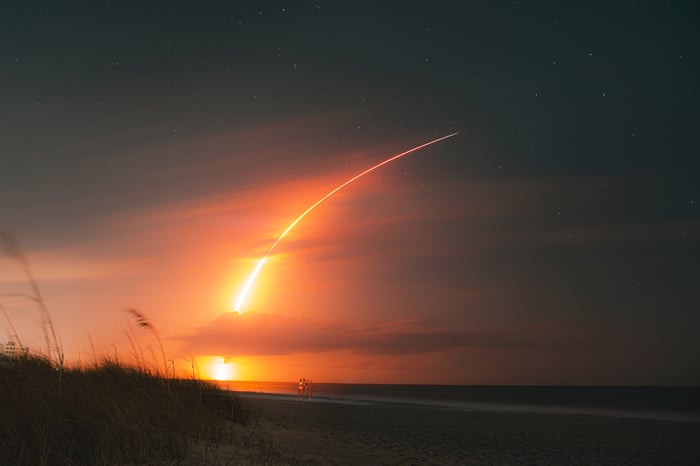
Image source: Getty Images.
Price matters
SpaceX raised the advertised price for its Falcon 9 rocket 6.1% this year, to $74 million -- because it can.
Both Arianespace in Europe and United Launch Alliance (jointly owned by Boeing (NYSE: BA) and Lockheed Martin (NYSE: LMT)) in the U.S., the two companies closest to SpaceX in terms of their rockets' capabilities, charge upwards of $100 million for similar launches.
SpaceX's closest competitor in terms of the number of rockets launched per year is Rocket Lab (NASDAQ: RKLB), which launched 18 orbital missions last year (and three suborbital missions). Rocket Lab's Electron rocket costs only about $8.4 million per launch, but it carries less than a ton of payload per launch, versus a 22-ton payload for Falcon 9.
Per kilogram of payload to orbit, SpaceX still vastly underprices Rocket Lab.
Simply put, by achieving reusability in rockets -- something no other company (or government) on Earth has yet accomplished, SpaceX can underprice its competitors. This wins SpaceX more business, increases the number of launches its rockets conduct, and as a result, amortizes the cost of building each Falcon 9 rocket across more launches, lowering SpaceX's cost per launch.
Price is not cost
This distinction is important: There's a difference between what it costs SpaceX to launch a rocket (a cost that falls as its launch cadence increases) and the price SpaceX charges a customer for a launch (which doesn't fall unless SpaceX says so).
Some analysts estimate, for example, that SpaceX's cost for a Falcon 9 launch may be as low as $17 million. We won't know the truth of this until SpaceX files its IPO prospectus, showing costs and earnings. Still, if this estimate is correct, SpaceX may be earning operating margins as high as 77% on its launches -- at least on those launches it performs for paying customers.
Launches SpaceX conducts on its own behalf, carrying Starlink satellites to orbit, for example, naturally earn the company nothing in and of themselves. What they do, however, is good enough: Sustain a satellite internet system that SpaceX believes will deliver 60% operating margins.
SpaceX versus the competition
How does this compare to the competition? Space profits at both Boeing and Airbus are notoriously hard to parse (because they report "space" as part of combined "defense and space" business units), but Boeing's partner at ULA, Lockheed Martin, earned only a 10% operating margin last year. Rocket Lab, one of the few other rocket stocks with a sizable business, is still earning negative margins.
When choosing to invest in either a high-margin space-and-internet company like SpaceX, or a low-margin space company like everyone else, I know which one I'd pick. With the best launch rate, the best prices, the best profits, and the only reusable rocket in the business, I expect the SpaceX IPO will be very popular among space investors.
Caveats and provisos
One final point. Whilst writing all of the above, a new wrinkle emerged that may complicate investors' view of the SpaceX IPO: A report from tech website The Information, reported but not yet confirmed by Reuters, suggests that SpaceX as a whole may be less profitable than its most famous, rocket-launching part.
As I've previously pointed out, when SpaceX IPOs, it will bring public not just the company's profitable rocket-launching business, and not just its profitable Starlink internet business, but also its money-losing X (Twitter) and xAI (Grok) businesses as well. Previously, I've estimated the sum total of these businesses' annual revenue at approximately $16 billion, and their annual earnings at $3 billion. According to The Information's unconfirmed report, however, the truth is both better and worse than that:
$18.5 billion in annual revenue (because xAI's business is growing faster than previously estimated), but $5 billion in losses in 2025. That's what The Information says SpaceX, plus X, plus xAI, actually produced in 2025.
Will the new numbers be enough to scare off Elon Musk's biggest fans, despite SpaceX's dominant position in space launch? I honestly don't know. Big losses didn't frighten Tesla (Nasdaq: TSLA) investors back when that Musk company was still losing money (and Tesla is profitable today).
Twist my arm, and my hunch is SpaceX investors won't scare easily, either.
Should you buy stock in Lockheed Martin right now?
Before you buy stock in Lockheed Martin, consider this:
The Motley Fool Stock Advisor analyst team just identified what they believe are the 10 best stocks for investors to buy now… and Lockheed Martin wasn’t one of them. The 10 stocks that made the cut could produce monster returns in the coming years.
Consider when Netflix made this list on December 17, 2004... if you invested $1,000 at the time of our recommendation, you’d have $555,526!* Or when Nvidia made this list on April 15, 2005... if you invested $1,000 at the time of our recommendation, you’d have $1,156,403!*
Now, it’s worth noting Stock Advisor’s total average return is 968% — a market-crushing outperformance compared to 191% for the S&P 500. Don't miss the latest top 10 list, available with Stock Advisor, and join an investing community built by individual investors for individual investors.
See the 10 stocks »
*Stock Advisor returns as of April 12, 2026.
Rich Smith has positions in Rocket Lab. The Motley Fool has positions in and recommends Boeing, Rocket Lab, and Tesla. The Motley Fool recommends Lockheed Martin. The Motley Fool has a disclosure policy.
Recommended Articles


