


Here's What the Futures Markets Are Saying About Oil and the Conflict in the Persian Gulf
Key Points
Oil futures are in backwardation due to the Persian Gulf conflict.
Markets expect the disruption to be temporary, with a likely resolution.
Energy stocks may be attractive during ongoing uncertainty.
- 10 stocks we like better than Chevron ›
It's always a good idea to look at what market data is telling you about the market consensus opinion on a matter, and right now, energy markets and the conflict in the Persian Gulf are front and center of investor concerns. Here's a look at what the oil futures market is saying about the conflict, and what it says about buying stocks like Chevron (NYSE: CVX) and other no-brainer stocks while the Strait of Hormuz isn't fully open for business.
The oil futures market
Futures contracts fix the delivery terms (including the price) for delivery of oil in the future. They usually trade in contango, whereby future prices are higher than the spot price to reflect storage and other costs. The opposite of contango is backwardation, where the spot price trades higher than futures prices, indicating a near-term supply scarcity or at least the fear of it.
Will AI create the world's first trillionaire? Our team just released a report on the one little-known company, called an "Indispensable Monopoly" providing the critical technology Nvidia and Intel both need. Continue »
As you can see below, the market is firmly in backwardation, reflecting the absence of crude oil flowing through the Strait of Hormuz. That shouldn't come as a surprise to many investors; after all, almost 34% of the global crude oil trade flows through the strait, according to the International Energy Agency.
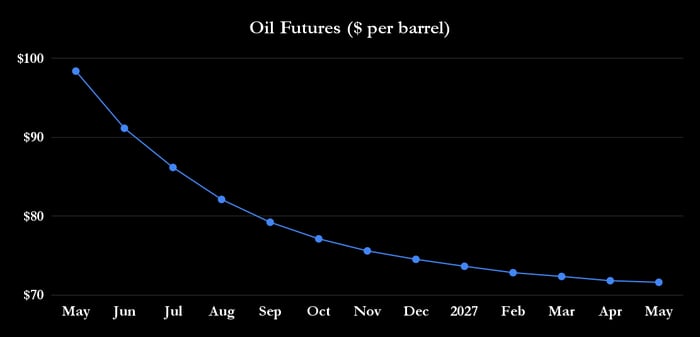
Data source: Oilprice.com, as of April 9. Chart by author.
What the oil futures market is also saying
In addition, the shape of the curve effectively implies that the oil market believes the issues are temporary. In other words, the futures market believes there will be a resolution to the conflict that allows energy to flow through the strait again.
It's not hard to be sympathetic to that view, because the U.S. wants the Strait of Hormuz to be open, as do many Asian countries (80% of crude going through the strait goes to Asia). So do European countries who are net energy importers as well as the countries of the Arabian peninsula that export energy through the strait. And Iran's 10-point peace plan acknowledges the reopening of the strait, at least in some form.
As such, the oil futures market appears to be pricing in only a temporary disruption.

Image source: Getty Images.
Why it's bullish for energy stocks
If you believe the optimism in the futures markets is mirrored in the equity markets, then there's a strong case for arguing that energy stocks remain highly attractive. The reality is, despite the agreed temporary ceasefire, the overall conflict is a long way from resolution, as are the terms of agreement on a full reopening of the strait. That's not even to mention the question of shipping companies obtaining insurance to transit the strait in the future, or the damage done to energy infrastructure in the region.
History suggests staying invested during difficult times, but it makes sense to increase an allocation to energy stocks in the current environment.
Should you buy stock in Chevron right now?
Before you buy stock in Chevron, consider this:
The Motley Fool Stock Advisor analyst team just identified what they believe are the 10 best stocks for investors to buy now… and Chevron wasn’t one of them. The 10 stocks that made the cut could produce monster returns in the coming years.
Consider when Netflix made this list on December 17, 2004... if you invested $1,000 at the time of our recommendation, you’d have $550,348!* Or when Nvidia made this list on April 15, 2005... if you invested $1,000 at the time of our recommendation, you’d have $1,127,467!*
Now, it’s worth noting Stock Advisor’s total average return is 959% — a market-crushing outperformance compared to 191% for the S&P 500. Don't miss the latest top 10 list, available with Stock Advisor, and join an investing community built by individual investors for individual investors.
See the 10 stocks »
*Stock Advisor returns as of April 11, 2026.
Lee Samaha has no position in any of the stocks mentioned. The Motley Fool has positions in and recommends Chevron. The Motley Fool has a disclosure policy.
Recommended Articles


