


Warren Buffett Successor Greg Abel Could Be Buying Billions Worth of This Stock Right Now. You Should Buy It Too.
Key Points
Berkshire Hathaway is sitting on $373 billion of cash and Treasury bills.
Abel's early investments as CEO are off to a hot start.
Berkshire's operating businesses are producing solid results.
- 10 stocks we like better than Berkshire Hathaway ›
Greg Abel took over as CEO of Berkshire Hathaway (NYSE: BRKA) (NYSE: BRKB) at the start of 2026, inheriting a massive marketable equity portfolio and an even bigger pile of cash and Treasury bills from Warren Buffett. While Buffett was an established portfolio manager, with limited interest in managing individual businesses, Abel is almost the exact opposite. Yet he's now tasked with managing nearly $650 billion in assets, with Ted Weschler overseeing about 6% of investments.
Abel has already made several moves as CEO, including buying one of Buffett's favorite stocks. Buffett bought nearly $79 billion worth of the stock between 2018 and 2024, but ceased purchasing shares as they got more expensive. In March, Abel started buying shares of the stock again, purchasing $226 million worth on March 4. He could be buying billions more right now.
Will AI create the world's first trillionaire? Our team just released a report on the one little-known company, called an "Indispensable Monopoly" providing the critical technology Nvidia and Intel both need. Continue »
Image source: Getty Images.
Abel's big Berkshire purchase
Abel has overseen multiple purchases for Berkshire in his first three months as CEO. While it was agreed upon prior to his promotion, Berkshire closed its $9.7 billion acquisition of OxyChem from Occidental Petroleum. Additionally, he and insurance head Ajit Jain oversaw a $1.8 billion strategic investment to acquire about 2.5% of Tokio Marine, a multinational insurance company based in Japan. Abel could also add to that investment in the open market.
But the stock Abel bought $226 million worth of in March, and may continue to buy throughout the year, is Berkshire Hathaway itself. While Abel ruled out dividends as a way to return capital to shareholders, he has reinitiated the company's share repurchase program.
The board of directors changed Berkshire Hathaway's share repurchase authorization in mid-2018. As long as the company maintains ample liquidity in the form of Treasury bills, the CEO may buy back the stock if it trades below its intrinsic value, as conservatively determined.
Buffett has long been wary of companies that repurchase shares without regard to the stock's price. "All stock repurchases should be price-dependent. What is sensible at a discount to business-value becomes stupid if done at a premium," he wrote in his 2023 letter to shareholders. That likely explains why Buffett stopped repurchasing shares in mid-2024. The stock was expensive.
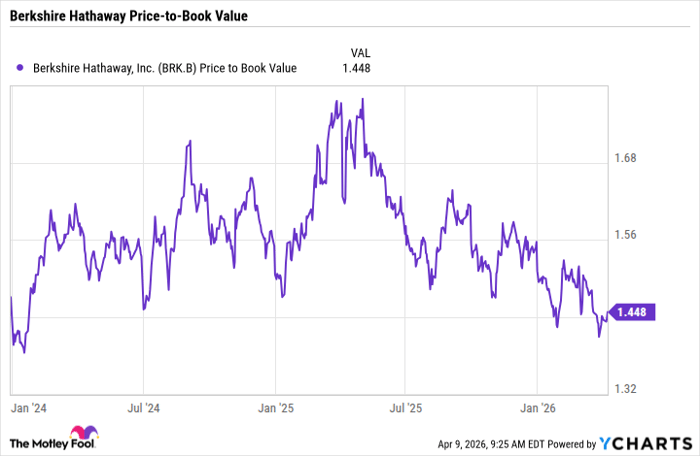
Berkshire's price-to-book value climbed above 1.5 in early 2024 and rarely came back down below that level through 2025. At one point, before Buffett announced his retirement, shares traded above 1.75 times book value. For a company with the majority of its value tied to liquid assets, that's a very high multiple.
BRK.B Price to Book Value data by YCharts.
But the stock price has moved sideways since Buffett announced his plans to hand over the job to Abel last May. Meanwhile, Berkshire's subsidiaries continue to throw off substantial operating earnings, and Berkshire's portfolio of stocks and T-bills keeps growing bigger. As a result, the stock's price-to-book ratio now sits closer to 1.4, a reasonable price to pay for the stock historically. The stock continues to trade at a valuation similar to early March's, opening the door to further share repurchases.
Solid operating results make it a good investment
Berkshire Hathaway is more than just a portfolio of stocks and bonds. It's a conglomerate with dozens of operating companies across insurance, manufacturing, railroads, energy, and retail. Those businesses generated a combined $44.5 billion in earnings last year. That's down slightly from 2024, but up significantly from 2023 ($37.4 billion) and 2022 ($30.9 billion).
The insurance business faced some headwinds from the Los Angeles wildfires at the start of 2025, but got lucky with a quiet hurricane season. That resulted in a combined ratio of just 87.1% last year. Still, underwriting income came in below 2024 (which benefited from higher pricing), but well above 2023 levels.
Abel called out the railroad business in his letter to shareholders, noting that, despite marked improvement last year, its operating margin still remains well below its competitors'. Its 34.5% operating margin sits in the bottom half of the group of North American railroad giants. With limited revenue growth across the industry, earnings growth will have to come from operating efficiency improvements.
Abel's early outside investments appear to be paying off well for Berkshire, too. The chemicals business is likely seeing increased demand due to the supply shock created by the war in Iran and the shutdown of the Strait of Hormuz. Berkshire's Tokio Marine shares are up over 20% since the purchase just a few weeks ago.
With the stock trading at a fair value and operations showing steady results, adding tons of capital to Berkshire's balance sheet, and Abel's early investments showing positive signs amid a volatile market, Berkshire Hathaway looks like a great buy right now.
Should you buy stock in Berkshire Hathaway right now?
Before you buy stock in Berkshire Hathaway, consider this:
The Motley Fool Stock Advisor analyst team just identified what they believe are the 10 best stocks for investors to buy now… and Berkshire Hathaway wasn’t one of them. The 10 stocks that made the cut could produce monster returns in the coming years.
Consider when Netflix made this list on December 17, 2004... if you invested $1,000 at the time of our recommendation, you’d have $550,348!* Or when Nvidia made this list on April 15, 2005... if you invested $1,000 at the time of our recommendation, you’d have $1,127,467!*
Now, it’s worth noting Stock Advisor’s total average return is 959% — a market-crushing outperformance compared to 191% for the S&P 500. Don't miss the latest top 10 list, available with Stock Advisor, and join an investing community built by individual investors for individual investors.
See the 10 stocks »
*Stock Advisor returns as of April 11, 2026.
Adam Levy has no position in any of the stocks mentioned. The Motley Fool has positions in and recommends Berkshire Hathaway. The Motley Fool recommends Occidental Petroleum. The Motley Fool has a disclosure policy.
Recommended Articles


