

Growth vs. Value: Which Side of the Trade Is Winning Right Now?

Source The Motley Fool

Key Points

  • Growth has led the overall market for several years now.

  • There’s a shift in this trend’s underpinnings, though.

  • Most growth stocks arguably don’t offer enough upside right now relative to their risk, while the opposite is the case for value stocks.

  • These 10 stocks could mint the next wave of millionaires ›

If you're a close follower of the stock market's inner workings, then you likely already know growth stocks have trounced value stocks for the better part of the past six years. Specifically, since the market's COVID-19 pandemic-prompted low in mid-March of 2020, the S&P 500 Growth index has rallied a little more than 200% versus the S&P 500 Value index's measurably more modest gain of just over 130%. Credit the incredible proliferation of artificial intelligence (AI), mostly, which disproportionally favored a small handful of big growth companies.

As the old adage goes, nothing lasts forever. Change is underway right now, in fact. Since the beginning of this year, the value index has held its ground while growth stocks have slipped nearly 7%.

Will AI create the world's first trillionaire? Our team just released a report on the one little-known company, called an "Indispensable Monopoly" providing the critical technology Nvidia and Intel both need. Continue »
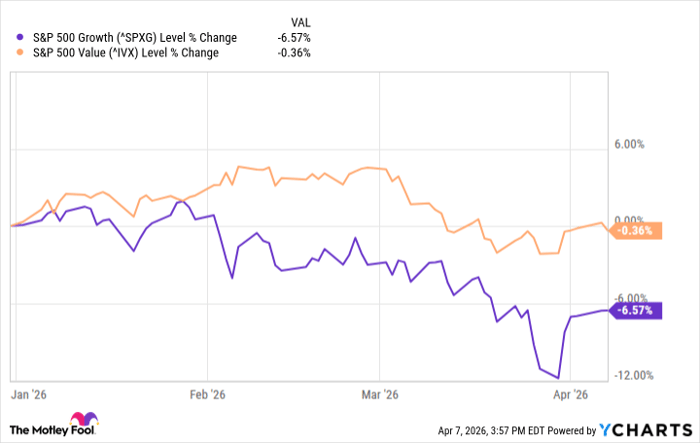
^SPXG Chart

Data by YCharts.

Not a surprising performance

It's not exactly an earth-shattering disparity. Three and a half months isn't a terribly long time, and a 7% performance disparity isn't enormous.

All big trends start out as small ones, though, and the argument that growth stocks have peaked and value stocks are poised to take the lead for a while holds more than a little water.

That's what analysts at Invesco expect, anyway. As Senior Director of U.S. Value Product Management Tracy Fielder penned late last year right before the aforementioned divergence started taking shape, "value stocks, based on the Russell 1000 Value Index, are at a 30% discount to the S&P 500 Index (SNPINDEX: ^GSPC), and a 50% discount to growth stocks, based on the Russell 1000 Growth Index." Their performance in the meantime suggests most investors agree.

Two people are studying what's displayed on a large computer screen.

Image source: Getty Images.

And it's not just Fielder. JPMorgan's market outlook for 2026 agrees, explaining "with overall valuations at multi-decade highs, select value sectors should play a bigger role in [portfolio performances] 2026." Economic uncertainty stemming from lingering inflation, conflict in the Middle East, and an artificial intelligence revolution that isn't quite as revolutionary as initially anticipated all make value stocks more compelling investment prospects if only because they offer at least a little more performance certainty than growth stocks do at this time.

Such a shift is certainly coming sooner or later

Past performance is no guarantee of future results, of course, and there are exceptions to ... well, everything. Not every value stock is poised to shine from here, just as not every growth stock will struggle. Indeed, JPMorgan's outlook acknowledges "growth should continue to fare well as the long-term secular force of AI continues to mature."

Do view the hint being given by recent performances through a lens of strategic realism, though. Change is normal -- and even predictable -- in the market, across both sector and style leadership. Veteran investors know such a change is coming sooner or later, but without any announcement or real fanfare. This performance diversion may be the only early warning that anybody's going to get.

Where to invest $1,000 right now

When our analyst team has a stock tip, it can pay to listen. After all, Stock Advisor’s total average return is 959%* — a market-crushing outperformance compared to 191% for the S&P 500.

They just revealed what they believe are the 10 best stocks for investors to buy right now, available when you join Stock Advisor.

See the stocks »

*Stock Advisor returns as of April 10, 2026.

JPMorgan Chase is an advertising partner of Motley Fool Money. James Brumley has no position in any of the stocks mentioned. The Motley Fool has positions in and recommends JPMorgan Chase. The Motley Fool has a disclosure policy.

Disclaimer: For information purposes only. Past performance is not indicative of future results.
placeholder
Bitcoin CME gaps at $35,000, $27,000 and $21,000, which one gets filled first?Prioritize filling the $27,000 gap and even try higher.
Author  FXStreet
Aug 22, 2023
Prioritize filling the $27,000 gap and even try higher.
placeholder
Pinduoduo Earnings Incoming: Morgan Stanley Sees Long-Term Profit Potential​Insights – On November 21, Chinese e-commerce giant Pinduoduo (PDD) will release its Q3 2024 earnings.
Author  Mitrade
Nov 20, 2024
​Insights – On November 21, Chinese e-commerce giant Pinduoduo (PDD) will release its Q3 2024 earnings.
placeholder
Elon Musk’s xAI and Neuralink Launch New Funding Rounds​Billionaire Elon Musk recently raised funds for his two high-profile tech companies, xAI and Neuralink.
Author  Insights
Jun 03, 2025
​Billionaire Elon Musk recently raised funds for his two high-profile tech companies, xAI and Neuralink.
placeholder
Bitcoin briefly loses 2025 gains as crypto plunges over the weekend.Bitcoin experienced a sharp decline this weekend, briefly erasing its 2025 gains and dipping below its year-opening value of $93,507. The cryptocurrency fell to a low of $93,029 on Sunday, representing a 25% drop from its all-time high in October. Although it has rebounded slightly to around $94,209, the pressures on the market remain significant. The downturn occurred despite the reopening of the U.S. government on Thursday, which many had hoped would provide essential support for crypto markets. This year initially appeared promising for cryptocurrencies, particularly after the inauguration of President Donald Trump, who has established the most pro-crypto administration thus far. However, ongoing political tensions—including Trump's tariff strategies and the recent government shutdown, lasting a historic 43 days—have contributed to several rapid price pullbacks for Bitcoin throughout the year. Market dynamics are also being influenced by Bitcoin whales—investors holding large amounts of Bitcoin—who have been offloading portions of their assets, consequently stalling price rallies even as positive regulatory developments emerge. Despite these sell-offs, analysts from Glassnode argue that this behavior aligns with typical patterns seen among long-term investors during the concluding stages of bull markets, suggesting it is not indicative of a mass exodus. Notably, Bitcoin is not alone in its struggles, as Ethereum and Solana have also recorded declines of 7.95% and 28.3%, respectively, since the start of the year, while numerous altcoins have faced even steeper losses. Looking ahead, questions linger regarding the viability of the four-year cycle thesis, particularly given the increasing institutional support and regulatory frameworks now in place in the crypto landscape. Matt Hougan, chief investment officer at Bitwise, remains optimistic, suggesting a potential Bitcoin resurgence in 2026 driven by the “debasement trade” thesis and a broader trend toward increased adoption of stablecoins, tokenization, and decentralized finance. Hougan emphasized the soundness of the underlying fundamentals, pointing to a positive outlook for the sector in the longer term.
Author  Mitrade
Nov 17, 2025
Bitcoin experienced a sharp decline this weekend, briefly erasing its 2025 gains and dipping below its year-opening value of $93,507. The cryptocurrency fell to a low of $93,029 on Sunday, representing a 25% drop from its all-time high in October. Although it has rebounded slightly to around $94,209, the pressures on the market remain significant. The downturn occurred despite the reopening of the U.S. government on Thursday, which many had hoped would provide essential support for crypto markets. This year initially appeared promising for cryptocurrencies, particularly after the inauguration of President Donald Trump, who has established the most pro-crypto administration thus far. However, ongoing political tensions—including Trump's tariff strategies and the recent government shutdown, lasting a historic 43 days—have contributed to several rapid price pullbacks for Bitcoin throughout the year. Market dynamics are also being influenced by Bitcoin whales—investors holding large amounts of Bitcoin—who have been offloading portions of their assets, consequently stalling price rallies even as positive regulatory developments emerge. Despite these sell-offs, analysts from Glassnode argue that this behavior aligns with typical patterns seen among long-term investors during the concluding stages of bull markets, suggesting it is not indicative of a mass exodus. Notably, Bitcoin is not alone in its struggles, as Ethereum and Solana have also recorded declines of 7.95% and 28.3%, respectively, since the start of the year, while numerous altcoins have faced even steeper losses. Looking ahead, questions linger regarding the viability of the four-year cycle thesis, particularly given the increasing institutional support and regulatory frameworks now in place in the crypto landscape. Matt Hougan, chief investment officer at Bitwise, remains optimistic, suggesting a potential Bitcoin resurgence in 2026 driven by the “debasement trade” thesis and a broader trend toward increased adoption of stablecoins, tokenization, and decentralized finance. Hougan emphasized the soundness of the underlying fundamentals, pointing to a positive outlook for the sector in the longer term.
placeholder
WTI holds steady above $92.00 as Strait of Hormuz remains closed; bulls seem hesitant West Texas Intermediate (WTI) – the benchmark US Crude Oil price – trades with a mild positive bias during the Asian session on Friday, though it lacks bullish conviction amid hopes of Iran ceasefire stabilizing.
Author  FXStreet
22 hours ago
West Texas Intermediate (WTI) – the benchmark US Crude Oil price – trades with a mild positive bias during the Asian session on Friday, though it lacks bullish conviction amid hopes of Iran ceasefire stabilizing.
goTop
quote