


$1,000 to Invest in Energy? This Is the Stock to Buy Right Now.
Key Points
Woodside Energy is well positioned amid Strait of Hormuz disruptions.
The company has strong Asian exposure and new U.S. assets.
Dividend appears secure, with potential for growth from market volatility.
- 10 stocks we like better than Woodside Energy Group ›
It's no secret that the near-total closure of energy flows through the Strait of Hormuz has led to serious short-term ramifications for global energy markets. However, there's a real risk that the issues will be deep and prolonged. If so, a stock like Australian energy company Woodside Energy (NYSE: WDS) is perfectly placed to benefit. The company has a U.S. listing and comes with a current dividend yield of 4.6%.
Is Woodside Energy stock a buy?
Even if the energy starts flowing through the strait, there are still plenty of question marks around how much damage to energy infrastructure (including refining capacity) has already been done or will be done by the time the strait is reopened. Moreover, the conflict is likely to lead to increased insurance premiums and security costs connected with buying energy that passes through the strait. In addition, customers value the security and reliability of a constant energy supply, not least to avoid paying soaring spot prices in a crisis.
Will AI create the world's first trillionaire? Our team just released a report on the one little-known company, called an "Indispensable Monopoly" providing the critical technology Nvidia and Intel both need. Continue »
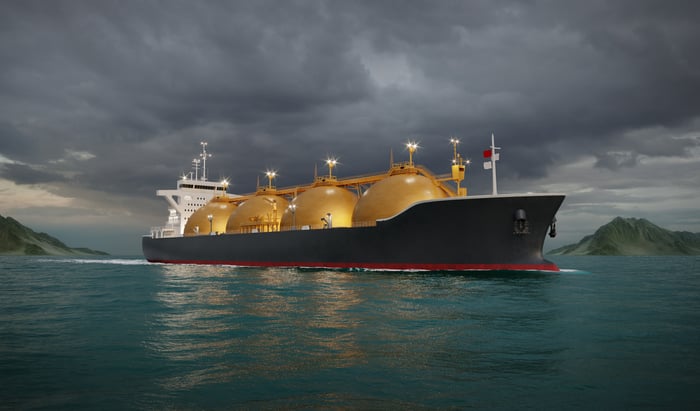
Image source: Getty Images.
All of which suggests favoring stocks that compete with liquefied natural gas (LNG) coming through the strait (almost all of it is from Qatar), which is where Woodside Energy comes in. While LNG is a global commodity, almost 90% of the LNG volumes passing through the Strait of Hormuz go to the Asian markets, with the rest going to Europe. As such, the lack of traffic through the strait is having a disproportionate impact on Asia.
For example, the Platts LNG Japan Korea Marker (a benchmark indicator of the spot price of LNG to Asian markets) is up 106% in 2026 as of the time of writing.
Woodside is a relatively conservative energy company, and has 75% of its LNG volumes in 2026 to 2028 already contracted, "With most oil-linked and some gas hub link exposure," according to CEO Elizabeth Westcott on a recent earnings call. However, as Westcott also noted, "This mixture provides diversification, portfolio resilience and the ability to capture value from market dislocations."
One of those dislocations is the kind of spike in prices caused by the conflict discussed above, so Woodside is a direct beneficiary, and it's one of 10 great energy stocks to buy.
A longer-term beneficiary
Woodside is primarily exposed to Asia, with 56% of its revenue coming from Asia in 2025, 24% from Europe, and nearly all the rest from the Americas. Woodside also has assets in the U.S., the Caribbean, and Canada. The U.S. assets include an ammonia facility (natural gas is the primary raw material for ammonia) in Texas, and an LNG terminal under construction in Louisiana. Both are investments made in the last few years and appear extremely opportune given recent developments. Another major growth project is the Scarborough Energy Project off the coast of Australia, set to deliver LNG starting in the fourth quarter.
A longer-term beneficiary?
According to S&P Global Market Intelligence, the Wall Street consensus already has Woodside generating more than $4 in cash flow per share over the next three years, meaning its $1.12 dividend is easily covered. Throw in the opportunity to sign contracts with Asian customers keen to avoid risk, and the near-term benefit of surging energy spot prices, and Woodside is an excellent stock in the current climate.
Should you buy stock in Woodside Energy Group right now?
Before you buy stock in Woodside Energy Group, consider this:
The Motley Fool Stock Advisor analyst team just identified what they believe are the 10 best stocks for investors to buy now… and Woodside Energy Group wasn’t one of them. The 10 stocks that made the cut could produce monster returns in the coming years.
Consider when Netflix made this list on December 17, 2004... if you invested $1,000 at the time of our recommendation, you’d have $533,522!* Or when Nvidia made this list on April 15, 2005... if you invested $1,000 at the time of our recommendation, you’d have $1,089,028!*
Now, it’s worth noting Stock Advisor’s total average return is 930% — a market-crushing outperformance compared to 185% for the S&P 500. Don't miss the latest top 10 list, available with Stock Advisor, and join an investing community built by individual investors for individual investors.
See the 10 stocks »
*Stock Advisor returns as of April 8, 2026.
Lee Samaha has no position in any of the stocks mentioned. The Motley Fool has no position in any of the stocks mentioned. The Motley Fool has a disclosure policy.
Recommended Articles


