

Walmart Stock is Sounding a Warning Bell for Investors, and It's Ringing Out at Its Loudest Since the 2008 Financial Crisis. History Paints a Clear Picture of What Happens Next.

Source The Motley Fool

Key Points

  • Longtime strategist Jim Paulsen says a look at Walmart stock relative to a particular index can offer valuable insights.

  • The stock market has been in rocky territory in recent weeks.

  • 10 stocks we like better than S&P 500 Index ›

The S&P 500 has stumbled in recent weeks and even delivered a negative performance in the first quarter of the year as it dropped 4.6%. Many investors hesitated to buy stocks, and the reason is clear: They worried about elements that could disrupt growth, from the potential for weakness in the artificial intelligence (AI) revenue story to the war in Iran.

All of this has created volatility, with the index swinging from gains to losses depending on the news of the day. And this movement, too, has weighed on the minds of investors.

Will AI create the world's first trillionaire? Our team just released a report on the one little-known company, called an "Indispensable Monopoly" providing the critical technology Nvidia and Intel both need. Continue »

Amid the turmoil, one particular stock is sounding a warning bell for investors. This company is very well known and is a part of daily life for many. I'm talking about retail giant Walmart (NASDAQ: WMT). Jim Paulsen, who retired as chief investment strategist at The Leuthold Group in 2022, continues to follow the market closely and recently highlighted this message from Walmart stock.

Let's check it out -- and consider what history says may happen next.

An investor works on a laptop.

Image source: Getty Images.

Walmart as a barometer

As you probably know, Walmart sells a broad range of goods, from groceries and essentials to general merchandise, and the company's focus is on value. So you can count on Walmart for extra-low prices. Lower-income individuals usually feel the pressure of recessions before others and feel it more deeply, Paulsen wrote last week in a Substack post. His theory is that Walmart, which often serves the most cost-conscious consumers, may be a good barometer of the economy.

With this in mind, Paulsen compares Walmart's stock performance with the S&P Global Luxury Index -- outperformance by Walmart could suggest a recession or slowdown is on the horizon. This is because, as these situations build, purchasing tends to be stronger at discounters versus luxury goods companies. Paulson updated the Walmart Recession Signal in his post, showing that it has reached almost its highest level ever -- that level was recorded during the financial crisis in 2008.

Paulsen doesn't forecast a recession this year, but says he's "becoming more convinced" that a significant slowdown is developing. And this comes at a time when fellow experts also are becoming more cautious about the U.S. economy -- for example, Goldman Sachs recently increased its recession probability to 30%.

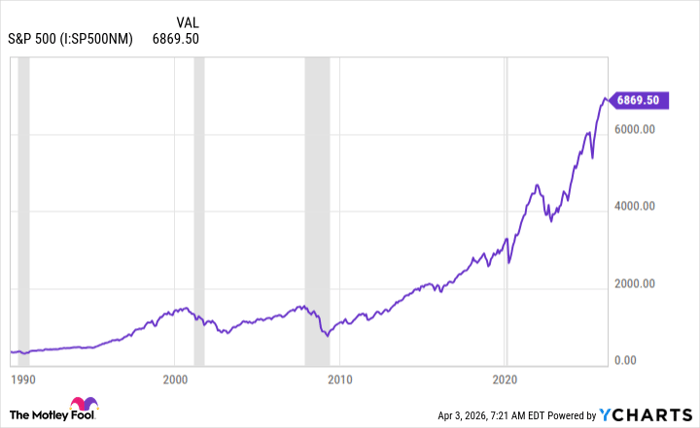
Now, let's consider what history says this may mean for the stock market. In the chart below, we can see periods of U.S. recessions -- the shaded areas -- and the dip in the S&P 500 that generally has accompanied those times.
S&P 500 Chart

S&P 500 data by YCharts

What valuation tells us

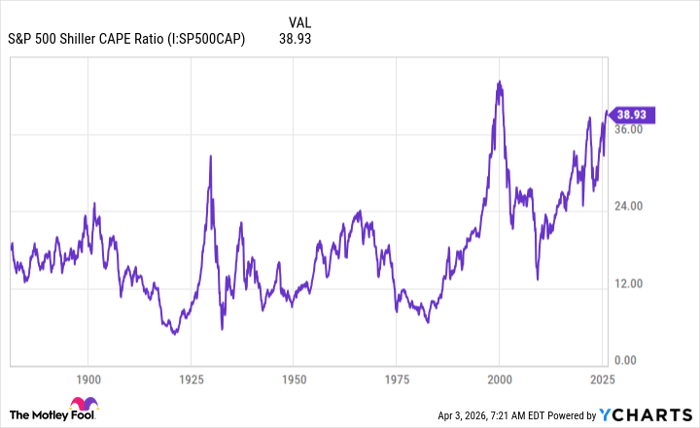
So, if the economy enters a recession, history suggests stocks will likely decline. But what if, as Paulsen suggests, the economy simply enters a slowdown? Before answering that question, it's important to take a look at another metric: the S&P 500 Shiller CAPE ratio. This is an inflation-adjusted measure of stock prices in relation to earnings per share. It offers us a clear picture of valuation today, and we can see how it's evolved over time.

And today, the Shiller CAPE ratio has reached a level it's only surpassed once before in history -- during the dot-com bubble.
S&P 500 Shiller CAPE Ratio Chart

S&P 500 Shiller CAPE Ratio data by YCharts

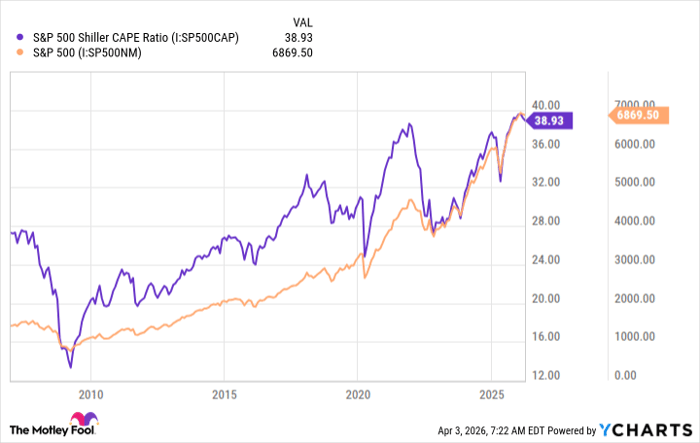
Stocks are expensive, and even recent declines haven't been enough to bring the overall price level back down to Earth. What happens when valuations are at peak levels? History shows that the market has declined on those occasions.
S&P 500 Shiller CAPE Ratio Chart

S&P 500 Shiller CAPE Ratio data by YCharts

So, Walmart, with its outperformance in relation to the luxury index, is sounding a warning bell for investors. And history paints a clear picture of what could happen next: Whether the economy slows significantly or slips into recession territory, the stock market, at today's high valuation level, may be heading for further declines.

There are two silver linings in this dark cloud, however: First, a drop in stocks should bring valuations down, and lower valuations offer investors buying opportunities. So you may find high-quality stocks trading at excellent levels. And second, history also shows us that the market has always recovered after tough periods and gone on to reach new highs over time. This means that, by holding on to your quality stocks over the long term, you can weather any market storm.

Should you buy stock in S&P 500 Index right now?

Before you buy stock in S&P 500 Index, consider this:

The Motley Fool Stock Advisor analyst team just identified what they believe are the 10 best stocks for investors to buy now… and S&P 500 Index wasn’t one of them. The 10 stocks that made the cut could produce monster returns in the coming years.

Consider when Netflix made this list on December 17, 2004... if you invested $1,000 at the time of our recommendation, you’d have $532,066!* Or when Nvidia made this list on April 15, 2005... if you invested $1,000 at the time of our recommendation, you’d have $1,087,496!*

Now, it’s worth noting Stock Advisor’s total average return is 926% — a market-crushing outperformance compared to 185% for the S&P 500. Don't miss the latest top 10 list, available with Stock Advisor, and join an investing community built by individual investors for individual investors.

See the 10 stocks »

*Stock Advisor returns as of April 6, 2026.

Adria Cimino has no position in any of the stocks mentioned. The Motley Fool has positions in and recommends Goldman Sachs Group and Walmart. The Motley Fool has a disclosure policy.

Disclaimer: For information purposes only. Past performance is not indicative of future results.
placeholder
Bitcoin CME gaps at $35,000, $27,000 and $21,000, which one gets filled first?Prioritize filling the $27,000 gap and even try higher.
Author  FXStreet
Aug 22, 2023
Prioritize filling the $27,000 gap and even try higher.
placeholder
Natural Gas sinks to pivotal level as China’s demand slumpsNatural Gas price (XNG/USD) edges lower and sinks to $2.56 on Monday, extending its losing streak for the fifth day in a row. The move comes on the back of China cutting its Liquified Natural Gas (LNG) imports after prices rose above $3.0 in June. It
Author  FXStreet
Jul 01, 2024
Natural Gas price (XNG/USD) edges lower and sinks to $2.56 on Monday, extending its losing streak for the fifth day in a row. The move comes on the back of China cutting its Liquified Natural Gas (LNG) imports after prices rose above $3.0 in June. It
placeholder
Bitcoin briefly loses 2025 gains as crypto plunges over the weekend.Bitcoin experienced a sharp decline this weekend, briefly erasing its 2025 gains and dipping below its year-opening value of $93,507. The cryptocurrency fell to a low of $93,029 on Sunday, representing a 25% drop from its all-time high in October. Although it has rebounded slightly to around $94,209, the pressures on the market remain significant. The downturn occurred despite the reopening of the U.S. government on Thursday, which many had hoped would provide essential support for crypto markets. This year initially appeared promising for cryptocurrencies, particularly after the inauguration of President Donald Trump, who has established the most pro-crypto administration thus far. However, ongoing political tensions—including Trump's tariff strategies and the recent government shutdown, lasting a historic 43 days—have contributed to several rapid price pullbacks for Bitcoin throughout the year. Market dynamics are also being influenced by Bitcoin whales—investors holding large amounts of Bitcoin—who have been offloading portions of their assets, consequently stalling price rallies even as positive regulatory developments emerge. Despite these sell-offs, analysts from Glassnode argue that this behavior aligns with typical patterns seen among long-term investors during the concluding stages of bull markets, suggesting it is not indicative of a mass exodus. Notably, Bitcoin is not alone in its struggles, as Ethereum and Solana have also recorded declines of 7.95% and 28.3%, respectively, since the start of the year, while numerous altcoins have faced even steeper losses. Looking ahead, questions linger regarding the viability of the four-year cycle thesis, particularly given the increasing institutional support and regulatory frameworks now in place in the crypto landscape. Matt Hougan, chief investment officer at Bitwise, remains optimistic, suggesting a potential Bitcoin resurgence in 2026 driven by the “debasement trade” thesis and a broader trend toward increased adoption of stablecoins, tokenization, and decentralized finance. Hougan emphasized the soundness of the underlying fundamentals, pointing to a positive outlook for the sector in the longer term.
Author  Mitrade
Nov 17, 2025
Bitcoin experienced a sharp decline this weekend, briefly erasing its 2025 gains and dipping below its year-opening value of $93,507. The cryptocurrency fell to a low of $93,029 on Sunday, representing a 25% drop from its all-time high in October. Although it has rebounded slightly to around $94,209, the pressures on the market remain significant. The downturn occurred despite the reopening of the U.S. government on Thursday, which many had hoped would provide essential support for crypto markets. This year initially appeared promising for cryptocurrencies, particularly after the inauguration of President Donald Trump, who has established the most pro-crypto administration thus far. However, ongoing political tensions—including Trump's tariff strategies and the recent government shutdown, lasting a historic 43 days—have contributed to several rapid price pullbacks for Bitcoin throughout the year. Market dynamics are also being influenced by Bitcoin whales—investors holding large amounts of Bitcoin—who have been offloading portions of their assets, consequently stalling price rallies even as positive regulatory developments emerge. Despite these sell-offs, analysts from Glassnode argue that this behavior aligns with typical patterns seen among long-term investors during the concluding stages of bull markets, suggesting it is not indicative of a mass exodus. Notably, Bitcoin is not alone in its struggles, as Ethereum and Solana have also recorded declines of 7.95% and 28.3%, respectively, since the start of the year, while numerous altcoins have faced even steeper losses. Looking ahead, questions linger regarding the viability of the four-year cycle thesis, particularly given the increasing institutional support and regulatory frameworks now in place in the crypto landscape. Matt Hougan, chief investment officer at Bitwise, remains optimistic, suggesting a potential Bitcoin resurgence in 2026 driven by the “debasement trade” thesis and a broader trend toward increased adoption of stablecoins, tokenization, and decentralized finance. Hougan emphasized the soundness of the underlying fundamentals, pointing to a positive outlook for the sector in the longer term.
placeholder
ECB Policy Outlook for 2026: What It Could Mean for the Euro’s Next MoveWith the ECB likely holding rates steady at 2.15% and the Fed potentially extending cuts into 2026, EUR/USD may test 1.20 if Eurozone growth proves resilient, but weaker growth and an ECB pivot could pull the pair back toward 1.13 and potentially 1.10.
Author  Mitrade
Dec 26, 2025
With the ECB likely holding rates steady at 2.15% and the Fed potentially extending cuts into 2026, EUR/USD may test 1.20 if Eurozone growth proves resilient, but weaker growth and an ECB pivot could pull the pair back toward 1.13 and potentially 1.10.
placeholder
Gold Price Forecast: XAU/USD opens lower around $4,450 on fears of widening Iran conflictsGold price (XAU/USD) opens over 1% lower to near $4,445.00 on Monday, as oil prices have rallied further on fears of further widening of conflicts in the Middle East. WTI Oil price is up almost 3% above $102.50 in the opening trade, increasing fears of higher inflation expectations globally.
Author  FXStreet
Mar 30, Mon
Gold price (XAU/USD) opens over 1% lower to near $4,445.00 on Monday, as oil prices have rallied further on fears of further widening of conflicts in the Middle East. WTI Oil price is up almost 3% above $102.50 in the opening trade, increasing fears of higher inflation expectations globally.
goTop
quote