


Forget Medical Properties Trust: This High‑Quality Healthcare Landlord Is the Safer Dividend Play
Key Points
Medical Properties Trust pays a high-yielding dividend, but it's a fundamentally flawed stock.
Welltower has a lower yield, but its dividend is much safer.
Welltower operates in a segment of the healthcare industry with serious growth potential: senior care communities.
- 10 stocks we like better than Welltower ›
Due to their structure, most real estate investment trusts (REITs) have an attractive dividend yield. After all, they must pay out 90% of their taxable income to shareholders in the form of dividends.
There are all kinds of REITs. They could be focused on residential real estate or even gambling and entertainment properties. All REITs, regardless of the type of real estate they invest in, should provide one thing above all else to their shareholders, and that is a safe, reliable dividend that investors could potentially set up a dividend reinvestment plan (DRIP) with. That's why, even when an REIT has a high yield, that alone is not a buy signal.
Will AI create the world's first trillionaire? Our team just released a report on the one little-known company, called an "Indispensable Monopoly" providing the critical technology Nvidia and Intel both need. Continue »
Case in point: Medical Properties Trust (NYSE: MPT), a healthcare REIT that holds hospital properties and pays out a dividend that yields 5.7% at current prices.

Image source: Getty Images.
Caveat emptor
A 5.7% yield sounds incredible, especially considering the average S&P 500 stock pays a dividend of about 2%. However, Medical Properties Trust's dividend is only $0.09 per share quarterly, or $0.36 annually. The dividend payout had been declining, but the recent announcement of $0.09 per share per quarter is a one-cent increase. The stock has also dropped 74% in the past five years, which helps push up yield.
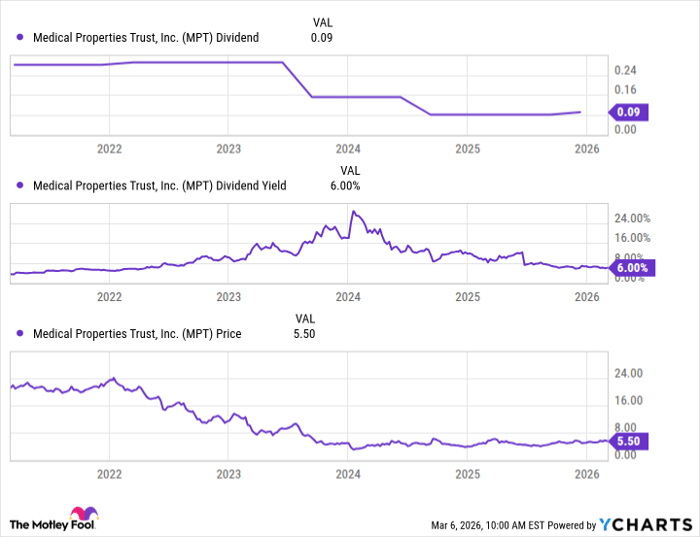
MPT Dividend data by YCharts
While an increasing dividend is a positive sign, there are still lots of negatives. Despite growing revenue in the fourth quarter of 2025, Medical Properties was not profitable for the year. 2025's loss of $276 million was an improvement from the net loss of $2.4 billion in 2024, but it's still not good that the company is losing money.
Funds from operations (FFO), an even more important metric for REITs, came in at $346.2 million for Medical Properties Trust in 2025, down almost 29% year over year. And none of this is helped by the fact that the company is running a debt load of $9.6 billion to $540.8 million in cash.
So, don't be taken in by the low share price and high yield. I'm a firm believer that you get what you pay for, and while Medical Properties Trust may yet recover, it's not a REIT you want to hold right now, especially not for a safe dividend.
A tale of two REITS
Welltower Inc. (NYSE: WELL) is a medical REIT like Medical Properties Trust. But unlike Medical Properties Trust, Welltower focuses on medical office space and senior living facilities.
The company owns over 2,500 senior and wellness housing communities across the United States, Canada, and the United Kingdom, all countries set to see their 80+ populations grow dramatically in coming years.
And where Medical Properties Trust is experiencing decline, Welltower is seeing some pretty incredible growth. For 2025, it grew its total revenue 35% to $10.8 billion. While its net income did shrink slightly in 2025, likely due to higher expenses, it only fell slightly from $972.8 million to $961.8 million.
The company also reported an annual normalized FFO attributable to common stockholders of $5.29 per diluted share, or a 22.5% increase over 2024. And despite the slight decline in net income, Welltower remains fairly profitable with an operating margin of 3.3% and a net margin of 9%.
That's admittedly thin compared to some other types of REIT, but it's considerably better than Medical Properties Trust.
Now, on to the dividend. At present, Welltower pays a dividend of $0.74 per quarter or $2.96 annually. That's good for a yield of 1.44% using Thursday's price at market close, which is much lower than Medical Properties Trust yield, but much safer too.
After dividends cut in 2020 and 2021, Welltower has begun growing its dividend again. From 2023 to 2024, it grew 4.9% from $2.44 per share to $2.56 per share and then another 10% in 2025. .
The only potentially concerning thing about Welltower is its current payout ratio of 189%, which is very high. But as long as Welltower continues to manage revenue growth as it has been, it should be nothing to worry about. It's also worth noting that it has been much higher in the past.
In 2022, Welltower's payout ratio was 697%, which fell to 353% in 2023 and then to 160% in 2024, so its current levels aren't that elevated from 2024's in the grand scheme of things .
Considering the fact that in the U.S. alone, the 80+ population is set to roughly double between now and 2045, Welltower should have a suitable market to drive further growth both in its revenue and its dividend.
I suggest giving Welltower a look for a secure long-term dividend play.
Should you buy stock in Welltower right now?
Before you buy stock in Welltower, consider this:
The Motley Fool Stock Advisor analyst team just identified what they believe are the 10 best stocks for investors to buy now… and Welltower wasn’t one of them. The 10 stocks that made the cut could produce monster returns in the coming years.
Consider when Netflix made this list on December 17, 2004... if you invested $1,000 at the time of our recommendation, you’d have $534,008!* Or when Nvidia made this list on April 15, 2005... if you invested $1,000 at the time of our recommendation, you’d have $1,090,073!*
Now, it’s worth noting Stock Advisor’s total average return is 949% — a market-crushing outperformance compared to 190% for the S&P 500. Don't miss the latest top 10 list, available with Stock Advisor, and join an investing community built by individual investors for individual investors.
See the 10 stocks »
*Stock Advisor returns as of March 9, 2026.
James Hires has no position in any of the stocks mentioned. The Motley Fool has no position in any of the stocks mentioned. The Motley Fool has a disclosure policy.
Recommended Articles


