


Oil Prices Have Spiked More Than 25% Since the Iran Conflict Began, Yet Oil Stocks Have Barely Budged. What's Going on in the Oil Market?
Key Points
Oil prices have spiked further since the war began.
Oil stocks haven't continued their pre-war rally.
Oil prices could rise or fall, depending on developments in the war.
- 10 stocks we like better than ConocoPhillips ›
Crude oil prices have gone hyperbolic since the U.S. and Israel launched attacks against Iran earlier this month. Brent, the main global oil benchmark, is up over 25% to more than $93 a barrel since the war began. Meanwhile, WTI, the primary U.S. oil benchmark, has surged 35% to more than $91 per barrel.
Typically, surging crude prices would fuel a similar rally in oil stocks. However, that hasn't been the case. Shares of oil giants ConocoPhillips (NYSE: COP) and Chevron (NYSE: CVX) are only up modestly, while ExxonMobil's (NYSE: XOM) stock has slipped a little.
Will AI create the world's first trillionaire? Our team just released a report on the one little-known company, called an "Indispensable Monopoly" providing the critical technology Nvidia and Intel both need. Continue »
Here's a look at what's going on in the oil market.
Image source: Getty Images.
Why have oil prices spiked?
Crude prices have surged in the wake of the war with Iran for two reasons. Iran is a major oil producer. Additionally, the country has targeted oil in retaliation for the war.
Iran produces about 3.5 million barrels of oil per day, roughly 4% of global oil production. If the country can't produce oil due to the war, it will have a meaningful impact on supply.
However, that's just a drop in the bucket compared to the oil that flows through the Strait of Hormuz in the Persian Gulf. This narrow passageway between Iran and Oman is a major oil chokepoint as 20% of global supplies flow through it each day. Iran has attacked ships carrying oil in the Strait, causing tanker rates to spike and insurance carriers to cancel their policies. As a result, it has virtually stopped the free flow of oil (shipments are down about 90%). While the U.S. is working to provide insurance and escorts to oil tankers, that hasn't solved the bottleneck.
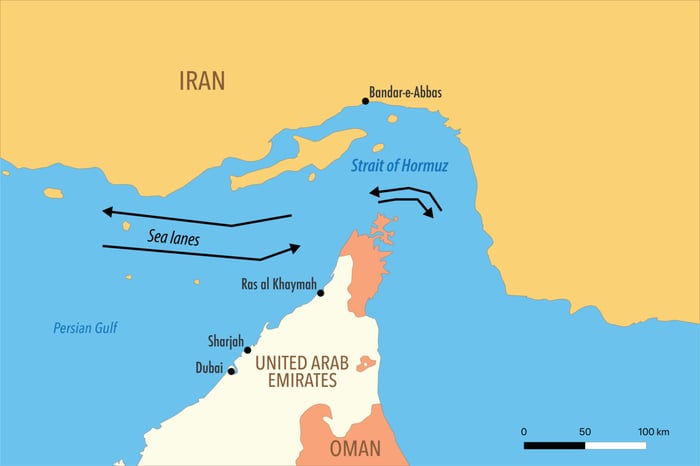
Image source: Getty Images.
Additionally, Iran has attacked some oil infrastructure in the region with drones and missiles. While it hasn't inflicted serious damage, it has caused oil companies to temporarily suspend operations at some key oil fields.
What's next for the oil market?
The longer Iran prevents oil exports from the Persian Gulf, the higher crude prices will likely go. Goldman Sachs expects oil prices to surge to more than $100 a barrel this week if there isn't a solution to the disruption of oil flowing through the Strait of Hormuz. Barclays believes crude prices could rise to $120 a barrel if the issue persists for a couple of weeks. Meanwhile, Qatar's energy minister has warned that crude could hit $150 if the Strait remains effectively closed.
However, while oil prices could continue to spike in the near term, the muted rise in the share prices of oil giants Exxon, Chevron, and ConocoPhillips suggests the market doesn't expect oil to remain elevated for very long. There seems to be some underlying optimism that a solution will emerge. For example, the U.S. announced a $20 billion reinsurance program for oil tankers transiting the Strait of Hormuz, which, along with Navy escorts, could help resume oil flows. The U.S. could also start releasing oil from the Strategic Petroleum Reserve to help increase oil supplies. Additionally, diplomatic pressure could force Iran to allow oil to flow through the Strait.
What's next for oil stocks?
While oil stocks haven't really budged since the war started, they did rally sharply before the war began as escalating tensions pushed oil prices higher. Both WTI and Brent spiked more than 15% from Jan. 1 to Feb. 27, in the lead-up to the war with Iran. That fueled a more than 20% rise in the shares of ConocoPhillips, Chevron, and ExxonMobil.
While their share prices haven't moved much in the past week since the war began, they could resume their rally if the war drags on and oil prices continue surging. A potential major catalyst would be if an Iranian attack on oil infrastructure in the Gulf inflicted major damage that could cause a long-term supply disruption. It would take the industry time to bring new supplies online to offset the loss.
However, if the Strait reopens and there's no lasting impact on global oil supplies, crude prices could fall quickly. That would likely still put some downward pressure on oil stocks, given their pre-war rally.
Focus on the long-term
It's anyone's guess what will happen next with oil prices. They could easily spike into the triple digits if oil supplies remain impacted by the war. Conversely, they could fall if a solution emerges that gets oil flowing again.
The same goes for oil stocks, which could rise or fall, depending on what's going on in the oil market. However, while the near-term picture remains unclear, Chevron, Exxon, and ConocoPhillips all expect to deliver robust cash flow growth through 2030 at an average oil price of around $70 a barrel, fueled by cost savings and expansion projects. That long-term growth outlook at a much lower oil price makes them the best oil stocks to buy despite the near-term uncertainty.
Should you buy stock in ConocoPhillips right now?
Before you buy stock in ConocoPhillips, consider this:
The Motley Fool Stock Advisor analyst team just identified what they believe are the 10 best stocks for investors to buy now… and ConocoPhillips wasn’t one of them. The 10 stocks that made the cut could produce monster returns in the coming years.
Consider when Netflix made this list on December 17, 2004... if you invested $1,000 at the time of our recommendation, you’d have $534,008!* Or when Nvidia made this list on April 15, 2005... if you invested $1,000 at the time of our recommendation, you’d have $1,090,073!*
Now, it’s worth noting Stock Advisor’s total average return is 949% — a market-crushing outperformance compared to 190% for the S&P 500. Don't miss the latest top 10 list, available with Stock Advisor, and join an investing community built by individual investors for individual investors.
See the 10 stocks »
*Stock Advisor returns as of March 9, 2026.
Matt DiLallo has positions in Chevron and ConocoPhillips. The Motley Fool has positions in and recommends Chevron and Goldman Sachs Group. The Motley Fool recommends Barclays Plc and ConocoPhillips. The Motley Fool has a disclosure policy.
Recommended Articles


