


Jerome Powell's Warning to Wall Street is Ringing Out Loud and Clear. History Says This May Happen Next.
Key Points
Stocks have soared in recent years, as investors piled into artificial intelligence stocks.
This created a headwind that the Fed chair spoke about back in September.
- 10 stocks we like better than S&P 500 Index ›
Over the past three years, investors identified a major opportunity in the tech space: artificial intelligence (AI) stocks. They piled into these players, betting on this technology's ability to revolutionize how business is done -- the idea is that AI could save companies time and money and supercharge growth.
On top of this, investors also cheered a lower interest rate environment -- the Federal Reserve began lowering rates in 2024 and continued doing so last year. This is positive for both companies and households, as it reduces their borrowing costs. In the case of households, this leaves them with more money to spend elsewhere, such as on products or services offered by companies. All of this favors earnings strength.
Will AI create the world's first trillionaire? Our team just released a report on the one little-known company, called an "Indispensable Monopoly" providing the critical technology Nvidia and Intel both need. Continue »
Buoyed by all of this, the S&P 500 delivered three consecutive years of double-digit gains and reached multiple record highs in this bull market. But, at the same time, one potential headwind was gradually picking up. Fed chair Jerome Powell spoke of it back in September, and today that warning is ringing out loud and clear. Let's check it out and take a look at what history says may happen next.

Image source: Getty Images.
From November through today
So, first, let's consider what's happened in the market over the past few months. Back in November, investors started to worry that the AI revenue opportunity wouldn't justify the pace of AI spending. Tech giants from Meta Platforms to Amazon have poured billions of dollars into building out AI infrastructure to meet current and future demand. In spite of these and other companies' comments about high demand, these concerns have continued to circulate -- and this has hurt tech stocks and other growth players.
Meanwhile, uncertainties about the economy and the pace of interest rate cuts, and just recently, the war in Iran, have shaken markets. The Iran conflict, in particular, and its impact on oil prices have been significant headwinds, sending the S&P 500 fluctuating from gains to losses.
Now let's consider Powell's warning to Wall Street. The Fed chair spoke of something that unfolded as stock prices skyrocketed over the past few years: Stocks have become expensive.
"By many measures," he said in September, "equity prices are fairly highly valued."
A look at valuation
This hasn't changed much since Powell made that comment, as we can see in the chart below.
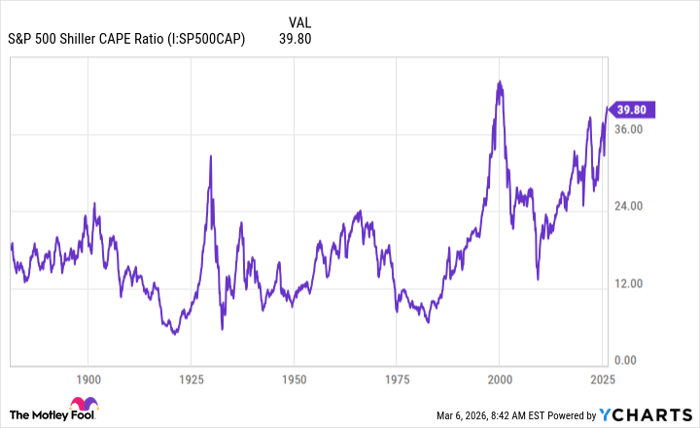
S&P 500 Shiller CAPE Ratio data by YCharts
The S&P 500 Shiller CAPE ratio measures stock prices in relation to earnings per share over a 10-year period to account for economic shifts -- so it's a pretty accurate metric. And here we can see that the index remains close to one of its most expensive levels ever. In fact, it reached this level only once before in history, during the dot-com bubble in 2000.
Now, let's consider what history says might happen next. We'll zoom in to take a closer look at patterns over the past 25 years, and here we can see that every time the Shiller CAPE ratio hit a peak, the S&P 500 went on to fall.
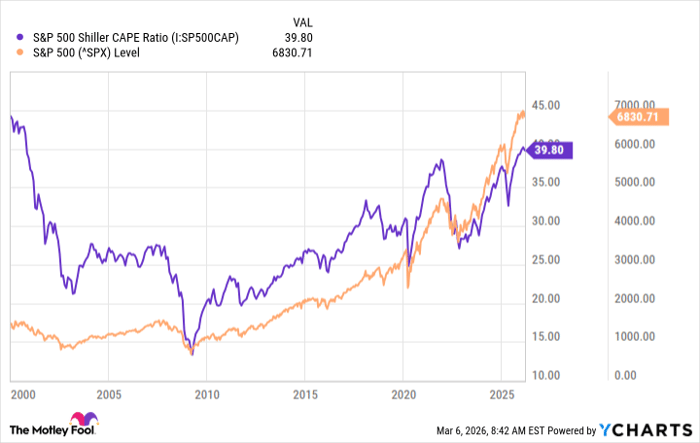
S&P 500 Shiller CAPE Ratio data by YCharts
So, history tells us that the next step for the market may be a decline. That isn't the news investors most like to hear, but there are a couple of silver linings in this dark cloud. First of all, this doesn't mean declines will be long-lasting. We might see indexes fall for weeks or even months, then rebound to deliver positive returns in 2026. Meanwhile, this movement would bring down the prices of many quality stocks, possibly to very interesting levels. We've already seen this happen in recent weeks as tech stocks have pulled back -- for example, AI giant Nvidia today trades near its lowest level in almost a year. So this could be a great time to go bargain hunting.
Finally, even if the worst happens and the market enters a prolonged period of declines, history shows us that it's always recovered and gained after declines and market crashes. And that's fantastic news for long-term investors.
Should you buy stock in S&P 500 Index right now?
Before you buy stock in S&P 500 Index, consider this:
The Motley Fool Stock Advisor analyst team just identified what they believe are the 10 best stocks for investors to buy now… and S&P 500 Index wasn’t one of them. The 10 stocks that made the cut could produce monster returns in the coming years.
Consider when Netflix made this list on December 17, 2004... if you invested $1,000 at the time of our recommendation, you’d have $534,008!* Or when Nvidia made this list on April 15, 2005... if you invested $1,000 at the time of our recommendation, you’d have $1,090,073!*
Now, it’s worth noting Stock Advisor’s total average return is 949% — a market-crushing outperformance compared to 190% for the S&P 500. Don't miss the latest top 10 list, available with Stock Advisor, and join an investing community built by individual investors for individual investors.
See the 10 stocks »
*Stock Advisor returns as of March 8, 2026.
Adria Cimino has positions in Amazon. The Motley Fool has positions in and recommends Amazon, Meta Platforms, and Nvidia. The Motley Fool has a disclosure policy.
Recommended Articles


