


3 Brilliant Growth Stocks to Buy Now and Hold for the Long Term
Key Points
Where MercadoLibre is now is very much where Amazon was in its early days. It’s just a different geography.
Amazon's Chinese counterpart is working on a business that could drive massive long-term growth.
Uber Technologies shares have underperformed mostly on growth and profitability concerns. The company, however, is plugged into a huge sociocultural shift.
- 10 stocks we like better than MercadoLibre ›
The stock market may be experiencing some turbulence at this time. As veteran investors know, however, this is just short-term stuff. In the long run, most good stocks will be priced higher than they are right now. That's why there's never really a bad time to step into a stake in a quality growth company.
With that as the backdrop, here's a rundown of three brilliant growth stocks you can comfortably buy today with plans to hold onto them indefinitely.
Where to invest $1,000 right now? Our analyst team just revealed what they believe are the 10 best stocks to buy right now, when you join Stock Advisor. See the stocks »
MercadoLibre
Do you ever wish you could go back in time and invest in Amazon (NASDAQ: AMZN) in its infancy? Well, there's no such thing as a time machine. You may be able to do something similar, however, by buying into the so-called Amazon of Latin America while its e-commerce market is still in a high-growth period.
The Amazon of Latin America is MercadoLibre (NASDAQ: MELI), by the way. The $100 billion company is expected to report nearly $29 billion worth of revenue for 2025 when all is said and done, up 38% year over year, with most of that coming from Brazil, Mexico, and Argentina. The chief difference between MercadoLibre and Amazon is simply that the South American e-commerce powerhouse also operates a huge online and in-person payment business, including payment processing for goods and services not sold via its online shopping technology.
Whatever the case, it's a right-time, right-place kind of trade.
Although neither the internet nor online shopping is exactly new in South America, they're just now becoming ubiquitous thanks to the recently accelerated proliferation of mobile internet service. Numbers from market research outfit Omdia indicate Latin America's smartphone deliveries reached a record-breaking 140.5 million units last year, accelerating to a growth rate of 12% in Q4. This ramped-up adoption underscores a more sweeping sociocultural trend for the entire region that (as was the case in North America) makes it even easier to shop online.
In this vein, consulting firm Endeavor predicts Latin America's e-commerce industry will grow to $215.3 billion this year, which implies this online shopping market will grow about 50% faster than the rest of the world's will, again underscoring a broader, long-lived trend. Moreover, Endeavor believes Argentina, Brazil, and Mexico -- where MercadoLibre already does most of its business -- will account for nearly 85% of this continent's 2026 e-commerce spending.
Alibaba
If owning a piece of the Amazon of Latin America is a smart move, it might be just as smart to own the Amazon of China. That's Alibaba Group (NYSE: BABA).
The similarities are clear. Alibaba's roots are planted in the e-commerce arena, which accounts for about half of its revenue -- a business that's on pace to grow roughly 15% this year. Alibaba also operates a handful of smaller side businesses like streaming video platform Youku, workplace collaboration outfit DingTalk, and grocery delivery service Freshippo, just to name a few. It even offers a cloud computing service, which generated $5.6 billion worth of revenue during the three months ending in September, up 34% year over year.
Where Alibaba is distinctly different than Amazon or MercadoLibre, however, is how its cloud business is suddenly doing so well.
This is the operating unit that manages the conglomerate's nascent artificial intelligence efforts. This includes a power-efficient conversational AI assistant/chatbot called Qwen that not only serves consumer-level users, but also empowers companies with tools like agentic AI, data-based decision-making, graphical visualization, computer coding, and more.

Image source: Getty Images.
This is still just the beginning, though. In August, the company unveiled a prototype of its own artificial intelligence processing chip that will be competitive with Nvidia's wares.
This matters simply because, even though China's AI industry is largely being built within a self-contained silo, it's still a big market, and could still serve customers outside of China. Indeed, last year Goldman Sachs predicted that the country's artificial intelligence market could be worth $1.4 trillion by 2030. Alibaba is well positioned to capture at least its fair share of the industry's growth.
Uber Technologies
Finally, add Uber Technologies (NYSE: UBER) to your list of growth stocks to buy and hold for the long term.
It's been tough to be a patient Uber shareholder of late. The stock's fallen 25% since late last year, mostly on worries of slowing growth, shrinking profit margins, and eventually, the sizable capital outlays that will be required when the company enters the robotaxi market at a scale that's big enough to make sense.
Just don't lose sight of the bigger picture. Even if Uber's revenue growth rate is slowing, it's largely a mathematical matter; the year-over-year comparisons are getting tougher mostly just because the ride-hailing company is getting bigger, and even then, the analyst community is still looking for steady top and bottom line growth at least through 2030.
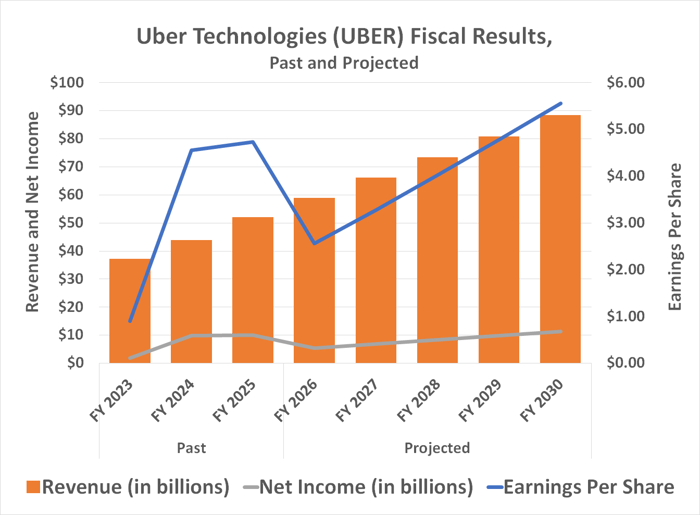
Data source: Morningstar, Uber Technologies. Chart by author.
Perhaps more important to interested investors, what's driving Uber's past, present, and future growth is built to last. That's a growing disinterest in driving a car (or even owning one), paired with a growing willingness to simply outsource deliveries and even personal transportation to a third party now that the option is widely available. For perspective, the U.S. Department of Transportation says only about one-third of the county's eligible teenagers currently hold a driver's license, versus roughly two-thirds of this same age group back in 1995.
Being a generational thing, this ongoing shift could persist for decades, sustaining Uber's growth the whole time.
And as for autonomous transportation, Uber CEO Dara Khosrowshahi recently predicted that robotaxis will eventually be a trillion-dollar business, jibing with an outlook from Straits Research. Uber won't be the only player in this market, to be sure. It's well positioned to be a leader of it, however. Even if these vehicles remain expensive once the tech is ready for widespread deployment, these cars can be operated without the expense of a human driver. In the long run, Uber's self-driving taxis should end up more than paying for themselves.
Should you buy stock in MercadoLibre right now?
Before you buy stock in MercadoLibre, consider this:
The Motley Fool Stock Advisor analyst team just identified what they believe are the 10 best stocks for investors to buy now… and MercadoLibre wasn’t one of them. The 10 stocks that made the cut could produce monster returns in the coming years.
Consider when Netflix made this list on December 17, 2004... if you invested $1,000 at the time of our recommendation, you’d have $424,262!* Or when Nvidia made this list on April 15, 2005... if you invested $1,000 at the time of our recommendation, you’d have $1,163,635!*
Now, it’s worth noting Stock Advisor’s total average return is 904% — a market-crushing outperformance compared to 194% for the S&P 500. Don't miss the latest top 10 list, available with Stock Advisor, and join an investing community built by individual investors for individual investors.
See the 10 stocks »
*Stock Advisor returns as of February 23, 2026.
James Brumley has no position in any of the stocks mentioned. The Motley Fool has positions in and recommends Amazon, Goldman Sachs Group, MercadoLibre, Nvidia, and Uber Technologies. The Motley Fool recommends Alibaba Group. The Motley Fool has a disclosure policy.
Recommended Articles


