


Prediction: After Beating the S&P 500 for the Last 15 Years, This Unstoppable Vanguard ETF Will Top the Market Again in 2026
Key Points
The S&P 500 is a diversified stock market index featuring 500 companies from 11 different sectors of the economy.
The Vanguard S&P 500 Growth index, however, exclusively holds just 139 of the best-performing growth stocks from the regular S&P 500.
The Vanguard S&P 500 Growth ETF tracks the performance of the Growth index, and it consistently beats the market.
- 10 stocks we like better than Vanguard Admiral Funds - Vanguard S&P 500 Growth ETF ›
The S&P 500 (SNPINDEX: ^GSPC), which is a highly diversified index featuring 500 companies from 11 different economic sectors, delivered a solid return of 16.4% in 2025. However, had you invested in the Vanguard S&P 500 Growth ETF (NYSEMKT: VOOG) instead, you would have earned a much higher return of 21.4%.
The Vanguard S&P 500 Growth ETF is an exchange-traded fund (ETF) that tracks the performance of the S&P 500 Growth index, which exclusively holds 139 of the best-performing stocks from the regular S&P 500, and disregards the rest. Last year's performance was no fluke, because its unique portfolio composition has propelled the ETF to market-beating returns consistently since it was established in 2010.
Where to invest $1,000 right now? Our analyst team just revealed what they believe are the 10 best stocks to buy right now, when you join Stock Advisor. See the stocks »
Here's why I predict it will beat the S&P 500 yet again in 2026.

Image source: Getty Images.
High exposure to the fastest-growing areas of the stock market
There are two aspects to the strong performance of the S&P 500 Growth index relative to the S&P 500: The stocks it holds and the stocks it doesn't hold. It selects stocks based on factors like their momentum and the sales growth of the underlying companies, and it rebalances on a quarterly basis by removing holdings that no longer meet its criteria and replacing them with more suitable candidates.
The information technology sector is a hotbed of growth and momentum thanks to companies like Nvidia, Broadcom, Microsoft, and Apple, which operate at the forefront of the artificial intelligence (AI) boom.
Then there is the communication services sector, which is home to tech-adjacent growth powerhouses like Alphabet, Meta Platforms, and Netflix. That's why these sectors have much higher weightings in the Vanguard S&P 500 Growth ETF relative to the S&P 500.
|
Sector |
Vanguard ETF Weighting |
S&P 500 Weighting |
|---|---|---|
|
Information Technology |
47.9% |
33.4% |
|
Communication Services |
17.6% |
11% |
Data source: Vanguard. Sector weightings are accurate as of Jan. 31, 2026, and are subject to change.
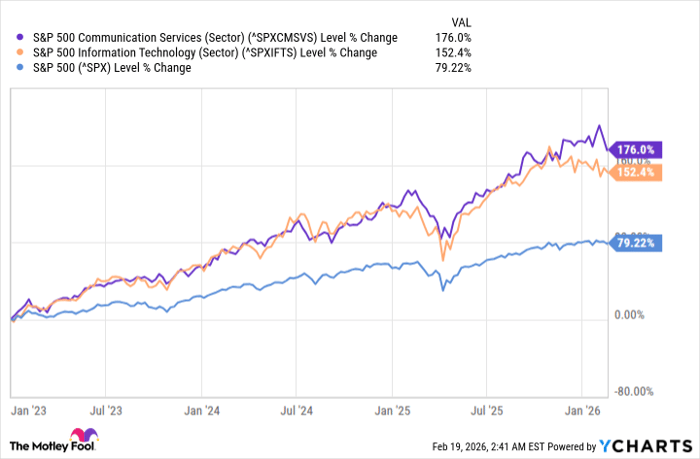
Since the AI boom started gathering momentum in early 2023, the S&P 500 has climbed by 79%. However, the S&P 500 information technology sector, specifically, has gained a whopping 152% since then, while the S&P 500 communication services sector soared by 176%. Therefore, any index (or ETF) with a higher exposure to these sectors would have significantly outperformed one with less exposure.
Data by YCharts.
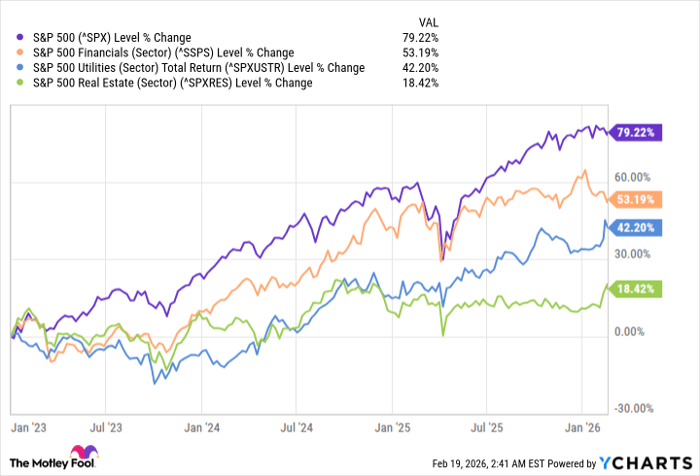
But many sectors have heavily underperformed the S&P 500 over the same period, like financials, utilities, and real estate.
Data by YCharts.
The Vanguard S&P 500 Growth ETF assigns these sectors much lower weightings compared to the S&P 500, which is another reason it consistently beats the index.
|
Sector |
Vanguard ETF Weighting |
S&P 500 Weighting |
|---|---|---|
|
Financials |
9.6% |
12.9% |
|
Real Estate |
0.6% |
1.9% |
|
Utilities |
0.4% |
2.2% |
Data source: Vanguard. Sector weightings are accurate as of Jan. 31, 2026, and are subject to change.
The Vanguard ETF has an incredible track record against the S&P 500
The Vanguard S&P 500 Growth ETF has delivered a compound annual return of 16.6% since its inception in September 2010, comfortably beating the S&P 500, which climbed by an average of 14% per year over the same period. The 2.6 percentage-point difference might not sound like much, but it has fueled a significantly higher return in dollar terms over the last 15 and a half years, thanks to the effects of compounding.
|
Starting Balance (Sept. 2010) |
Compound Annual Return |
Balance In February 2026 |
|---|---|---|
|
$50,000 |
16.6% (Vanguard ETF) |
$540,502 |
|
$50,000 |
14% (S&P 500) |
$381,061 |
Calculations by author.
Based on the ETF's high exposure to the strongest sectors of the market, and its low exposure to the lesser-performing sectors, I think it's well-positioned to beat the S&P 500 again in 2026. The ETF might suffer a short period of underperformance if growth drivers like AI hit a serious speed bump, but this would likely be resolved after a series of quarterly rebalances.
But in my view, tech and tech-adjacent stocks are likely to continue leading the broader market higher in 2026 and beyond. Even once the red-hot AI industry inevitably cools, emerging industries like robotics, autonomous vehicles, and quantum computing could take over as sources of significant long-term growth.
Should you buy stock in Vanguard Admiral Funds - Vanguard S&P 500 Growth ETF right now?
Before you buy stock in Vanguard Admiral Funds - Vanguard S&P 500 Growth ETF, consider this:
The Motley Fool Stock Advisor analyst team just identified what they believe are the 10 best stocks for investors to buy now… and Vanguard Admiral Funds - Vanguard S&P 500 Growth ETF wasn’t one of them. The 10 stocks that made the cut could produce monster returns in the coming years.
Consider when Netflix made this list on December 17, 2004... if you invested $1,000 at the time of our recommendation, you’d have $424,262!* Or when Nvidia made this list on April 15, 2005... if you invested $1,000 at the time of our recommendation, you’d have $1,163,635!*
Now, it’s worth noting Stock Advisor’s total average return is 904% — a market-crushing outperformance compared to 194% for the S&P 500. Don't miss the latest top 10 list, available with Stock Advisor, and join an investing community built by individual investors for individual investors.
See the 10 stocks »
*Stock Advisor returns as of February 23, 2026.
Anthony Di Pizio has no position in any of the stocks mentioned. The Motley Fool has positions in and recommends Alphabet, Apple, Meta Platforms, Microsoft, Netflix, and Nvidia. The Motley Fool recommends Broadcom. The Motley Fool has a disclosure policy.
Recommended Articles


