




Should You Invest $1,000 in Broadcom Right Now?
Key Points
Broadcom is partnering directly with AI hyperscalers to design AI computing units.
Broadcom's stock is a bit expensive, but worth the price.
- 10 stocks we like better than Broadcom ›
While most of the investing attention in the artificial intelligence (AI) realm is directed toward Nvidia (NASDAQ: NVDA), Broadcom (NASDAQ: AVGO) is starting to gain momentum. Both companies are competing in the AI computing unit field, but Broadcom's product represents the next iteration that could really take off over the next few years.
But is it worth a $1,000 investment right now?
Where to invest $1,000 right now? Our analyst team just revealed what they believe are the 10 best stocks to buy right now, when you join Stock Advisor. See the stocks »

Image source: Getty Images.
Broadcom's approach to AI computing is specialized
Nvidia makes graphics processing units (GPUs), which can be deployed in many applications beyond AI, like cryptocurrency mining or drug discovery. Broadcom is taking a more direct approach and designing a custom AI chip for each of its clients. So, any company that has partnered with Broadcom is getting an application-specific integrated circuit (ASIC) chip suited directly for its workload. This means that a chip designed for Google won't look the same as one for OpenAI; however, each company benefits because their interests are being tailored to.
Furthermore, by partnering with Broadcom, companies don't have to pay a high premium for its services as they do with Nvidia. Nvidia's profit margin tops 50%, so more than half of the cost of an Nvidia GPU goes to its bottom line. AI hyperscalers are well aware of this, and getting a cheaper alternative through Broadcom that can provide comparable results is the way the market is shifting.
In the first quarter, Broadcom expects its AI semiconductor division to double year over year.
For reference, Nvidia's data center division, which encompasses most of its AI hardware, saw revenue growth of 66%. While Nvidia's growth is impressive, Broadcom's is better. This shows the direction that the industry is headed and makes Broadcom a worthwhile investment.
However, Broadcom isn't a pure play like Nvidia has become. AI semiconductor revenue still makes up less than half of Broadcom's total, although that could shift by the end of the year if its AI semiconductor growth rate continues at its rapid pace. This drags the overall growth rate down, although Wall Street analysts still expect over 50% revenue growth for Broadcom during fiscal year 2026.
The last consideration for Broadcom's stock is its valuation. At 32 times forward earnings, Broadcom isn't a cheap investment.
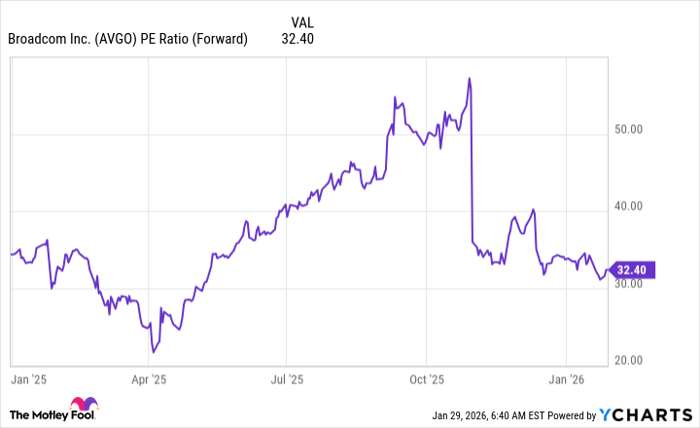
AVGO PE Ratio (Forward) data by YCharts
This is about where the big tech companies trade, so it isn't that expensive. Furthermore, the AI spending spree is expected to last through at least 2030, and if Broadcom's computing units continue to gain market share, this is a reasonable price to pay now.
I think Broadcom is well worth a $1,000 investment, and it will be among the best performers in the stock market over the next five years.
Should you buy stock in Broadcom right now?
Before you buy stock in Broadcom, consider this:
The Motley Fool Stock Advisor analyst team just identified what they believe are the 10 best stocks for investors to buy now… and Broadcom wasn’t one of them. The 10 stocks that made the cut could produce monster returns in the coming years.
Consider when Netflix made this list on December 17, 2004... if you invested $1,000 at the time of our recommendation, you’d have $450,256!* Or when Nvidia made this list on April 15, 2005... if you invested $1,000 at the time of our recommendation, you’d have $1,171,666!*
Now, it’s worth noting Stock Advisor’s total average return is 942% — a market-crushing outperformance compared to 196% for the S&P 500. Don't miss the latest top 10 list, available with Stock Advisor, and join an investing community built by individual investors for individual investors.
See the 10 stocks »
*Stock Advisor returns as of February 2, 2026.
Keithen Drury has positions in Broadcom and Nvidia. The Motley Fool has positions in and recommends Nvidia. The Motley Fool recommends Broadcom. The Motley Fool has a disclosure policy.
Recommended Articles


