




With Shares Down 10% After Its Earnings Call, Is Microsoft a Buy?
Key Points
Microsoft's stock price fell 10% on Thursday despite reporting double-digit growth in profit and revenue.
Profits and revenue topped Wall Street's expectations, but analysts expressed concern over Microsoft's hefty spending on AI data centers.
The selloff drove Microsoft's price-to-earnings ratio to its lowest level in three years.
- 10 stocks we like better than Microsoft ›
You know that expectations for a company are sky high when it can report a 60% year-over-year jump in profits, a 17% rise in revenue, a 45% increase in users of its flagship product, and $12.7 billion returned to shareholders that quarter ... and the stock still tanks by 10% the next day. Microsoft (NASDAQ: MSFT) was the victim of this expectations hit last Thursday, as Wall Street digested its Q2 2026 earnings report released the day before. The sell-off wiped away a staggering $357 billion from the tech giant's market capitalization.
Analysts pointed to slower-than-expected growth in its cloud computing segment, as well as concerns over its plans to ramp up spending on data centers. Are analysts right to be rattled? Or are they overreacting as the company pivots in ways they don't fully grasp?
Where to invest $1,000 right now? Our analyst team just revealed what they believe are the 10 best stocks to buy right now. Continue »
Here's what the numbers say.
Image source: Getty Images.
What's troubling Wall Street about Microsoft
Microsoft Cloud revenue came in at $51.5 billion for the quarter, a 26% rise year over year. This matched the 26% growth in the segment the quarter prior, but analysts took a dim view of growth failing to accelerate.
Microsoft's $37.5 billion in spending on artificial intelligence (AI) data centers also drew consternation. This 65% jump in AI infrastructure investment from a year ago is testing investors' patience in the company's AI vision, even as CEO Satya Nadella says the AI revolution is still in its "early innings."
Perhaps aware that Wall Street would be leery, CFO Amy Hood explained on the earnings conference call that Microsoft's cloud business will be able to grow even faster once the company gets past its shortage of AI hardware. Nonetheless, at least four analysts lowered their price targets on Microsoft.
But for all the hand-wringing over rising capital expenditures, it's notable that operating expenses, or what a company pays for day-to-day business functions (paying employees, research and development, keeping the lights on, etc.), grew by just 5% year over year. That's far less than the 19% growth in operating income and 15% growth in revenue that the company reported, while its gross margin growth of 14% shows Microsoft is becoming more efficient in producing and managing direct costs.
Microsoft's AI bets are already paying off
Microsoft received $7.6 billion last quarter from its partnership with OpenAI, the pioneering company behind ChatGPT. OpenAI committed to buying $250 billion worth of Microsoft Azure compute services to help train its AI models.
Its AI assistant Copilot now has 4.7 million paying subscribers, a 75% surge year over year. With the agentic commerce market forecast to hit up to $500 billion by 2030, the rise of agentic AI could be a huge catalyst for Microsoft, especially since no other Magnificent Seven company can rival its customer base of Microsoft Office Suite users to whom it can market AI agents. If Microsoft captures significant market share, it could eventually pay for its data center splurge several times over.
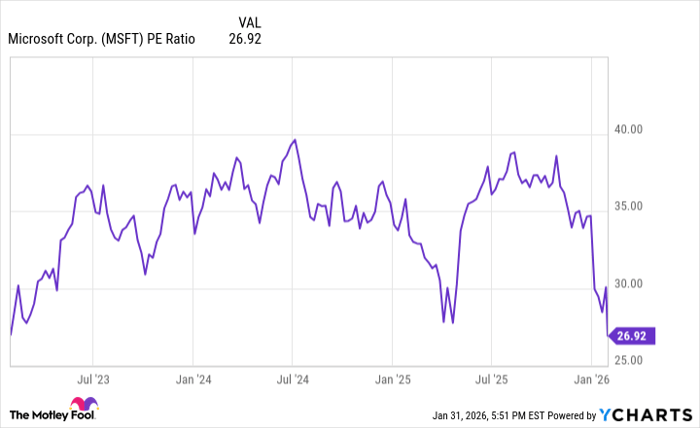
In the meantime, the sell-off has made Microsoft shares cheaper than they've been in three years, as measured by their price-to-earnings (PE) ratio.
Data by YCharts.
As you can see, the P/E ratio hasn't been this low since January 2023, when shares were just starting to recover from the 2022 tech sell-off (though they came close in April 2025 at the height of tariff uncertainty). Management will likely announce a dividend increase later this year, extending Microsoft's dividend-growing streak to 16 years and giving investors another reason to buy shares of Microsoft now.
I believe that this temporary sell-off has created a buying opportunity for a fantastic company at the center of the $15.7 trillion AI revolution. It may be years, if ever, before shares are this cheap again.
Should you buy stock in Microsoft right now?
Before you buy stock in Microsoft, consider this:
The Motley Fool Stock Advisor analyst team just identified what they believe are the 10 best stocks for investors to buy now… and Microsoft wasn’t one of them. The 10 stocks that made the cut could produce monster returns in the coming years.
Consider when Netflix made this list on December 17, 2004... if you invested $1,000 at the time of our recommendation, you’d have $450,256!* Or when Nvidia made this list on April 15, 2005... if you invested $1,000 at the time of our recommendation, you’d have $1,171,666!*
Now, it’s worth noting Stock Advisor’s total average return is 942% — a market-crushing outperformance compared to 196% for the S&P 500. Don't miss the latest top 10 list, available with Stock Advisor, and join an investing community built by individual investors for individual investors.
See the 10 stocks »
*Stock Advisor returns as of February 2, 2026.
William Dahl has no position in any of the stocks mentioned. The Motley Fool has positions in and recommends Microsoft. The Motley Fool has a disclosure policy.
Recommended Articles


